
To care for someone is an honor
On armor, seva, and what it means to truly care.
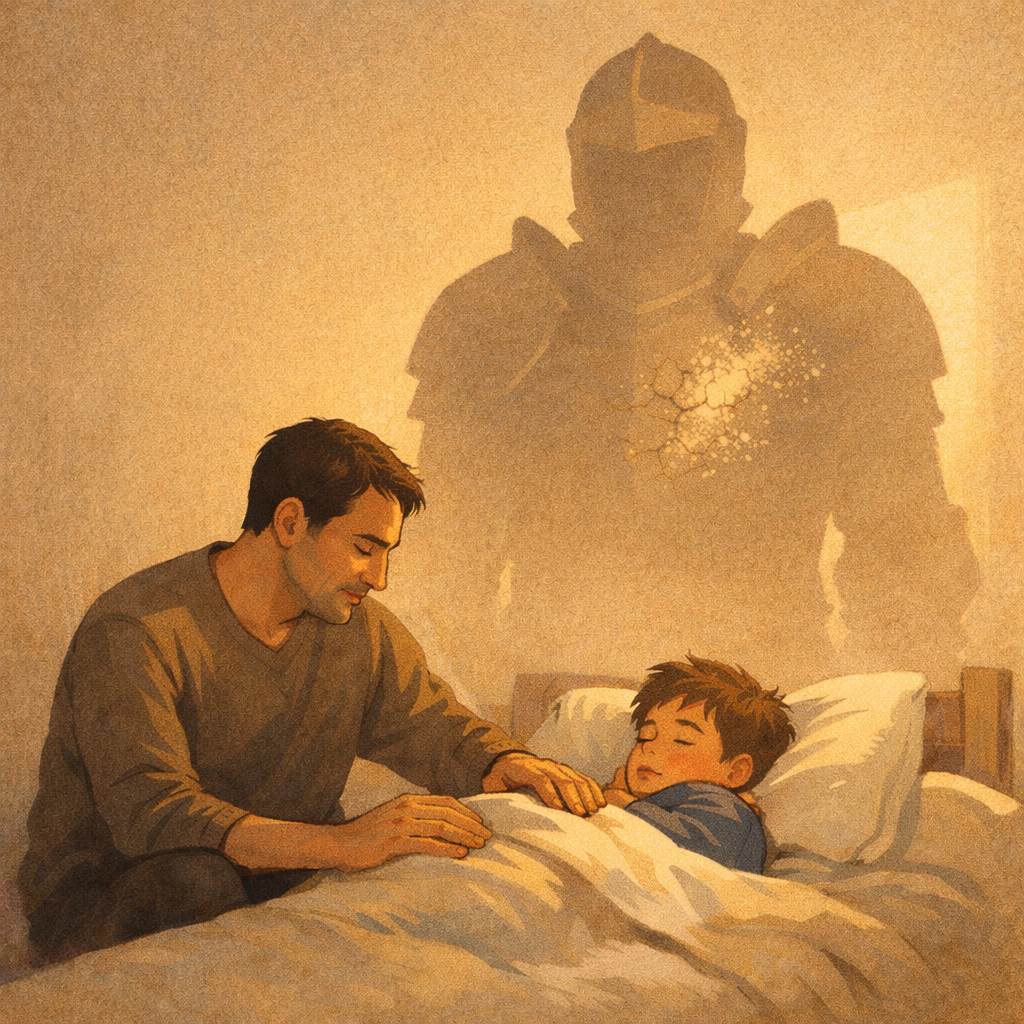
We had four kids home sick over a week, and I stayed back with Emmett, whose fever breached 104 degrees. The first step in taking care of a child, of course, is to take off our armor. My heart has to be ready to care.
The armor exists because of the drudgery of the world, not because of my kids—but they have to deal with it just the same.
The first layer of the armor is anger, which keeps my kids in line when I just can’t—or just won’t. The armor is the exasperation on my face that keeps questions at bay, so I don’t have to weep during a Teams call about the status of IT projects. The armor is my cursing—at everything I can’t control—which injects a dose of illusion into the reality of how hard life is. The armor is the sarcasm that lets me talk back without admitting how sad something one of my sons said to me actually made me feel.
I had forgotten how much I was wearing, honestly.
But there was Emmett—eyes as red as his burning cheeks. He told me, so softly, with a quivering lower lip, in a mix of suffering and despondency, “I don’t feel very well, Papa.”
And the armor took itself off. It just evaporated from my chest and shoulders. I sat with him. Rubbed his legs. Even now, half a week later, I am crying as I write this—both because I remember his suffering, and because I remember the honor it is to care for someone.
—
In Hindi, there is a concept called seva. SAY-vah. Emphasis on the first syllable. The translation of “caring for someone” doesn’t quite capture the depth of what it means.
Seva is a giving of care, but it is also a giving of oneself. It is not done at arm’s length. You are there, enmeshed with someone as you care for them—as if giving them some of your care, your love, even a bit of your life force to spark theirs into healing. It is not just physical and emotional comfort, but spiritual as well.
I used to think my parents were giving me a chore when they asked me to do seva—for my mom or dad, my aunt, or my grandmother. I thought it was a task they were delegating because they had to wash a dish or cook a meal.
I know now that was precisely wrong. They were asking me to do seva—and doing seva for me when I was sick—to show me the way.
Seva is what we are here to do. It is an act that fulfills the human aspiration to grow our spirits. We do not do seva because it will be reciprocated, or even because it helps someone heal, though it does. We do it because it is the way of the light.
And that is why the tears came, as I rubbed Emmett’s legs and comforted his fever—with medicine, yes, but also with my unarmored, fully open heart.
To care for someone is an honor, and I felt its light.
To care for—and to do seva for—my child is one of the highest forms of that honor. To join ourselves to the way of the light is a gift. Seva is not a chore. It is what we were made to do.
I want to remember this.
When the armor feels most necessary. When time feels most compressed. When I feel like I have nothing left to give.
I want to remember the feeling in my chest as I cry these tears—how light it feels, how freeing.
I want to remember: when my child, my wife, my family and friends—or even a stranger who needs seva but cannot ask for it—is in front of me, I am here to care for you. To do your seva.
I want to remember that my heart can be open. That the armor can fall away. That seva is not just a chore, or even a duty—it is a gift.
And it is my honor.

Honoring Love That Can’t Be Reciprocated
Children caring for aging elders is uniquely beautiful, precisely because often the child knows their love can’t be reciprocated.
A parent’s love and a child’s love are different.
A parent’s love for a child is, and ought to be, unconditional. Despite occasionally being angered or critical of our children’s antics, we, as parents, embraced this unwavering love as part of our commitment when starting a family.
I don’t think a child’s love for their parents is necessarily unconditional, nor should it be. For example, if I abused my kids, they certainly shouldn’t love me unconditionally.
What I realized this week, as I’ve observed aging family members up close and from afar, is the concept of unreciprocated love. A child’s love for their elders may be unreciprocated—unable to be returned as those elders age and lose their mental and physical capacities. This unreciprocated love so often shown by children to their aging elders is courageous, thankless, and uncommonly special.
Sometimes, as our elders age—our parents, aunts, uncles, grandparents, and godparents—they might not have the capacity to love us back in the ways they once did. They may become too weak to hug, kiss, or care for us as they did when we were younger. In the most cruel of possibilities, they may not even recognize the person in front of them who is offering love and care. They may want to reciprocate the love they’re receiving, but there may come a time when our older loved ones simply can’t.
Fourteen percent of the population, equating to 37.1 million people, provide unpaid eldercare in the United States, according to the Bureau of Labor Statistics (BLS). In our culture, and especially in the workplace, the caregiving these people do is invisible. Being a parent, on the other hand, is very visible and at least a little bit supported. Even though the US lags behind the rest of the world in workplace policies related to families, parenting is at least visible and acknowledged.
Adult caregiving is much less visible, supported, or even understood to be a reality that millions of people live with every day. It seems, sometimes, that we often forget that adult caregiving even exists.
In my writing, I often talk about parenting and its immense struggles. I’m a parent, so I unsurprisingly over-index there.
Today, I’d like to put us aside as parents and pause to be grateful for the children, grandchildren, nieces, and nephews who are caring for older loved ones, even though that love and care might be unreciprocated. Even if we don’t celebrate it or value it broadly in our culture, I think we should at least acknowledge and name this very gracious sacrifice of unreciprocated love.
Let us hope and pray that we have the strength to care for someone even when they can’t reciprocate our love. And that we are good enough to our children that they are willing to love us when our love for them is unconditional, yes, but cannot be reciprocated.