
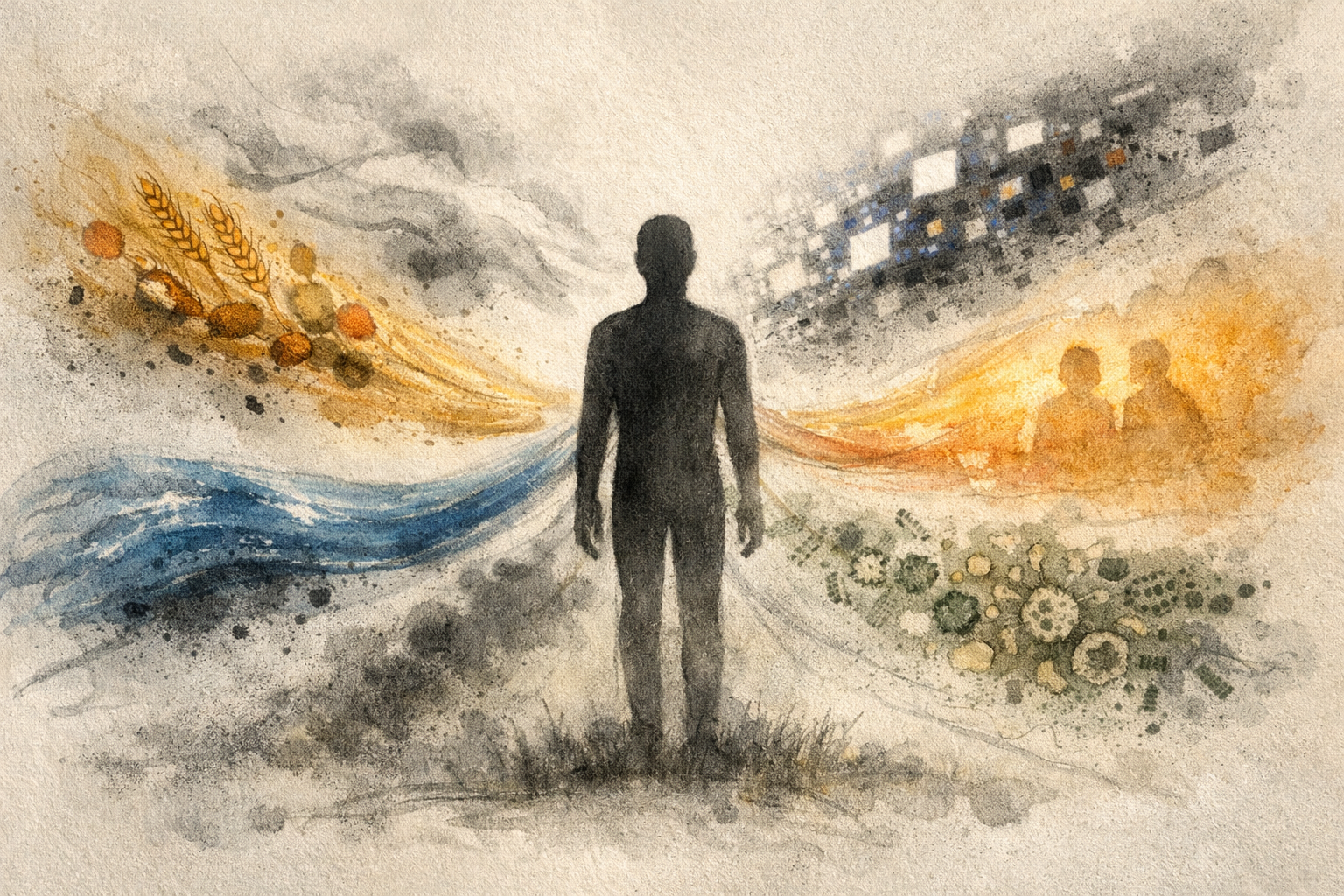
The Six Streams That Shape Human Life
The streams that shape human life are surprisingly easy to corrupt—and surprisingly hard to guard.
Human beings are porous creatures. These six streams flow into us constantly.
Food.
Water.
Air.
Information.
Microbes.
Relationships.
The streams that shape human life are surprisingly easy to corrupt—and surprisingly hard to guard.
These streams shape our bodies, our minds, and the communities we build together. And unsurprisingly, each of them is vulnerable to corruption, because it’s easy to affect these flows without anyone noticing.
We ingest them largely automatically, without thinking. We trust that what we are offered is nourishing and healthy for us.
But temptation comes easily, and so do examples of corruption. Food additives can make things cheaper but affect our health. Algorithms feed us novel videos, but they can wreck our attention, our minds, and our sense of self. We can be in relationship with someone and absorb their love, but also harm that relationship when we fail to show up for them, or when we try to control them by withholding love.
We hardly notice in the moment when the big six are corrupted, and we trust that someone is watching. Surely someone is discerning whether these things are corrupted. Someone must be monitoring the air, the water, and the food. Surely someone isn’t letting the people we trust cut corners on ensuring information is truthful…right?
This is why societies build institutions around these streams. We create food safety systems, water utilities, environmental regulation, journalism, public health systems, and community norms because these inputs matter so deeply. These institutions exist to guard the flows that shape human life. But institutions cannot function on rules alone. They depend on people who are capable of noticing when something is wrong—people who can interpret signals, weigh trade-offs, and decide when the system is being bent or quietly corrupted.
And this reveals something about preventing corruption: we must be willing and able to discern.
This is not just a matter of transparency. Transparency is a precondition, but what difference does transparency make if we cannot make meaning of it? We have to be able to evaluate whether the inputs that shape individuals and society are corrupted or not.
Sometimes this discernment happens individually, and sometimes it must be collective. Any time we read a food label or look at an air quality report, we are discerning at the individual level.
But we also discern at the community level. Communities deliberate on questions like: Do we want this? and How will it affect us? Communities themselves are a kind of living organism. Just as our bodies must determine whether what flows into them is nourishing or harmful, communities must do the same.
To prevent corruption we don’t just need laws, and we don’t just need transparency—we need discernment.
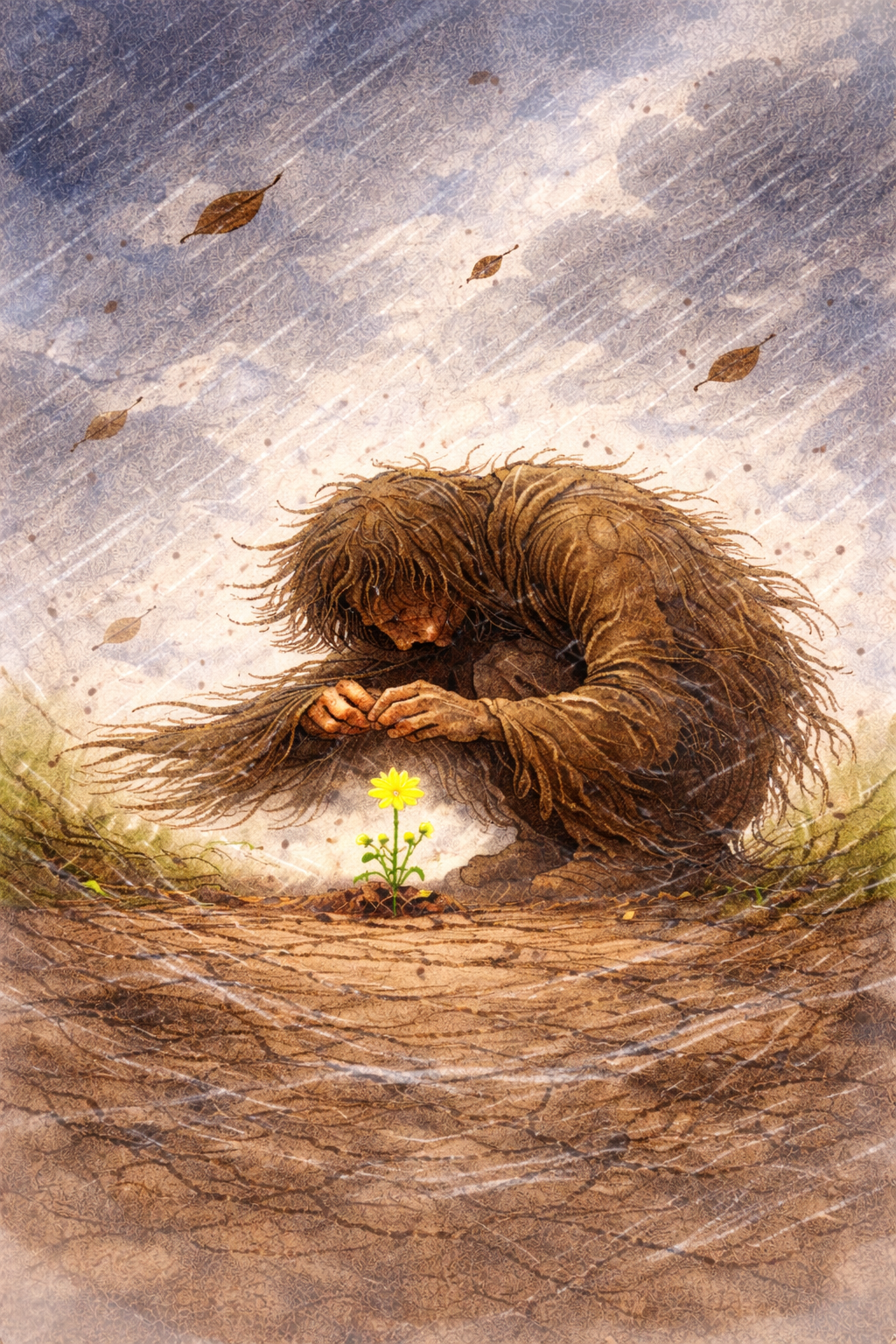
Joy comes at a terrible price
But all the work and suffering is worth it.
To experience joy is to experience something perfect.
But even joy comes at a price. Because to feel a truly sublime joy, even for a moment, requires two things of us: we must be fully present and fully open—emotionally and perhaps even spiritually. This takes inner work. That work can’t be priced in dollars, but it is surely costly.
Fully Present, Fully Open
Joy is a feeling of the present—and of the body. It’s not something that can be experienced in the mind alone.
To see what I mean, try this: imagine a time you experienced true joy—one of those full tingles of lightness, where your soul felt like it was rising through your body. Does it feel the same as a memory? Try imagining a future moment of joy. Can you? Joy outside its exact moment is hard to replicate, isn’t it?
The closest we can come is when our senses trick our bodies into believing we’re back in that moment. Like when we see an old photo with our family, or smell a spice that reminds us of what our mother made during the holidays. Or maybe it’s a sound or song—like the echo of a marching band—that makes us feel as free and enmeshed as we once did at an alma mater.
These things are like a tuning fork striking a resonant frequency, making everything nearby vibrate. But they’re only echoes. The real thing—real joy—only happens when our attention and our feet are in the same place and time.
But full presence isn’t enough for joy. We must also be fully open—of heart, of spirit. Joy, after all, needs a way in.
I think of it like the aperture of a camera lens, or the pupil of an eye. The pupil expands to let in more light when it’s dark. It happens automatically in the body. For the photographer, it’s a choice. If more light is needed, the aperture must be widened. I believe our hearts are similar. We have to be open enough for the light to enter.
This can be difficult because the border of our inner world is like a two-way tunnel. If we want joy to find its way in, we also have to let darker feelings—sadness, grief, fear, anger—and all their discomfort and ugliness find their way out. We can constrict our hearts to shield ourselves from that pain when darkness leaves, but doing so also seals the tunnel to joy. Openness is not selective; we can’t welcome light without also making space for the dark. We can’t have one without the other.
How do we become fully present and fully open? That’s exactly what makes joy such an elusive feeling. One path requires tremendous inner work—through self-expression, journaling, prayer, meditation, or any other spiritual or contemplative practice.
The alternative to that discipline is suffering. Whether it’s grief, loss, or injustice, suffering forces us to become more present and more open. It changes us, whether we want it to or not, by giving us new eyes. In that sense, suffering is a kind of shortcut to joy—but it comes with its own heavy toll. In reality, most of us walk both paths: the slow transformation of discipline, and discontinuous growth borne of pain.
It Comes at a Terrible Price
It’s a common cliché to say, “you can’t appreciate sunshine without the rain.” And that may be true. It’s cute when it’s written in calligraphy on a craft at a farmers market. But what I’m talking about goes deeper than a resetting of perspective.
Joy is harder than that.
It’s not just a trick of the mind or a lesson to learn. The work we must go through—and the suffering we endure—is not optional. It’s a precondition of joy. We have to let something in us be broken down. Or we have to endure years of reflection, effort, and spiritual labor to even be capable of joy.
But at least we have that as comfort. At least all this suffering and journaling and spiritual struggle might make something beautiful.
Next week marks ten years since my father passed unexpectedly from congestive heart failure. It gives me hope—and some encouragement—that if I had to endure something so painful, so unjust, it at least carved out space for a deeper experience of joy in being a father myself.
I endured nearly ten years of loneliness and desperation before I met Robyn. It gives me hope that if I had to wander for so long, there’s a deeper joy I now experience in marriage.
Joy is really hard. And it comes at a terrible price. Sometimes I need to remind myself of that—that it’s supposed to be hard. I have chosen joy, and it’s supposed to be nearly unbearably difficult.
I’m not in this for pleasure. I’m not in this for a fun life. I don’t care about once-in-a-lifetime experiences that are perfectly photographed and meticulously shared. I don’t care about extravagance or self-care. I’m not here for hedonism, or validation, or the gram, or whatever else. I’m not even here for meaning and impact.
I’m in this for joy. And I have paid a terrible price for it. But I wrote this post, I suppose, to remind myself that even though I have chosen to endure all this, it is for something beautiful.
Joy may be the only perfect thing we can obtain in this imperfect human life. It has come at a terrible price—but it has been, and will be, worth it. Even if, one day, all I have left in this world are the remnants of that joy in whatever remains of me—then still, it will have been worth it.
Joy comes at a terrible price, but it is worth it.