
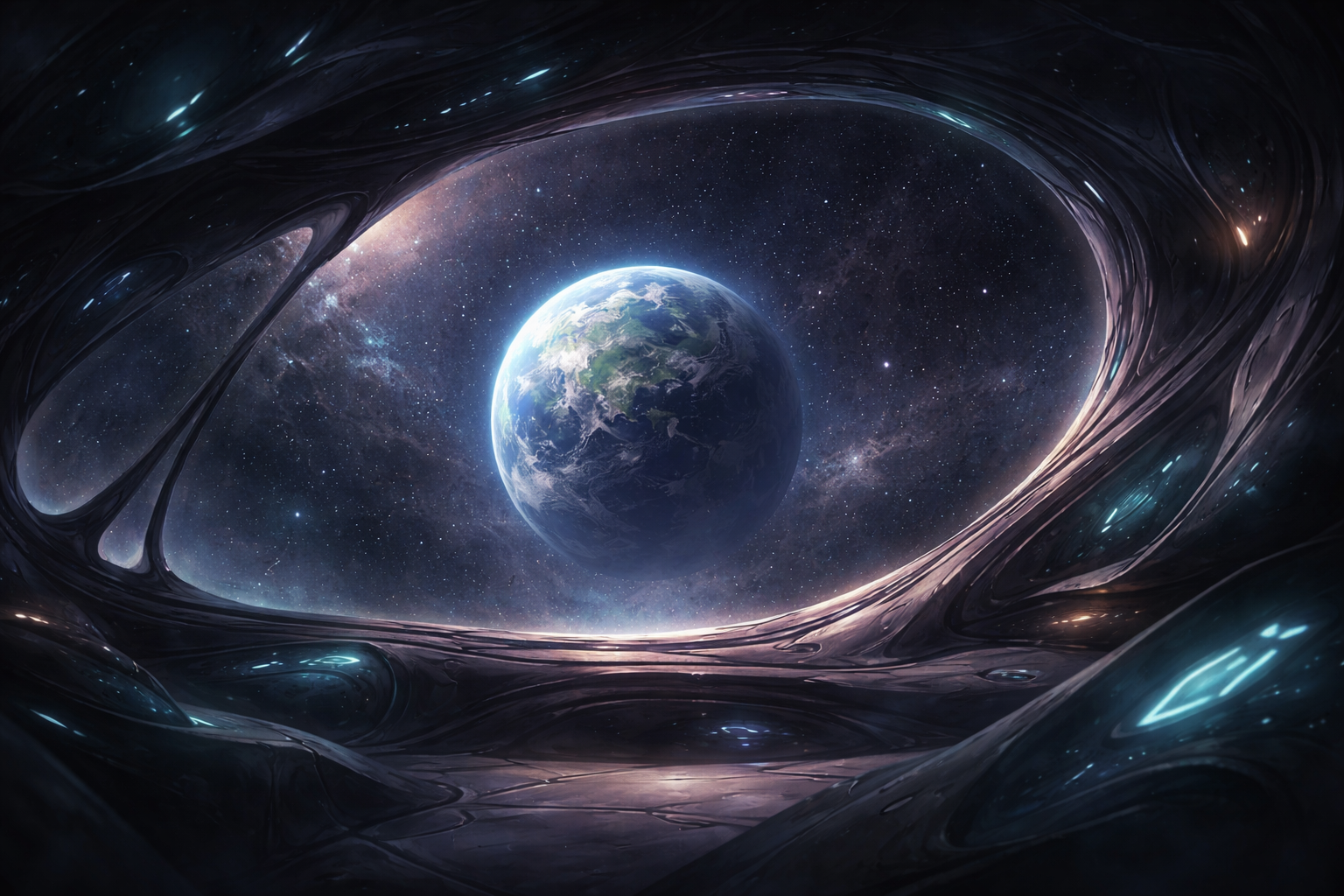
Would they stop for us?
We are feeble and reckless. But we have grown morally over the millennia. Would aliens passing through our solar system stop to engage our world?
Encountering another intelligent species from elsewhere in the universe is a problem for the distant future. Still, it is an instructive one for our time.
Imagine that we had the capacity for first contact—say, through faster-than-light travel. Our interstellar flagship passes near a distant world. The first question its crew would ask is simple: Do we want to stop?
If they had the luxury of choice, they would likely evaluate that civilization along two dimensions.
First: What is their intent? Do they seek cooperation and mutual enrichment, or exploitation and dominance?
Second: What is their capability? Do they actually possess the power to carry out their intentions—peaceful or otherwise?
A civilization that is hostile and capable would be dangerous. One that is peaceful but utterly incapable might not be worth engaging. Intent and capability, together, would shape our decision.
Of course, determining either would be extraordinarily difficult. Learning to assess an alien civilization might take centuries. But these questions are not merely hypothetical.
We may create an artificially intelligent, Earth-based species in our lifetimes. But long before AI takes on physical form, we will face the same dilemma: What are its intentions? And how powerfully can it impose its will?
Yet before worrying about how we evaluate others, a more uncomfortable question presents itself.
What about us?
If an extraterrestrial civilization were passing through our solar system, how would they assess humanity’s intent and capability? Given the choice, would they stop—or continue on their way?
When I look in the mirror, and consider the history of our species up to the present, here is what I see.
I see a civilization whose intent has long been fearful and exploitative, yet has slowly, unevenly, inched toward governing itself more justly. Our past includes conquest, slavery, genocide, and monopolistic corporations. Empires swallowed continents. Entire peoples were systematically pillaged or murdered. Private power frequently corrupted public life. It is arguable that all these are still part of our reality.
And yet, over centuries, something has shifted.
Large-scale territorial conquest has become less acceptable, even when it still occurs. International institutions intervene—imperfectly, but meaningfully. Economic power remains unequal, but counterweights exist: unions, industry associations, regulatory regimes, and cultural movements that attempt to restrain abuse.
History does not move in a straight line. Exploitation resurfaces in new forms. But over long periods, the trajectory seems to bend—slowly—toward cooperative enrichment rather than exploitation. Two steps forward, one step back.
That progress matters. It suggests that, in the long run, our species has shown some capacity for moral learning. We inherit exploitative systems, but we also attempt—however inconsistently—to reform them rather than let them expand.
Our capability, however, tells a different story.
We have not harnessed the energy of our own planet, let alone our sun. We cannot survive beyond Earth without elaborate life support. We are actively degrading the habitability of the only home we have. We do not fully understand our ecosystems, our biology, or even our own minds.
Technological power has grown faster than wisdom. We build tools whose consequences we cannot fully contain. From nuclear weapons to climate systems to algorithmic platforms, our inventions routinely outrun our ability to govern them.
We are both feeble and reckless.
If I were the captain of a spacefaring vessel, I might conclude that, whatever our intentions, humanity remains a relatively immature civilization—morally improving, yet operationally juvenile. I would probably keep moving. Why risk engagement with a species still learning how to manage itself?
And yet, I wonder what we might still offer.
Perhaps our stories would matter. Homer and Shakespeare, Whitman and Rowling, express something enduring about love, fear, identity, and loss. Even an advanced civilization might find in human literature a unique window into our shared experience of consciousness.
Perhaps our experience with diversity would be instructive. Earth’s extraordinary ecological and cultural variation has forced us—imperfectly—to negotiate difference. Managing pluralism is central to our history. It may not be universal across intelligent life.
Perhaps even our physical fragility is meaningful. We are short-lived creatures, acutely aware of mortality. “Life is short” is not a cliché for us; it is a through line of how we navigate reality. For a species that lives centuries, or never dies, our relationship to time and death might offer unexpected insight.
It is possible that artificial intelligence will become our first true encounter with another form of intelligence. It is also possible that, centuries from now, we will meet non-Terran life. In either case, the same questions will apply.
What are our intentions? And are we capable of living up to them?
These questions offer a kind of civilizational north star. If we can cultivate a shared commitment to enrichment rather than exploitation—and if we can build institutions and technologies capable of sustaining that commitment—we will not only prepare ourselves for first contact.
We will make life better, here and now, for the people who already call our sacred, fragile, beautiful planet home.
How We Should Treat Aliens
Thinking about how to treat aliens, helps us think about how we treat each other.
How should I treat a glass of water? Here are a few gut reactions:
I should not shatter it senselessly on the floor. Effort and resources went into making the glass. Destroying it for no reason would be wasteful.
I should keep it clean and in good working order. That way, there’s no stress because it’s ready for use. There’s no need to inconvenience someone else with even a trivial amount of unnecessary suffering.
I should use it in a way that’s helpful. It would be exploitative, in a way, if I took a perfectly good glass and used it as a weapon. If it’s there, I might as well use it to quench thirst, or do something else positive with it. Even glasses are better used for noble purposes than ignoble ones.
If I’m thirsty, I should drink the water. After all, it’s here and it won’t be here for ever - life is short.
And finally, if someone else is thirsty, I should share what I have. After all, we’re all in this together, trying to survive in a lonely universe.
How should I treat an alien?
The thought experiment of the glass of water is interesting because I don’t know how the glass wants to be treated. I can’t communicate with the glass, so I don’t even know if it has preferences. It is after all, just a glass.
And because the glass doesn’t have any discernible preferences, all my suppositions on how to treat the glass are a reflection of my own intuitions about how other beings should be treated. The question is a revealing one, if one chooses to play along with the thought experiment, because I’m asking a question that’s usually reserved for sentient being about an inanimate object. I can more easily access my true, unbiased, preference because I’m thinking about how to treat a glass of water and not, say, my wife and children.
Helpfully, asking the question revealed some of my deep-seeded moral principles. Each of these intuitions are builds on one of the statements I made above:
Don’t be wasteful - energy, and resources are finite.
Be kind - other beings feel pain so it’s good not to inflict suffering unnecessarily.
Have good intentions - I have the chance to make the world better, using my talents for good purposes. The world can be cruel, so why not make it more tolerable for others.
Uncertainty matters - Sooner is better than later because we don’t know how much time we have left. If you have an opportunity, take it. The opportunity cost of time is high, and the future has a risk of not happening the way we want it to.
Cooperate if you can - we are all in this universe together, nobody can help us but each other. Life is precious, beautiful, and so rare in this universe, so we should try to keep it going even if it requires sacrifices.
Like a glass of water, if we were to come across an alien species, we would not know what their preferences were. But unlike a glass of water, the aliens might actually have preferences - presumably, the aliens wouldn’t be inanimate objects.
And let’s assume for a minute that we out to respect the moral preferences of aliens, though I acknowledge that whether or not to recognize the moral standing of aliens is a different question, which we may not answer affirmatively.
But let’s say we did.
How we should treat aliens (and how they might treat us)
What this thought experiment helps to reveal is that we have meta-constraints that shape our moral intuitions and in turn, affect our moral preferences.
It matters to our morality that resources and energy are finite. It matters to our morality that we feel mental and physical pain. It matters that the world is an imperfect, sometimes brutal, place. It matters that the future is uncertain. It matters that life is fragile and that for the entirety of our history we’ve never found it anywhere else. Our reality is shaped by these constraints and manifest in how we think about moral questions.
So, like many difficult questions I only have a probabilistic answer to the question of how we should treat aliens: I think it depends. If they face the same sorts of constraints we do, maybe we should treat them as we treat humans. If they face the same constraints we do - like finite resources, uncertainty, and the feeling of physical pain - maybe we could also expect them to treat us with a strangely familiar morality, that even feels human.
But what if? What if the aliens’ face no resource constraints? What if their life spans are nearly infinite? What if their predictive modeling of the future is nearly perfect? What if they know of life existing infinitely across the universe? If some of these “facts” we believe to be universal, are only earthly, it’s quite possible that the aliens’ moral framework is, pun intended, quite alien to our own.
Maybe we’ll encounter aliens 10,000 years or more from now, and maybe it’ll be next week. Who knows. I hope if you are a human from the far out future, relative to my existence in the 21st Century, I hope you find this primitive thought experiment helpful as you prepare to make first contact. More than anything, I’m trying to offer an approach to even contemplate the question of alien morality: one tack we can take is to look at the meta-constraints that affect us at the species and planetary level, and then see how the aliens’ constraints compare.
But for all us living now, in the year of our lord, two thousand twenty two, I think there’s still a takeaway. Thinking about how we should treat glasses of water and aliens provides a window into our own sense of right and wrong. Maybe we can use these same discerned principles to better understand other cultures and other periods of history. Do other cultures have different levels of scarcity or uncertainty, for example? Maybe that affects their culture’s moral attitudes, and we can use that insight to get along better.
If we’re lucky, doing this sort of comparative moral analysis will make the people and species we share this planet with feel a little less, well, alien, while we figure out who else is out there in the universe.
