
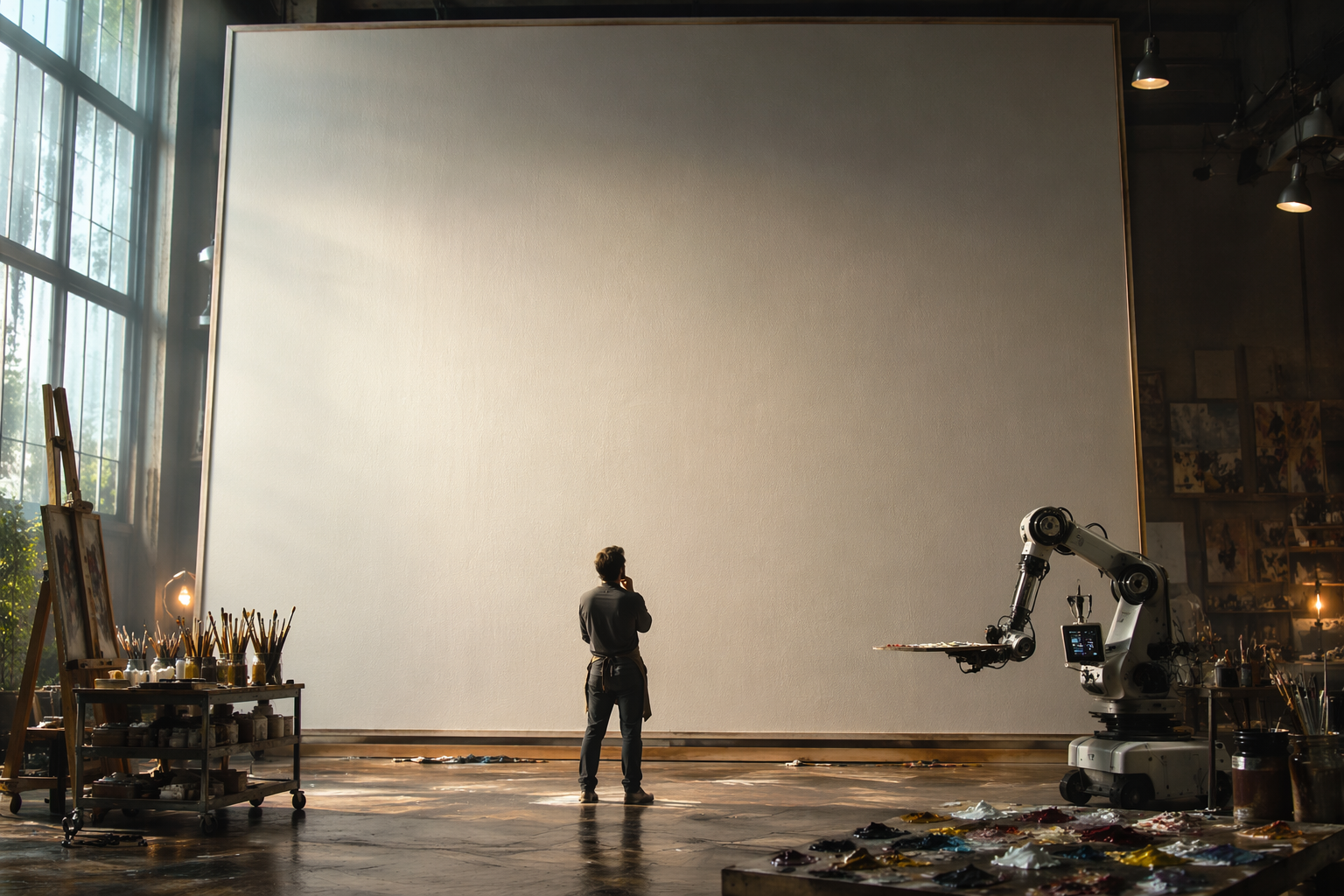
“What shall I make?”
On making things beautiful in an age of AI.
When I was a younger man, I had this little phrase that I kept close to my heart. I didn’t say it often, but I would come back to it when I felt lost in the sea of adult life—drudgery, hustle, responsibility.
“Make things beautiful and make beautiful things.”
It was a way of remembering who I was. The version of me that felt like an artist, who had big dreams, a little bit of flair, and a soul he let other people see freely and shake hands with.
Surprisingly, AI is helping bring that version of me back to life. At first, I let it create for me, and I didn’t like it. It felt hollow. It had no soul, and it wasn’t any fun. So I stopped letting it do that.
But now I use it differently. It helps me create more, and spend less time on the parts that aren’t that fun. It clears space instead of taking over.
And in a world where we suddenly have these power tools—tools to imagine, design, refine, build, and share, cheaply and almost delightfully—the biggest question shifts. It’s no longer “can I make this?” but “what shall I make?”
There’s so much I would love to make beautiful, or just make more beautiful, and more of it feels within reach than ever. My own watch straps. New variations of pizza dough. Another book. Choreography. A family cookbook. A trellis for the tomatoes in the backyard.
Tools aren’t really the constraint anymore. The limit now is more human than that—our imagination, our point of view, our ability to notice something and say, that’s worth making.
That’s why the humanities and the arts feel more valuable than ever to me. Not instead of STEM, but alongside it. We need to understand the world, the tools, and what’s worth doing with them.
If we can stay curious, be empathetic, and keep teaching ourselves, we can create a lot. But only if we have some sense of what is beautiful—or at least, if we’re willing to wrestle with that question.
That’s also why I think, perhaps paradoxically, that AI and robots might actually make us more human. Because the alternative to leaning into our humanity isn’t scarcity and poverty. It’s something worse—a kind of boredom that comes from having endless possibility, but no idea what to do with it.
Wouldn’t it be something if AI and robots ended up being the greatest catalyst for beauty humanity has ever known? It might be optimistic. But I think it’s possible.
But have to choose it. We could do a lot of destructive stuff with all of this, or we could commit to making things beautiful, and making beautiful things. And if we’re serious about that, then it becomes pretty important—for us, and for our kids—to wrestle with a deeper question: what is beautiful? Not in a shallow way, but in a way that is personal, soulful, and human.

We're in the era of falling in love again
New eras are worth the struggle because we get to see those we love with new eyes.
I Have Fallen in Love, Again
On quiet weekend mornings, I stand at the stove, often with a spatula in hand, flipping pancakes. Robyn comes downstairs in her pajamas, her hair pulled back in a ponytail. She smiles, tilts her head, and walks over to me with her arms outstretched. Without saying a word, we hug right there in the kitchen.
It’s not one of those young, giddy embraces. It’s a hug worn in by years—familiar, steadfast, with the kind of patina that only time and shared struggles can create.
This is what love looks like now.
And I’m falling in love with her again.
It’s a love I’ve rediscovered, not just because of who she is, but because of who we’ve both become. In this new era of our lives, she is still Robyn—but also someone new.
The Beauty of Changing Eras
I started to understand why I’ve been feeling this way over the Thanksgiving weekend. Something has shifted—not just in our relationship, but in our entire world.
We’ve entered a new era.
In our home, the signs are everywhere. We’re going to be parents to a newborn for the last time, and the weight of that reality feels both solemn and profound. Our sons have transitioned into school-aged kids, with piano lessons, soccer games, and social lives. Even our house itself has transformed—we’ve remodeled and repaired, shaping it into the place we’ll live for decades to come.
As individuals, we’ve changed too. Robyn and I are no longer just contributors at work; we’ve both shifted toward leading others. I hear it in her voice when she’s on a conference call—steady, calm, full of gravity that she’s earned over years of experience. Her team leans on her not just for answers but for her wisdom, and it shows in the way she carries herself.
And me? I finally got my book, Character by Choice, out into the world after seven years of working on it. It feels surreal to see it finished. That process stretched me in ways I didn’t expect, but it also revealed a new grittiness for sticking with something for years at a time with no guarantee of success that I didn’t know I had in me.
The changes of this era haven’t always been easy, but they’ve revealed so much beauty. Like the quiet strength Robyn shows every day. The way she hugs our sons or me—not just as a gesture, but as a statement of presence and love, even when she’s exhausted. Or the way she listens to friends who are newer parents with such intense warmth that it lifts them up without them even noticing. These things were always part of her, but this new stage of life has brought them to the surface.
But it’s not just us.
Our close-knit family and friends are evolving, too. Our siblings are becoming parents, which will soon add to the gaggle of kids running through our lives. With each new arrival, our family grows—cousins, nieces, and nephews weaving together a new web of connection and joy.
At the same time, our parents are navigating their own shifts. Robyn’s parents are caring for aging loved ones while preparing to move into homes that fit the lives they need now. My mom is still grappling with life after my father. Despite her health and strength, she’s navigating the reality of aging—for her and her siblings. Even things she’s done her whole life, like traveling back and forth between India and the U.S., aren’t as simple as they used to be.
It feels like everyone we know is moving into a new chapter at once.
And it doesn’t stop there.
Society is shifting all around us. Politically, both the Trump and Duggan eras are coming to an end within the next four years, making way for what’s next in the country and Detroit. Technologically, we’re stepping boldly into the age of AI and the wonder of tools like the James Webb Space Telescope, showing us the universe in ways we never imagined.
Change is everywhere, and it’s compelling all of us to grow in response.
Entering a new era doesn’t demand growth from us in an adversarial way. Instead, it calls to us gently but insistently, urging us to uncover new parts of ourselves. As the world around us changes, it doesn’t obligate us to change—that’s a choice we make—but the influence of a shifting context is undeniable.
Robyn’s quiet strength, her firm tenderness—it was always there, but this moment in time has brought it to the surface. And in seeing her anew, I’ve found myself falling in love with her all over again.
This is the beauty of changing eras. When everything shifts, we have the chance to become something new and to notice the people we love in new ways. The struggle of change—the hard work, the sacrifice, the heartbreak—gives us a rare gift: the chance to see life, and each other, with fresh eyes.
Marking the Era
My father used to say there’s no free lunch, and he was right. Change doesn’t come easily. To move into a new era, we have to let go of the old one. We have to embrace the challenges and celebrate the rhythms as they shift around us.
But here’s what I’ve learned: the struggle is worth it.
There’s a brilliance in how Taylor Swift brought this lesson to life through her Eras Tour. From all I’ve read and heard from friends, her concert marks eras, celebrates them, and embraces the growth that comes from moving forward. She so beautifully illustrates how the struggle of moving through eras is worth it.
When we mark the era—when we take the time to notice the passing of one chapter and the beginning of another—we honor the transformation. We honor what we’ve lost and what we’ve gained.
And in doing so, we give ourselves the chance to fall in love again.
So, my friends, don’t fear the reset. Lean into it. Notice the beauty it reveals in our lives and the lives of those we love. And when you look back on this new era we are all in, I hope you find yourself saying: It was worth it.