

What I Learned In Ten Years of Marriage
Marriage is made or broken in the dozens of moments each day when we turn toward each other—or away.
Staying happily married comes down to one behavior.
In times of suffering, or joy, or even in the mundane—do I turn toward my partner, or away from them?
In the past ten years married to Robyn, this is what I’ve learned. It all comes down to a simple thing that happens dozens of times a day. Turning toward builds intimacy and nurtures love. Turning away builds resentment and undermines connection.
The key question then is this: how do I turn toward my partner, consistently?
The first “how” is uncompressed, emotionally available time.
In other words—time together that isn’t rushed.
To turn toward requires being in the same place long enough to actually confide about a struggle or savor a joy. And not just that—we have to be there. There’s no space for turning toward if we’re silently preoccupied with work or the kids or chores.
There are many obvious examples of this—going on dates, therapy, and more. But I don’t think it always requires talking.
Turning toward can happen while just being in the same room, even silently—as long as the time is uncompressed and both partners are emotionally available. Maybe that’s reading next to each other. Maybe it’s holding hands while walking the dog. Maybe it’s just sitting on the couch at the end of the day without rushing to the next thing.
The second “how” is building the mentality, the systems, and the trust to deal with conflict.
Unresolved conflict is a killer, obviously. But it’s also more nuanced than that, and there are many habits to stack beyond just “good communication.”
I think it starts with a mentality of gratitude and generosity.
You have to genuinely assume that your partner is doing more, suffering more, and trying harder beneath the surface than what you can see. You have to assume good intent even when you feel wronged. You have to train your mind—and sometimes force your heart—to find reasons to appreciate them.
That posture matters because it moderates our natural inclination toward defensiveness in moments of conflict. It’s why we start our temperature checks with gratitude.
Resolving conflict also requires self-discipline.
It’s not just Robyn’s job to bring her issues to the table. More often, it’s on me to be the type of person who creates a safe enough space—one of genuine care and understanding—so that when she is emotionally vulnerable and needs to talk about something hard, she trusts that I will love her in that moment.
I have to be healthy and stable enough to make a space sacred enough for her to share her heart and soul.
And the roles flip.
When I’m in that vulnerable place, Robyn has to do the same. When we both give more, listen more, and take on more than what we perceive to be our fair share, our marriage wins.
There are so many skills and practices that support our ability to manage conflict.
We swear by a weekly temperature check. But it’s also getting enough sleep, eating well, exercising. It’s listening well and using “I” statements. It’s having good role models—friends and family who set me straight when I’m angry or off base. It’s journaling, prayer, or other forms of discernment and expression that turn down my own anxieties.
Managing conflict comes down to having the mentality, systems, and skills to actually resolve it—and both partners giving more than 50% in that effort.
Unresolved conflict turns you away from your partner. So we have to resolve it, and we have to stack every habit we can to make that more likely.
The third “how” is having a vision for the future.
Building a life and a way of living that we both want is an incredibly strong force for turning toward each other.
Something Robyn and I talk about a lot—and even do reflection exercises on—is:
What do we want our life to be like in five years? Ten years? When we’re retired? When we’re old and gray?
How are we doing? Are we building the life we imagined? What does it feel like?
Down to the details—what do we want our life together to be, and are we actually living it?
Having a shared dream is a powerful relationship magnet. It builds energy and excitement. It also ensures that we’re both moving toward a place we actually want to go.
And that dream has real, practical consequences.
When you see it clearly, it shapes decisions—big and small—and those decisions compound.
We chose a smaller house in a diverse, friendly neighborhood, even though finding a good school has been harder and more expensive. We’ve traded more time with family for fewer cultural experiences and life in the city. We’ve gone on fewer dates out and chosen less luxury so we can hopefully retire a little earlier.
We’ve made our kids share a room so they spend more time together, and so we feel freer hosting guests. We overseed the grass so it can stand up to the backyard soccer our boys love to play.
Seeing the dream clearly shapes these big and seemingly insignificant decisions. And those decisions, over time, reinforce the dream we’re trying to build.
It becomes a virtuous cycle.
We talk about it. We get excited about it. It turns us in toward each other. We make decisions, and the dream becomes more real. And so we’re drawn in even further.
A clear, compelling dream also helps us make sense of sacrifice.
I could probably have made more money if we had moved to a coast after business school, or if I hadn’t gone into public service. Robyn could have worked full-time after we had kids instead of being in a flexible work schedule. We would almost certainly be less tired if we had a smaller family.
We could spend less time at soccer fields. We could skip church more often. We could have chosen “easier” paths in a hundred different ways.
But that’s not our dream.
We make these sacrifices, and they are more palatable—more meaningful—because we can see how they fit into the life we are trying to build.
There are moments, in the middle of the chaos, when we can look at each other and say: this is the dream.
And that acknowledgment creates a bond. It helps us appreciate what each of us is carrying—individually and together. The dream binds us and turns us toward each other.
—
Turning toward each other is not trivial. Marriage is hard.
In a world of constant rushing, shifting expectations around family and gender roles, distraction, and self-promotion, it can feel like the deck is stacked against it. Even if you choose the right partner, even if you are mature enough to be married—it is still really hard.
Maybe that’s part of why so many marriages fail.
And at the same time—we all can do this.
We can have healthy, thriving marriages. We can learn to turn toward each other. We can help each other learn a better way to live and to be married people.
I’ve been blessed to learn a lot in our first ten years of marriage—through joy, and through real hardship. We’ve been shaped by mentors, and by a community that has loved and nurtured our marriage deeply.
We are lucky.
Lucky to have each other. And lucky to be surrounded by many couples who model what a loving, generous, and committed relationship looks like.
My hope in writing this is to solidify what I’ve learned so far—and, in some small way, to take the love and wisdom that so many people have poured into us and pay it forward.
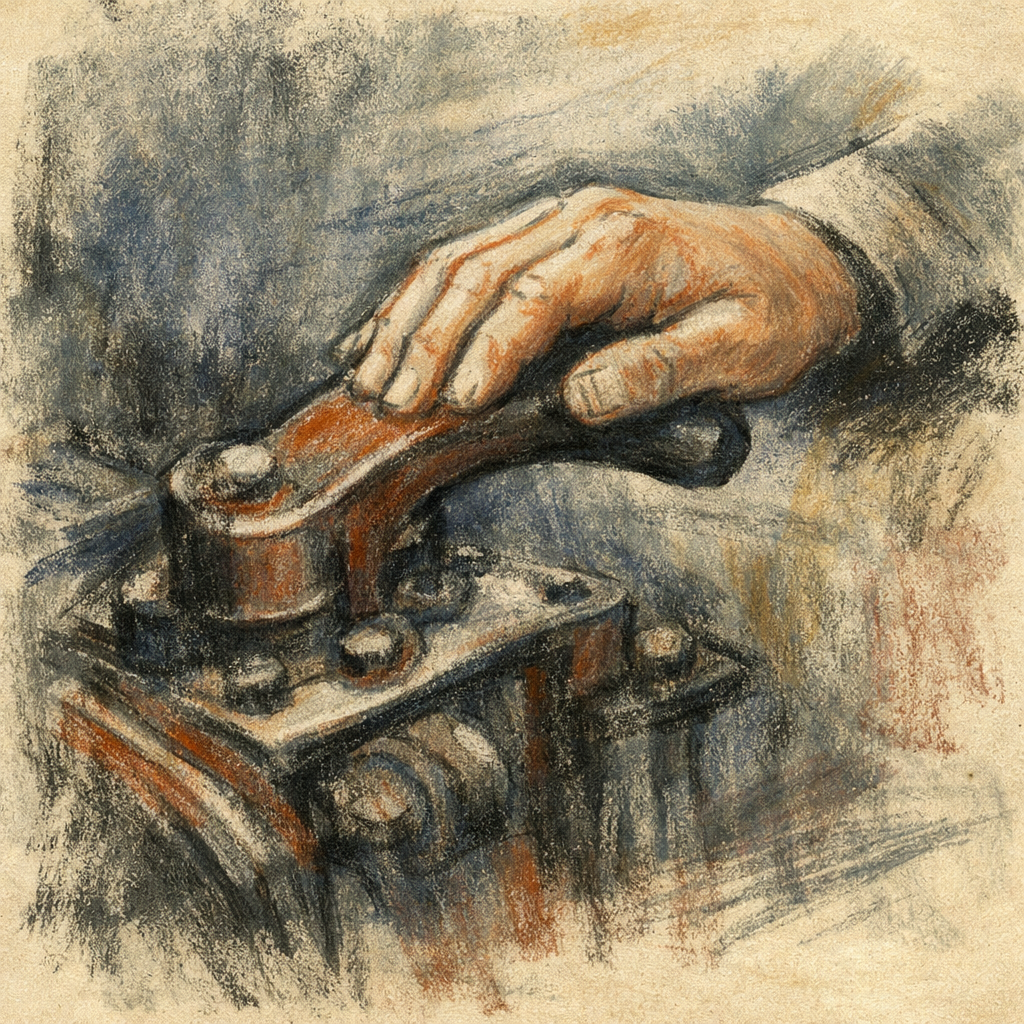
Be the Brakeman
A short story about conflict resolution, and evolving as a coach.
I’ve known for a long time that solving my sons’ conflicts for them creates fragility. At some point, after all, I’ll be gone, and they’ll need to resolve conflict without me as their judge and jury.
For several years, I tried to facilitate their peacemaking in two ways: by prompting the “right” discussion, or by imposing my less-favored answer to the problem—nobody watches TV if you can’t agree.
Stepping in strongly was necessary for a time. They needed guidance on how to resolve conflict; they weren’t born with those skills. But if I kept playing broker of peace, I knew their relationship would stay fragile—dependent on my presence, my rulings, my leverage.
Now I’m better served—and so are they—if I play a different role: brakeman, not intermediary.
I can slow things down. I don’t have to direct the entire outcome. I don’t have to do all the talking. They already have some skills, because we’ve practiced.
My job now is to be the person who says, “Whoa. Let’s slow down.”
Just this weekend, a Valentine’s Day trade went badly. And for the first time, by accident really, I slowed it down instead of negotiating a truce. Over a few hours, with some help, they worked it out themselves.
This was growth all around, for them and for me
The real insight is simple: they can do more on their own, and they should—but first, someone has to slow the moment down long enough for thinking to happen. They can resolve much more independently if hearts aren’t already racing and there aren’t already tears and screaming.
Slow it down. Be the brakeman. That’s my new job. If I do that, everything else becomes easier for them, and they can keep practicing conflict resolution—with less and less supervision from me over time.
Eventually, they’ll be able to pump their own brakes. And then I can coach a more advanced skill: self-reflection, repair, and the ability to turn hard moments into opportunities to deepen trust.
This feels like the pattern of any good coach. You start with fundamentals. You teach them to mastery. Then you coach the same fundamentals one level deeper. The temptation is to get stagnant—to keep teaching yesterday’s lesson after your kids have already moved on.
But we can’t.
As they grow, we have to deepen our own mastery so we can deepen theirs. If we stop learning, they will too.
Braving new worlds: the astronaut in all of us
There are four versions of the world, and they might as well be different planets.
There are four versions of the world. They exist for everyone and we all move between them.
The first world is my world. The world inside my head, my inner world of thoughts and fears. What I’ve learned about this world is that I can make it a peaceful and verdant place. It doesn’t have to be a MadMax sort of rugged and dystopian Outback. I can make my inner world a pleasant and nurturing place instead of a scary place if I turn my inner critic into a coach.
The second world is the world of others. I have to inhabit someone else’s world to love and understand them. And I have to inhabit their world for someone to feel loved and feel understood. What makes this hard is that everyone else’s world is different, which makes getting there hard. It’s truly like being on a different planet. I feel this acutely with my children, in their worlds of cooking tomato pancakes or caning on pirate ships in our family room.
What I’ve learned about this world is that I will never ever spend too much time here. I will always spend less time than I need to in the worlds of others. If something feels tense, heated, or frustrating, there’s one obvious strategy every single time: walk around with them, in their world. Just be there for a little while before trying anything else. Doing this is never a waste of time.
The third world is the real world. The three dimensions in front of our face where our entire lives happen. Every hug and kiss, every swing of a tennis racket, every birthday cake, every wedding vow. Every misunderstanding and every karaoke night happens here. Every family dinner and scientific discovery - it all happens here. Whether or not we’re mentally there, our life, shared with everyone else, happens in the real world.
I’ve learned two things about this real world. One, things like meditation, prayer, and yoga - that help us to focus in the moment - are so important that it is difficult to overrate them. Anything we can do so help us stay in the moment is priceless.
Two, I’ve learned that it’s important to be honest instead of delusional. We can choose to accept the world as it is, or we can lie to about what’s real. We can see what we want to see, but then our reality is distorted. Distortion, I’ve found, is like drinking: the longer you let it ride, the worse the hangover.
We all travel from world to strange, new, world, and it honestly feels as significant as the spacefarers in movies like Star Trek or Star Wars. We are all astronauts in this way. It’s hard and scary.
And as I’ve penned this post, it just makes me remember how important it is to have grace. Grace for others as they trip up and fumble their way from their world into ours, and grace for ourselves as we try, feebly, to do the same. There’s nothing trivial about this travel from world to world. To be an astronaut in this life is significant and heroic.
But alas, there is still the fourth and final world. It is the world of our dreams - the sacred place. The world of dreams is the hardest to reach, requiring hope, vision, and optimism to find. The portal to the world of dreams is like the 9-and-three-quarters platform - only the indoctrinated can see it and it feels like something from a magical world. Because to dream is to imagine and to imagine is to contemplate something that has never been. To dream about the world that ought to be is to be an explorer in everyday life: dreaming is the act of charting something in our mind’s eye, that no other astronaut has ever seen.
I learned my most important lesson about dreaming from Chief Craig and the leaders I worked for at the Detroit Police Department: we have to talk about our dreams.
For the dream to come true, what I see in my minds eye, you have to see in yours. Without doing this we cannot work toward the same dream.
To be sure, this is uncommonly hard. In our stressed out world, finding the wherewithal to dream on our own is hard. Guiding someone else to meet you there, in that holy plane, is even harder.
So if the universe or our creator blessed us enough to get to the plane of dreams, why would we do anything but dream the biggest, simplest dream we could? To dream big and simple is the most rational choice one can make.
All this inspires me. That we all traverse and inhabit these different worlds inspires. That we all have something in us that allows us to think beyond our own world inspires me. That we are all astronauts, inspires me.
We just have to find the astronaut within, and explore the have the courage to explore these new worlds.
How We Should Treat Aliens
Thinking about how to treat aliens, helps us think about how we treat each other.
How should I treat a glass of water? Here are a few gut reactions:
I should not shatter it senselessly on the floor. Effort and resources went into making the glass. Destroying it for no reason would be wasteful.
I should keep it clean and in good working order. That way, there’s no stress because it’s ready for use. There’s no need to inconvenience someone else with even a trivial amount of unnecessary suffering.
I should use it in a way that’s helpful. It would be exploitative, in a way, if I took a perfectly good glass and used it as a weapon. If it’s there, I might as well use it to quench thirst, or do something else positive with it. Even glasses are better used for noble purposes than ignoble ones.
If I’m thirsty, I should drink the water. After all, it’s here and it won’t be here for ever - life is short.
And finally, if someone else is thirsty, I should share what I have. After all, we’re all in this together, trying to survive in a lonely universe.
How should I treat an alien?
The thought experiment of the glass of water is interesting because I don’t know how the glass wants to be treated. I can’t communicate with the glass, so I don’t even know if it has preferences. It is after all, just a glass.
And because the glass doesn’t have any discernible preferences, all my suppositions on how to treat the glass are a reflection of my own intuitions about how other beings should be treated. The question is a revealing one, if one chooses to play along with the thought experiment, because I’m asking a question that’s usually reserved for sentient being about an inanimate object. I can more easily access my true, unbiased, preference because I’m thinking about how to treat a glass of water and not, say, my wife and children.
Helpfully, asking the question revealed some of my deep-seeded moral principles. Each of these intuitions are builds on one of the statements I made above:
Don’t be wasteful - energy, and resources are finite.
Be kind - other beings feel pain so it’s good not to inflict suffering unnecessarily.
Have good intentions - I have the chance to make the world better, using my talents for good purposes. The world can be cruel, so why not make it more tolerable for others.
Uncertainty matters - Sooner is better than later because we don’t know how much time we have left. If you have an opportunity, take it. The opportunity cost of time is high, and the future has a risk of not happening the way we want it to.
Cooperate if you can - we are all in this universe together, nobody can help us but each other. Life is precious, beautiful, and so rare in this universe, so we should try to keep it going even if it requires sacrifices.
Like a glass of water, if we were to come across an alien species, we would not know what their preferences were. But unlike a glass of water, the aliens might actually have preferences - presumably, the aliens wouldn’t be inanimate objects.
And let’s assume for a minute that we out to respect the moral preferences of aliens, though I acknowledge that whether or not to recognize the moral standing of aliens is a different question, which we may not answer affirmatively.
But let’s say we did.
How we should treat aliens (and how they might treat us)
What this thought experiment helps to reveal is that we have meta-constraints that shape our moral intuitions and in turn, affect our moral preferences.
It matters to our morality that resources and energy are finite. It matters to our morality that we feel mental and physical pain. It matters that the world is an imperfect, sometimes brutal, place. It matters that the future is uncertain. It matters that life is fragile and that for the entirety of our history we’ve never found it anywhere else. Our reality is shaped by these constraints and manifest in how we think about moral questions.
So, like many difficult questions I only have a probabilistic answer to the question of how we should treat aliens: I think it depends. If they face the same sorts of constraints we do, maybe we should treat them as we treat humans. If they face the same constraints we do - like finite resources, uncertainty, and the feeling of physical pain - maybe we could also expect them to treat us with a strangely familiar morality, that even feels human.
But what if? What if the aliens’ face no resource constraints? What if their life spans are nearly infinite? What if their predictive modeling of the future is nearly perfect? What if they know of life existing infinitely across the universe? If some of these “facts” we believe to be universal, are only earthly, it’s quite possible that the aliens’ moral framework is, pun intended, quite alien to our own.
Maybe we’ll encounter aliens 10,000 years or more from now, and maybe it’ll be next week. Who knows. I hope if you are a human from the far out future, relative to my existence in the 21st Century, I hope you find this primitive thought experiment helpful as you prepare to make first contact. More than anything, I’m trying to offer an approach to even contemplate the question of alien morality: one tack we can take is to look at the meta-constraints that affect us at the species and planetary level, and then see how the aliens’ constraints compare.
But for all us living now, in the year of our lord, two thousand twenty two, I think there’s still a takeaway. Thinking about how we should treat glasses of water and aliens provides a window into our own sense of right and wrong. Maybe we can use these same discerned principles to better understand other cultures and other periods of history. Do other cultures have different levels of scarcity or uncertainty, for example? Maybe that affects their culture’s moral attitudes, and we can use that insight to get along better.
If we’re lucky, doing this sort of comparative moral analysis will make the people and species we share this planet with feel a little less, well, alien, while we figure out who else is out there in the universe.
