
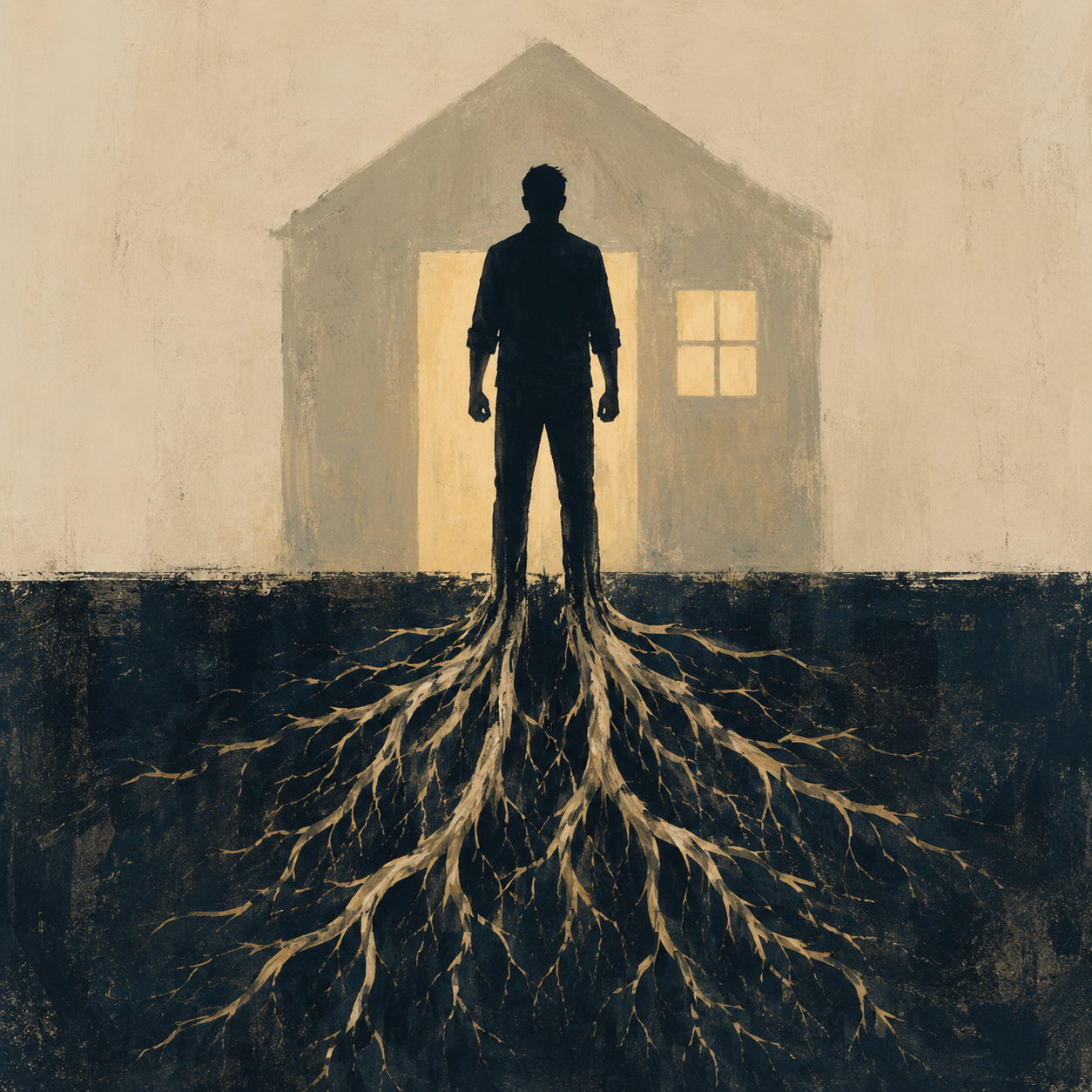
Just Try To Rip My Legs From This Ground
On refusing the gremlin who insists I’m never enough.
The gremlin — my dark alter ego who always wants more and believes I’m never enough — is lingering outside my front door. I sense him knocking, demanding to come inside, and I can’t let him in. I can’t go back to when he lived, rent free, as my captor.
“More!” he used to say, brooding. “There are people younger than you who have advanced further. Be afraid of how your savings will be wiped out in a crisis. Your colleagues think you’re weak. Your friends are going to lap you — I heard them talking.”
“Robyn and the kids deserve better than what you’re giving them. Your parents sacrificed everything they knew to come to this country, and you only have this?” he whispered, with disgust.
“You’re not even close to where you need to be. More, more, MORE!!!”
The gremlin doesn’t just want me to keep up with the Joneses — he wants the Joneses to have to keep up with me. As if the only way to stay safe in this world is to be “superior” to others, whatever that means.
How do I stop him? How can I banish him again?
To send him away the first time, it took a decade’s worth of reflection, study, and writing. My book, Character by Choice, is the fruit of that labor. But it won’t work to banish him again through contemplation. I can’t write letters to send him away this time, I tried that already and he’s back.
I need an anchor that lets the gremlin know I’m standing firm — that I’m committed to the life I’m living and content enough to grow at my own, sustainable pace. I need roots that keep me grounded, that help me close doors, and that keep me from falling back into the trap of “more, more, more” because I haven’t articulated what “enough” is. If he sees that I’m anchored and can’t be kidnapped…he will leave disappointed and empty-handed.
Robyn is an anchor. The moment I proposed to her in Campus Martius Park was the moment I committed to a family-centered life — when she said “yes,” I said no to a career of chasing titles, moving across the country, and even running for office. Our home is an anchor. It’s small, and even if we had the money for a flashy renovation or fancier cars, it wouldn’t be valued by the culture of our relationship-oriented neighborhood.
Faith and our church community is an anchor. Our parish emphasizes being welcoming, and actively rejects a culture where piety is compared based on appearances or social status. My sons are an anchor. They constantly prove to me — when they ask to play a game, or ask me to stop working — that my undivided attention is what they’re desperate for, not my money or social status.
These anchors are not words. They are not cheap talk. They are expansive actions. They show the gremlin that he should take a hike — that I’m not giving up these things, not trading them for more. If the gremlin wants to take me on a different path, he will have to rip my legs from the ground and carry me there.
It’s hard to find examples of this among people my age, so I looked to the natural world instead. The ability to be rooted is why I am so in awe of trees. They stay put, and branch outward above and below the ground. They can withstand wind and storms. They stay steady, committed to where they are, enhancing the ecosystem around them with their shade, the air they purify, and their ability to stabilize the ground. You have to rip a tree out of the ground to take it away. Trees are the epitome of rooted.
And I can remember this, and feel this rooting in my body every day. When I embrace my wife in the kitchen, afraid of the failure I’ll be reminded of at work, I’ll feel my feet planting firmly into the tile floor. When I sit with my kids on the couch in the few minutes we have before bedtime, worried about whether we’ll have enough money for Catholic schooling or Griffin’s long-term care, I will feel my back rooting into the cushion and my arm intertwining with their shoulder. When I am in the pews of the church, praying that the Lord lets me lay the pressure I feel to be more, and the heaviness of my responsibilities, at his feet for a little while, I will feel my knees burrow into the ground below me.
In these moments, I will let this feeling in my body remind me that I am anchored, like the trees are. The gremlin will not walk through my door and take me captive, as he once did — because I will be rooted.
What Loneliness Feels Like To Me
We are all on a journey. We are all living out our own memoir, in a way. For our journey to become that of a hero, we must face our fears and conquer them. For me, that means confronting and conquering loneliness.
I fear loneliness. More than anything. I don’t always mind being by myself as I’m happy to be in my own thoughts or take a long run, but I hate being alone. Loneliness is my darkest place. Isolation is my hell. I will do almost anything to avoid loneliness.
I recently finished listening to Will Smith’s memoir, Will, on audiobook. It’s my third venture into listening to memoirs read by their authors, which has become a bit of a hobby as it’s perfect for washing dishes. I’ve completed A Promised Land (Barack Obama), Greenlights (Matthew McConaughey) and I just started Becoming (Michele Obama). All are excellent.
One of the central theme’s in Will is fear. We must face our fears if we want to thrive. If we want to live a meaningful life serving others, we cannot let fear take the wheel. We have to conquer our fears. There is no other way.
Smith has a unique perspective on fear because of his profession. Fear is central to acting. I’m paraphrasing here, but in one of the passages, Smith describes that how fear helps an actor understand a character. Fear shapes our desires, and our desires influence our behaviors. So to play a character well, and represent their story well, you must understand their fears. Fears are central to their story.
Loneliness, therefore, is central to my story. To understand me, you must understand my fear of loneliness.
Honestly, this is something I don’t even understand. I haven’t been able to go there, even though I’ve loosely acknowledged that “I don’t really like being alone” in my own mind. I haven’t even really spoken about the stories I’m about to share, let alone writing them, until literally right now.
—
What does loneliness feel like?
I’m transported back to my childhood. I remember mental images of pay phones. Lots of pay phones. I always had quarters in my bag - whether it was my school backpack or a bag for dance class or swim practice. I always put the quarters in the outside top pocket - the little one, so the quarters would be easy to find when I needed them.
I used so many quarters calling home. It’s me, I’m done with class. Can you come pick me up? Where are you? When will you be here?
In those moments between a phone call and pickup is when the clock was always slowest. Will they make it in time before the building closes? Will I have to wait outside? What will everyone else think as their parents come, of me just standing here? Will I be the last one picked up? Loneliness was the panicking, the waiting. It was the feeling of being stranded, stuck.
What does loneliness feel like?
At our dance studio growing up, we’d have guest teachers come in for workshops. One workshop that I remember vividly was a partners’ workshop. I was probably 12 or 13 at the time. Every male dancer in the company was assigned a female dancer as a partner for the workshop. My assigned partner’s name wasn’t “Michele” but let’s just pretend it was.
One of my buddies, who was a year or two older than me and admittedly a better dancer, was without a partner. His wasn’t there, she was sick or something. Michele knew my buddy better than me, too.
Michele comes up to me, averts her eyes, and tells me she’s leaving to dance with someone my partner-less friend.
“…his partner isn’t here, and he needs one…so I’m going to go dance with him...”
And there I was. Completely dumbfounded. This workshop was about to start, and my partner just left. What is wrong with me? Am I that bad a dancer? Am I disgusting? What is wrong with me? Am I ugly? Does she think I’m weird? Am I a loser? What is wrong with me?
Within seconds, I felt the bottoms of my cheeks starting to quiver, which remains to this day the first physical reaction I get when I’m about to start sobbing. I was humiliated, and it’s still one of the worst memories to relive in my entire childhood.
Loneliness was the feeling of being an outcast, the feeling of being discarded. The feeling of being singled out as garbage. Thank God for Miss Carla, my ballet teacher, who saw this transpire and immediately stepped in to be my partner for the workshop, making it so I could pretend like nothing happened. I wish I had thanked her then.
What does loneliness feel like?
It’s so odd, but in addition to these childhood memories, when I think about what loneliness feels like, I can’t help but think about hotel rooms.
My first job out of college was as a business consultant. I still joke that it was a job I was paid too much for. Starting in November 2009, I traveled every week for almost four years.
The routine was consistent: get up early Monday morning, catch a flight somewhere, drag my briefcase and carry-on to a client site. Then, I would work all day, exhausted from the early morning. When it was finally quitting time, I’d hitch a ride from a colleague in the team’s rental car. Sometimes we’d eat together, sometimes we wouldn’t. I’d usually get a quick run in, and work in the hotel lobby.
And then it would be bedtime. The dreaded bedtime.
I’d walk into the hotel room. It would be dark. It smelled exactly the same as the previous week. Like every hotel room I’d ever been in. The bed would be pristinely made.
But that goddamn bed. Every single week, the bed would remind me that it was just me. I was out here, hundreds of miles from home, with nothing to do but work. It reminded me that I had no partner in life. No girlfriend or wife to call. No children. No kickball game to go to with friends. Nowhere to go. I was just…gone, the only places to belong to were the hotel lobby, and that damn hotel bed. In those days, I worried that I’d always come to an empty home, which wouldn’t be a home at all.
Loneliness feels like the opposite of being home. It feels like being nowhere. Belonging nowhere. Living in nowhere. It feels like what it feels like when I’m in the absence of love. It feels like hopelessness.
—
So many of the choices in my life make sense when applying the lens of loneliness. I have gone to such great lengths to avoid loneliness.
Being a part of every club in school helped me avoid being alone. Trying to be friends with everyone helped me avoid being alone. Joining a fraternity helped me avoid being alone.
Staying in Michigan after college helped me avoid being alone and apart from my family. Living with roommates until I was married helped me avoid being alone. Living in a City helped me avoid being alone. Having a big family helps me avoid being alone. Having music on in this house helps me avoid being alone.
Even my profession is affected by this fear. I work in the niche of business and management that works on organizations, their performance, and their culture. The nature of my works is in teams, so I never have to be alone. The work that I do helps build teams and companies that thrive - and when teams thrive, nobody else ever has to feel alone.
—
I don’t really know how to conclude this essay, because the story isn’t done yet. I am not the hero of this story. I still fear loneliness. Even tiny little things that happen - whether in our marriage, family, or community - trigger this loneliness. It’s paralyzing, still. It’s dark, still. It’s lonely, still.
One of the other recurring theme in Will is that of the “hero’s journey”. It’s something Smith draws on often in his narrative, because the hero’s journey is the most core of human stories. Basically every great book, and every great movie is some form of the hero’s journey. One of the core elements that makes a journey heroic, is that the hero suffers a terrible fate and must overcome adversity, and their fears.
We are all on a journey. We are all living out our own memoir, in a way. For our journey to become that of a hero, we must face our fears and conquer them. For me, that means confronting and conquering loneliness.
