
Detroit adopted me
Fifteen years, and I’m still not born and raised — but I’m home.
Detroit didn't raise me, but it did adopt me.
In 2011, when I moved here, I was a high-functioning person who was very lost, and lonely. I was a great yuppie, but I lived in only two dimensions: work and going to bars on the weekends.
But then when I moved here, I started to grow a life with more than two dimensions. In the past 15 years, this community has given me more than I could ever give back.
Detroit gave me my first grown-up job, a good one at that. I expected to go to DC — I'd interned there every summer. But I stayed because I wanted to be close to my parents. Even my father thought I was crazy to forgo the opportunities of a larger city.
Detroit gave me friends, when we were all figuring out our twenties in a place that was already showing glimmers of magic and resurgence. And it's kept on giving: more friends along the way, whether by luck at a bookstore or through our sons playing sports. I get to live in a place where I know people around town. Just last week, Robyn took the kids to the Rocket Mortgage Classic and bumped into a neighbor and two of Robert's soccer teammates.
Detroit is an amazingly interwoven big city, where people actually live in community.
Along the way the city taught me to serve. First with pro bono work for non-profits. Then working for the City at the Police Department. Over those years I went from a boy with hubris into someone with a greater understanding that service requires humility and listening more than achievement.
And at the most unexpected time, I met my wife here — through the friends I made when I first moved here. The old St. Cece's in Corktown is where we met, on a St. Patrick's Day pub crawl our crew organized, the day I was so happily drunk I started imitating a toothbrush. The city helped us find our way to dating, then let our young love grow and blossom. We married at a beautiful church downtown — Ss. Peter and Paul — and had a barn burner of a wedding reception; still the best party we've ever been to.
As a child, this was my American dream: to have a family and live in a place where neighbors cared about each other. Detroit gave us this dream. We have a sturdy old home with a yard that fills with fireflies on summer nights. And we know our neighbors, we stop on our walks with Riley, we trade desserts, and have had them in our backyard for pancakes.
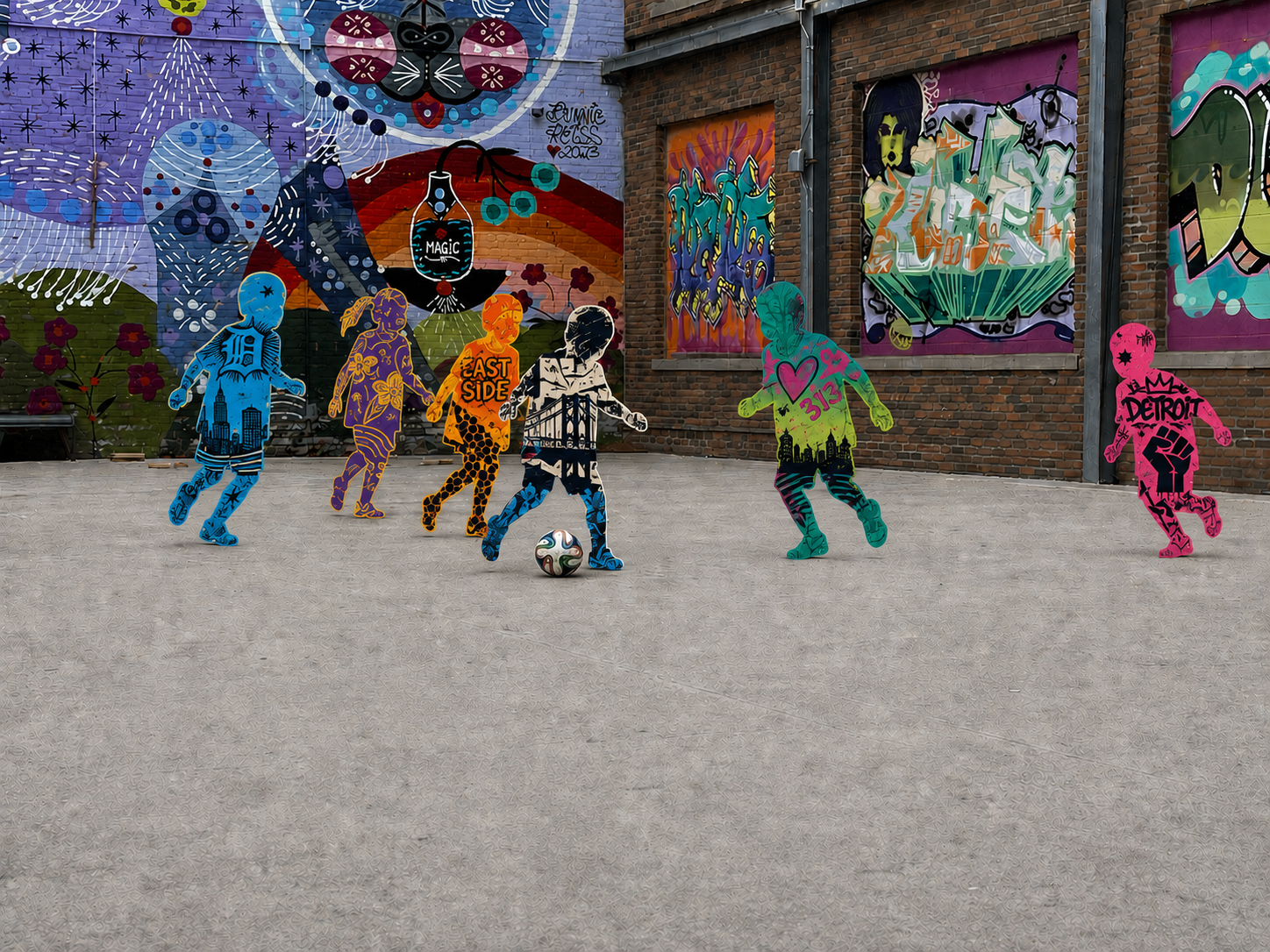
Detroit has given our kids something that seems like it's on its way to becoming extinct: a childhood. Our culture puts adult pressure on kids way too fast. But this City has given us a shot at giving our kids beautiful family memories. They'll remember walking to Good Cakes and Bakes together and playing soccer in art parks filled with graffiti, or under the Ambassador Bridge. They'll remember going to a school in our own neighborhood where they're accepted even as an unlikely racial minority. They'll remember playing tennis and seeing the police horses at Palmer Park, and having a charcuterie picnic on the Riverwalk every summer. This is Detroit's magic.
Finally, Detroit gave me a spiritual home. I was wandering for a long time. Gesu welcomed me as a non-Christian for years. I didn't take communion, but people cared about me anyway. Our children were baptized there, and people look after and pray for us. Eventually, I was baptized there too. People embraced what I carried with me from growing up Hindu, and told me how Christian communities have coexisted with Hinduism in India for centuries. This is a place where I can pray as a man whose Hindu roots and Catholicism coexist. Gesu is where I have peace, can weep, and have fellowship over coffee and donuts. I spent over 35 years trying to find this. Detroit just gave it to me.
I can't claim to have been born and raised here. For Detroiters, that distinction matters. But the City took me, a lonely lost twenty-something, in anyway.
So many people here gave me the care and guidance to build the simple life I dreamed of. Detroit adopted me before I even knew I needed looking after.
Detroit is a city defined by its people and its neighborhoods, more than its buildings or its statistics. It's a hard-working place that finds a way to make it, and to make beauty out of nothing but grit and a prayer. I am grateful that y'all took me in 15 years ago, and let me become part of this community.
Thank you for giving me more than I could have hoped for. I am proud to be an adopted Detroiter, and become part of this place. Thank you for being my neighbors and letting me be yours.
Detroiter Kindness
Kindness, as it’s practiced in Detroit, is different.
Detroit has taken me in like no place I have ever lived.
Photo Credit: Unsplash @gerogia_vis
Having left Buffalo at age 5, I don’t remember much other than glimpses of my Kindergarten classroom, the nearby Tops grocery store, and the red-haired girl named Dina who lived next door - who was both my first friend and someone I will likely never hear of again.
Rochester was where I lived for most of my childhood, a well-to-do northern suburb of Detroit. It was a good place to grow up, but there were enough glares that I received in public - which I realize now were from a place of discomfort and skepticism, probably about race - to never allow that place to feel like one I could be from.
Ann Arbor was nice - lively, intellectual, and inclusive. People there were kind, even though I was a shrimpy college kid, and therefore loud and usually irritating to the locals.
Living there, something funny happened. The same, race-based, alienation I felt in Rochester made me feel exotic in Ann Arbor. It was as if the town was so oriented toward inclusion, people so willing to be kind, that my race felt extra salient.
That attitude of inclusivity that seemed to permeate the town was so generous, and I am grateful to have lived in place that was so midwestern, in the purest sense. But alas, Ann Arbor couldn’t feel like home for the same reason Disney World cannot: Ann Arbor is among the happiest of places, but it’s too magical - just beyond what feels real - to feel like I could actually be from there.
I never expected Detroit to be the place, the first place, to feel like home. And yet, here we are.
One of my favorite things to do while running is to wave. I wave at everyone I see. When I used to live nearer to the City center, I would go jogging, often ending up downtown. And no matter who it was I waved at - whether old, young, rich, poor, without a fixed address, or a young professional walking a dog - almost everyone waved back at me. This place, Detroit, I thought, was different.
When started working as in intern in City government, later joining the Police Department I was in the most diverse workforce I’d ever been part of, and not just on the basis of race. But also by age, professional experience, creed, sexual orientation, educational background, family origin, and likelihood to use profanity.
And yet, no matter whether I was talking to a career public servant, a political operative, a cop, a returned citizen, a pastor, a basketball coach, or an activist - people were cool with me. Citizens I met because of my job were cool with me. Everyone was cool with me. It wasn’t that people treated me in any special way - they were just cool with it.
It was precisely that I wasn’t special, that made the interactions I had feel so uncommon. For the first time in my life, I was just a guy doing a job. I was treated, just like a regular guy. If I was a decent guy, they were decent back. If I was respectful, I got it back. I was given the chance to just…be a guy doing a job. Detroit, I thought, is different.
When we moved into our neighborhood, I realized this Detroiter kindness wasn’t a coincidence or an unusual deference paid to me because I was a political appointee.
When Robyn and I walked down the street, first with our pup, and later with our sons, people would smile and wave back. Our neighbors, irrespective of our obvious demographic differences, actually wanted to know us. We would talk on the street, and everywhere we went, we got to be Neil and Robyn, that young couple up the street with the black dog and those three sons who were always rolling around on a stroller, tricycle, or scooter. This could be the last place I ever live, and that’d be nice, I thought. Seeing myself in this one place, for the rest of my days was different.
And then there was Church today, which reminded me of all this Detroit kindness and brought these memories about place back to the forefront of my mind in a surge.
Gesu is a Catholic Church of the Jesuit tradition. It’s a place where every week, during church announcements, any one who is a guest is invited to stand and be recognized. And the applause that follows is unfailingly sincere. I know many churches do this, but it just feels so sincere and never something that is just going through the motions.
In the pews there, I can be there and listen and pray. I don’t feel the searing eyes of the congregation, questioning why I’m there, when I don’t come forward to take communion. At that point in the service, when it’s time to give a sign of peace to others, people give me a sign of peace, warmly. It feels different.
There is an usher at the 8:00am Mass who is always at the door near where we usually sit. He is dressed well, usually with a brown overcoat, brown turtleneck, and a thin gold chain. He is older, but what I notice more is that he’s always smiling. At the end of mass today, he came over to say, “you have a beautiful family, such nice kids.”
“Thank you, we are blessed,” I said. And after a pause I added, with the slightest trepidation, “I’m Neil.”
“I’m Fitz. They call me Fitz. And this is my friend Walter.”
This type of interaction, genuinely kind and without any frills, pomp, or reservation, has only ever happened to me at Churches in Detroit. Detroit is different.
If you’ve never been here, I must admit that I don’t know quite how to describe Detroiter kindness. It’s genuine, but not from a place of bubbly energy or naïveté. It’s warm, but never given with waste or haste. It’s a no frills, meet-energy-with-energy, this is just how we do it, sort of kindness. It’s a kindness that seems like it can only be given by a person that’s lived in a City who has seen some things. It is a kindness that is not flashy and lavish, but is also not meek, and because of that it feels more sincere and is somewhat disarming. It’s a kindness that can only be earned, I think, not inherited.
Detroiter kindness is different.
I am so grateful for this place, and for it’s kindness. For many years I felt like a nomad in my own country, my identity caught between geography, ancestry, demeanor, and race. When someone asked me where I was from, I didn’t have an answer I actually felt comfortable saying or actually believed.
But now, I can say, “I’m from Detroit.” And it’s actually true. I actually feel it, and feel it in my bones. What a gift it has been for Detroit to have taken me in. What a blessing it is to finally be home.