
Teachings from Buddhist Monks in Thailand
One of the most interesting things we did in Thailand was to attend a monk chat. During this chat we learned about what it is like to be a monk and about some of the fundamental tenants of Buddhism. That's a topic that I'll have to explore more, but one of the things I've been really riveting and reflecting on is some of the transformations I've undergone since I've graduated college - and lost some of my youthfulness.
Patriots will weep
As a young boy, I was filled with hope for American republican democracy. I traveled to foreign countries and saw the gentleness of our people compared with the weight of king-like corruption and the contrast between citizens who littered shamelessly and those who swept the streets their friends and family walked on. Even the air smelled different.
Choices
I just can't do it.
I'm so torn between adhering to the values and princples that I was taught about how a gentleman treats a woman and what it sort of takes to "make progress" so to speak. If you're aggressive you win. If you do what you think is right, i.e. show respect, you end up sleeping on the couch. It's effing terrible.
I don't want to live in a world where one has to out-aggress others to win. I don't want to be the type of person which uses tactics and strategies to get someone to like you. I want to live in a world where people are honest, genuine and can be themselves in social situations and be accepted for it.
I'm out of air in my lungs for game. I'm so disillusioned by meeting opportunistic people in public. I can't be like this forever - what does it say for our species' future if we live out a scenario where the more you take, the more you get. Why doesn't sacrifice happen?
And as pissed as I am for not being taller, for being "old school", for being disgusted with the twenty-something "scene". I just want to understand why. Why is selfishness a pre-requisite for getting what you want?
It takes someone special to change the rules of the game or play by the spirit of the rules and "win" whatever the game is, I think.
The evolution of human interaction
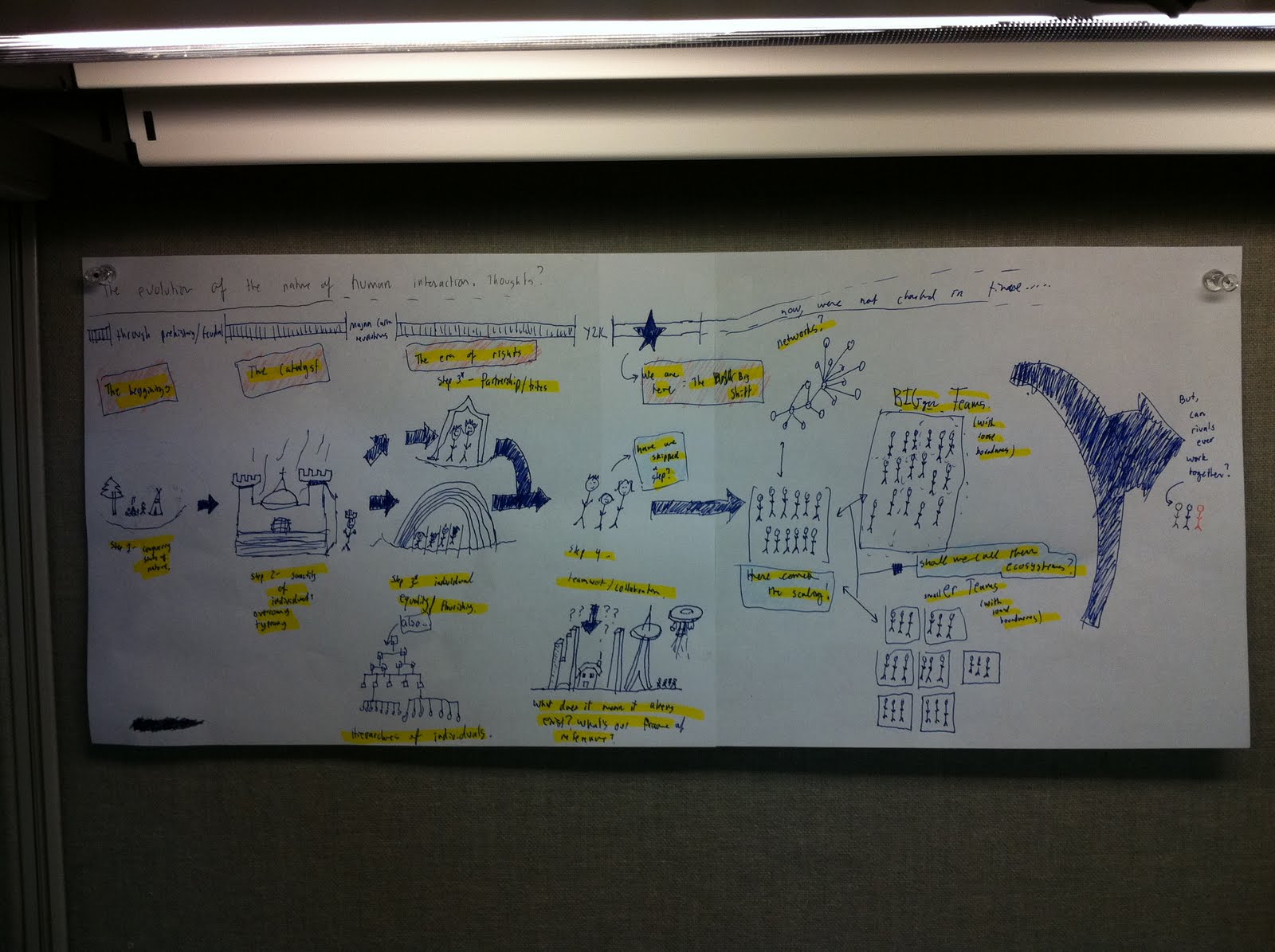
Pretentious title aside, I was working on some cool brainstorming the other day. Basically, I'm on this quest to understand what it takes to form effective teams. And by that I mean real teams not collections of individuals in a group setting.
Here are the steps:
There's going to be a Big Shift in how we interact, it's already started, really. We have to form teams to figure out the difficult problems we are faced with. We're fooling ourselves if we think we can do it without teams of everyone pulling together. We can't.
But, it's also not good enough if the team-mentality doesn't captivate our species. We have too many problems to play in small arenas. We have to scale our teams. But how will we do it?
Will we create networks? Will we create really, really big teams? Will we create an army of small teams and get the individual teams to form teams? I haven't quite gotten to a good level of analysis yet. But, I'm thinking about it.
We have to crack the code on teams. We have to figure it out. Otherwise, I fear our most pressing problems will become irreversibly complex and damning. That would be awful.
Hubris / Speedometers
One of the most difficult decisions I make on a daily basis is a simple one.
Because of all this, I've been paying closer attention to my speedometer lately. And I'm still speeding, albeit less. I hope I can control it. If I can't, it might mean hubris will consume me one day. I don't want that. I don't want that at all.
First born.
You will be my greatest project,
Our lives' seminal work.
From tears into uncertainty, continuing to apprehension and exploration. Next courage, honesty then humility until you have a project of your own.
The toybox is empty. No bottles are at the ready. But a lifetime of protection, love and wonderment are already in plentiful supply.
All potential energy, though.
When your birthday comes, you'll be ready, and so will I.
I think I'm ready to be a man, now. I don't know if others men have these coalescing moments where they realize that they have to grow up, or that they want to. I don't even know what these moments have been or what they can be.
Memories
The way a memory feels is miraculous. All it takes is remembering something which reminds you of what makes you whole. Family, places or experiences before...triggered by something big (like...an anniversary, or an elephant) or something small (like a smell, a letter or a song) is sufficient.
It is freeing; the epitome of hope, one might say.
Apollo
Naming our dog was a very deliberate exercise. It was very much a product of my parents and me and my upbringing. We generated a list of 30 or 40 names and we methodically narrowed the list down over the course of a few rounds. Finally, we decided to choose one of two names, Rocket or Apollo.
If you know my family, you know we decided on Apollo – named after NASA’s Apollo program, which was named after the Greek sun god. Probably because my father liked it more than Rocket.
There are many days from my youth I don’t remember, but I certainly remember the day I met Apollo. He was only a few weeks old at the time and was just too big to fit into my open palms. He was supposed to be a “trial” dog that we were “babysitting” for a short time. But we kept him, much to my father’s chagrin (at the time, now he loves Apollo dearly).
I was laying, partially upright, on our family room floor with outstretched legs. He climbed up on my belly and put his head on my chest. In that moment, we became friends instantly. It’s my fondest memory of Apollo and it probably will be for the rest of my life.
In some ways, I suppose Apollo owes my family a lot. We did house him, feed him, take him to the bathroom and other typical doggy-dog things. In addition to that, my pup eats better than most dogs I know and is given a spot to sleep under the covers, in my parents’ bed, every night. All in all, he lives a pretty good life.
Truth be told, though, I owe Apollo much more. He was a rock which kept my family intact, in some ways. He kept my mother company while I was away at school and when my father was away working. He took my dad on walks and gave him things to do when he was unemployed and noticeably frustrated. By letting my parents care for him, Apollo was really giving my parents unconditional love and was providing happiness in their lives when I couldn’t take care of them. For that I am eternally grateful.
Apollo also raised me in some ways. I used to become really frustrated when I would have to take him to the bathroom, stealing precious minutes from doing my homework, hanging out, or watching TV. How rude of him!
I realized later that I was so very wrong. Apollo depended on me for his well being and I was really the one being selfish. I had to put his needs above mine. I had to be less selfish. This humbled me and taught me a dangerously important lesson: a successful life is not “making it” or being powerful, but rather a life in which you fulfill your duty and serve others. It’s not about lifting yourself up, but about lifting others up. Apollo is the unlikeliest of mentors.
At the same time, he taught me to stick up for myself…if he hadn’t, I’d still be waiting on Apollo hand and foot, err…paw and paw, and letting him walk all over me. I’ve had this thought hundreds of times, “No Apollo. We are not going outside, because you don’t have to go to the bathroom, you just want to play. Stop being a baby.”
We share little in common, except for our family, and an affinity for laying in the grass on sunny, breezy days. I suppose for Apollo and me, though, that’s all we really need. The bond between a man and his dog really is a special one.
Why worry?
There are some days, more than others, that I think about how unlikely it is for anyone to live very long, or even to live at all. Everyday we wake up in the morning, it's like a miracle all over again. So few things in the universe ever live. An even smaller subset on Earth. A microscopic subset of that are humans. Of humans, our clock is ticking from the time we're born...every second we have is borrowed.
All that makes me think at how nonsensical it is to worry about things like work, or the little instances where people annoy you. It even doesn't make sense sometimes to worry about politics or money or whatever. It's all so petty.
Then there's stuff like family or poverty - and other really compelling, human issues - and it starts to make sense why people worry about those things...they're life and death sorts of things. But even then, we are not entitled to living, it's all a gift anyway. So why worry?
And those other things (career, money, self-indulgence) can and will happen to if you place priority on things that are virtuous, but they're not the endgame, they're incidental and on top of that, they're ephemeral.
I don't know where this is coming from. I feel like the yogi in me has finally been set free. It's weird.
Above Average
I had a good conversation with the roomzies at dinner on Saturday night. (We were at Grange's upstairs bar...that itself is something to note).
Above Average
I had a good conversation with the roomzies at dinner on Saturday night. (We were at Grange's upstairs bar...that itself is something to note).
Anyway, we were talking about whether we've met a lot of extraordinary people at Michigan, or just a few. W and I think we haven't. J didn't exactly say she has, but she certainly had a differing opinion.
I've never really appreciate just being "above average" before Saturday night, now I really do.
I can't do anything but admit that I'm only an above average person, at best. There really are some extraordinary people in the world that do extraordinary things. I'm probably not one of them. If I do something extraordinary, it will be because I'm in the right place at the right time and I've put in enough to hang with the big dogs.
I'm certainly not fishing for compliments, simply acknowledging the way of the world. But who knows what the future holds. Teams may be the next big thing. All I know, is that it's okay to only be "above average", not everyone can be superstars and not everyone should be. We should probably "stay hungry" and assume that we're only above average. But above average in a world like ours, ain't bad.
No stamina to edit, falling asleep.
Timeless Friends
Some friends are truer than others. They come into your lives and they stick around, while others are the ones who are great to have around for awhile but fade because of circumstance.
The friends that are permanently affixed to you are special. They are friends with you and you are friends with them. They are not friends with your intellect or your kindness or your success. And you are not friends with them because of their car, ability to listen or good-looking sister. They speak and listen and are honest. They may not be a part of your daily life, but they are part of your life, period.
Friends like that are special. They are timeless. Not everyone is a timeless friend, but those that are never go out of style.
Leadership and Solitude: A response
I can't disagree with Eden that the author does put up strawmen and mow them down because it's popular to undermine bureaucracy and social media. And I don't disagree with those who find it to be a refreshing call to reflection which is hardly ever voiced with a full-throated bellow. I will however, explore a bit the most insightful part of the talk to me: the dissection of leadership and achievement.
Let's look for a moment at the progression of leadership in organizations and the incentives surrounding leadership.
By and large, leaders are brought up through organizations. Let's create a basic hypothetical situation. Imagine Pete. Pete joins the sales organization of Standard Widgets Corp. (SW). He does well and gets promoted. He increases his capability to sell and recieves a larger sales territory. Eventually, he manages other sales people. Along the way, he hones his "leadership" skills on-the-job and through some sort of corporate program. This is a pretty standard model for advancement - you do well and you move up. But, does this really mean Pete is good at leading? Not necessarily. Of course, it's very likely, even probable that Pete is a good leader. But that's precisely the point, Pete doesn't rise through the organization because of his ability to lead. He rises because he's a high achiever.
Incentive structures match this notion of high achievement = skill -> leadership = excellence. The pay difference between "leadership" or "executive" positions compared to senior technical people is large and in some cases exorbitant. The top of the pyramid is a CEO position or other leadership/management type position. We hold "leaders" in esteem, publicly.
This is all fine, I guess I just take issue with the process. With the exception of end-to-end leadership development programs which start from early career levels we're using achievement as a proxy for leadership selection. Which is fine, it just seems like a whiff because we ought to be selecting leaders based on their potential, desire or aptitude for leadership. Or, if leadership is a universally needed quality, we should be making leadership at the core of an organization's DNA and not separating people based on their leadership potential.
In any case, I'm circling the point. This is what I want to suggest. In the US (perhaps elsewhere, I haven't really thought about international implications) we use achievement as a pre-requisite and sometimes as a proxy for leadership. This is incorrect and dangerous.
First the obvious, it's incorrect. I suppose it's not supremely obvious but I don't really want to spend time defending this assumption. I'll leave it at this, posing it as a question. How can leadership and achievement be synonymous unless achievement in leadership is what one is looking at? Why would achievement in something like sales or research (basically anything other than leadership) translate to leadership success?
[As I've attempted to show above, we select leaders from the pool of high achievers, not directly from the pool of capable leaders...achievement is a proxy it seems].
It's dangerous, in my opinion, because there are two axioms which doesn't necessarily vibe with eachother:
1. Leadership is for doing the right thing (i.e. we value leaders because they are necessary to guide groups to do the right thing)
2. Incentives for achievement don't always align with incentives for doing the right thing.
Therefore - incentives for achievement don't always align with leadership.
Simple, yes. But, can you imagine if leaders don't understand the distinction between leadership and achievement. We're risking that ethics, morality and principle be superceded by achievement. Achievement need not be benign (e.g. credit default swaps and increased profits at the cost of emissions. The social sector isn't immune...it's not impossible for not-for-profits to go after grant money even though it doesn't make the most impact in the community, etc.).
In any case, I have to run to hang out with friends (woot, slows bbq!). But the two sentence summary is:
The distinction between leadership and achievement is an important one because if we, and leaders, don't understand the difference we're setting ourselves us to risk sacrificing doing the right thing for doing what's "highest achieving". This isn't always a bad thing but when doing the right thing contradicts with achievement and we don't do the right thing, we have messy, costly situations.
ME first vs. me FIRST
Even though I have a notable distaste for elections, I watch election night coverage enthusiastically. What of it? It's fun.
What I find troublesome is that Mr. Boehener, Ms. Pelosi, Mr. Obama, Mr. Reid, etc. all let the American people get away with believe that they're the bosses. [I deliberately exclude Mr. Bush from this list because I think he actually acted very much on principle, which I deeply respect, even though I still disagreed with him a lot of the time]. And, of course, the American people are in fact, "the bosses", but that doesn't mean that they're right.
The problem is, as I see it, is that Americans have a "me first" mentality, in the bad sense of the word. In fact, I'd say in the phrase "me first" Americans emphasize the ME first.
What do I mean by this? That we (collectively) are selfish - individually too. We burn the candle at both ends, in a way. We want government to do all this stuff and cry wolf when it doesn't do what we expect it to do. We don't want to pay for it, either. We don't vote in high amounts (again, collectively) and still expect legislators to be responsive. We want to shop without saving (at least we did in the past 5 years, not sure about now) and keep oil prices down. We WANT all this stuff without giving. It's an arrogance to think that we as individuals and our nation can get away with being selfish and narcissistic because we're American. That's what I mean by ME first.
Anyway, in whatever way I can, I'm going to remind people that YOU come first and I go FIRST. I think we all could live by that mentality a bit more...before we tear ourselves apart. It's a long road ahead, we've gotta make sacrifice.
And, why do I write about this stuff so much? Because I see my youthfulness and ability to take risks challenged by the institutions which I operate in. I see the "ME first" mentality creeping into my life. I want to fight it back at every opportunity I can. Not because I want to inflate my ego by being positioning myself as some civic martyr or charitable kingmaker, but because I know it's the only way out of our problems. Something's gotta give, if we don't give of ourselves the balance in the universe will do it for us.
I wrote this in a cab, haha.
Let's go Rick Snyder, I'm your corner sir. Help us make sacrifices so that our state can be more vibrant.
Michigan Men, Morality, and Mentorship
I've been sitting on this post for awhile.
I think being a Michigan Man means a lot of things, as you could probably guess.
1 Corinthians 13:11
So, it's kind of unexpected...I draw on the Bible for small snippets of wisdom sometimes. Nearly all of the passages that I think of often come from fraternity lore. I'm reminded of 1 Corinthians 13:11 today. It reads (King James Version):
Having it all
I had a provocative conversation with a family-friend today. She's a medical resident in Flint right now and was telling me about what being a new resident is like and the sorts of challenges she's been facing. They are hard. Really hard.
Over the course of our conversation, she got to something I have been thinking about a lot lately: can we have it all. Can we live a life with a fulfiling career and a strong commitment to family. Can we do good in the world and still make enough money to live a secure, comfortably, plentiful and fun life? Can we make a difference in the world without compromising our integrity?
I've realized over the past year that this isn't an easy task, at all. The complexities of human interaction, especially when security of self and well-being is not guaranteed, are enough to topple empires if not handled well. Other people aside, too, it takes so much energy on the individuals' behalf. The prospects of being able to conquer the dualities I mentioned are slim. Having it all is ambitious, if not foolish. It might even be an indicator of insanity.
But as we chatted, I started to reject this. If we do, that is, if we have agency, there is no doubt that we can have it all. We can have what really matters. But it takes an incessant willingness to work, I think, and work smartly. It takes tenacity, a warm touch and self-awareness. Sometimes I don't know if I'll be able to manage it. But then I think, one must just think that they can. That they can claw their way to the great light. You've gotta. No matter how bad things seem.
If you want it all, there's no out that's required...there's not "option". It's a "you're in or you're out kind of deal.
Time to saddle up.
-PS, not sure how coherent this is...hopefully so.
"Real" life
On my way home from work today, I read this article in GQ, titled Boom. It was one of the more moving things I had read in awhile. I swear, the article wasn't shmaltzy, though it had pretty "heart-tuggy" passages. It was just raw, real and honest...and that's what was moving about it.
This passage in particular (the last bit of the piece):
"Shane always told me, 'If anything ever happens to me out there, you better fight till you're blue in the face,'" she says. Because if something ever happened to Shane, that meant something went wrong—something that shouldn't have gone wrong and shouldn't go wrong again—and usually it takes a judge and a jury to get that point across with any authority. "I want to be able to sit down with Blaine twenty years from now and tell him something really bad happened one night," she says, "but here are all the good things that came out of it. Here are the safety rules that changed, here are the regulations that changed."
But what does she tell him now? What does she tell a 3-year-old boy who'd just figured out that Daddy was gone when his truck was gone and Daddy was home when his truck was home, but now Daddy's truck is home and Daddy's not? What does she tell him when Blaine is playing with a toy John Deere and slips and bumps his arm and he's not really hurt but he's crying and he wants his Daddy? What does she tell him then?
She tells him the only thing she can think of. "Just raise your arm up toward the sky," she says, "and let Daddy kiss it."
And because Blaine is only 3, he believes her. So he raises his arm and says, "Thank you, Daddy," and sniffes away the last of his tears.
And, I was just sitting in my seat and I was just moved. Slightly teary, but most just jolted...like the way you perk up in your office chair just as your body loses its grogginess for the day.
And walking out of the terminal, I just wondered why. And this is what I thought.
It was just so real. It was honest. It wasn't manufactured, it was just a moment that really caught its own essence. It was like reality TV, except not on TV and actually reality.
And then I realized how sometimes we just want moments to be special, because we want them to mean something. Or mean something more...something that trancends the very moment that we're experiencing. There are times that we're deliberate about moments, we either make them happen or really focus on the fact that they happened.
But that moment, described in that article, was different. It was precisely real. Precisely real. Not just, "in the moment". It was REAL life.
As much as I like powerful, meaningful moments, it doesn't have to be like that. There's something about moments just as they are, that can be wonderful. They can be amusing, charming, emotional, funny or uncomfortable...just as they're supposed to be. And that they deliver exactly that breed of emotion - the real moment they're supposed to - makes them amazing in retrospect.
Those moments, though, are elusive...because it takes everything about the moment to be real, from the people to the context. It's like being silent with someone you love, in an elevator. The time that passes - all of 15 seconds - is almost naked and so binding...because those 15 seconds are exactly what they are supposed to be.
That begets the question, in my mind, what does it take to be real?