
Trying to get specific on civic engagement and communication
-NT
---
Reframing Bradford Frost's, 'The State of Our City Is Fragile'
And now, to something more critical (sorry, I always feel a little bit guilty about laying it on thickly).
You'll notice, perhaps, that Frost's post is framed (notice the use of the word "you") to speak directly to city leaders. It's a call to action of the political and cultural players in the city asking them to do something, and live up to their responsibilities as civic leaders. This is reasonable, but I think it's the wrong frame.
What I think is more appropriate, accurate, effective, and important is to point the finger squarely back at ourselves. Solving these problems is not the express responsibility of the city and it's leaders (Moreover, I think trying to "fix the problem" is the wrong way of thinking about our situation...it's about shaping, not fixing, but more to come on that later). We are the city and we are it's leaders. To punt on our responsibilities as citizens, and downplay our own agency as members of this community is a miss. I think it'll lead to worse outcomes, and it's an inaccurate (and destructive) narrative to communicate to people who are yearning to be part of solutions to community problems. I also think we need to affirm the fact that we have agency instead of throwing our hands up, mailing in our agency, and expecting "the city" to solve all our problems.
It's actually quite the opposite in Detroit. Because our institutions are weak and distributed, citizens have an uncommon amount of latitude (and I'd say responsibility to create something remarkable and impactful. For a city our size, the amount of opportunity for entrepreneurship and intrapraneurship we have is unprecedented. We have a lot of influence as citizens in Detroit. We need to believe it, and embrace the civic responsibility that comes with it, not rebuke our "leaders" and sit on our hands.
Absolutely, city leaders have an important, and powerful role to play in reinventing Detroit - but it won't happen because of that small group of people alone. It will happen because of all of us, city leaders included - we all have a role to play. We need more people shouting this from the tops of every skyscraper in the city, exclaiming that we all have agency to improve this city and that we need to participate to make it happen.
We and the city are one in the same, the city is not our leaders alone. Yes, leadership matters (at least for now) but we all have something to bring to the table and we all have to bring that to the table to make this city work, in my opinion.
That's the most important role of leaders, creating narratives and opportunities which unlock the potential and agency of Detroit's citizens to live out what they bring to the table - large or small.
I agree with Frost's impassioned plea:
As unsexy as it is, the tone and substance of the work ahead must show our grit and determination to achieve these three aims. We must channel all of our energy on these tasks to meaningfully reset Detroit's lurching and fitful progress so it may meaningfully emerge into a city built for growth, prosperity and an inclusive future.
I just think relegating this work to the realm of "city leaders" is impractical, inaccurate, and dangerous. Let's do this. To borrow from the University of Michigan Men's Basketball Team: "We [all] on."
---
*That being said, it's one thing to identify the issues as fundamentals, building community, and standing up to solve challenges. It's another thing to have ideas on how to actually do those things. If I was probing Frost in person, that's what I would lead with. That'd actually be a good future post...talking about how to actually do that stuff.
The words that matter
Here's a summary of what people said:
Them
Us
Love (x2)
You
Repudiate
Quintessence
Yes
No
Profound
Frat <-- This was a good joke, sort of indicates the power of humor, actually
Hello
Goodbye
Hate
Trust
Redemption
Rape
Fag
N-word
C*nt
It doesn't take outrageous vernacular to have power. In fact, many of the words on this list are surprisingly simple. They are words that create in-groups and out-groups. Words that elicit primary emotion and common understanding of the world we live in. They are words about the human condition, or reflections of the human condition (e.g., take "frat" for example...humor is part of our humanity).
There are also words that have jarring connotation and are by their nature incendiary. This is what SB pointed out when he posted his words on my wall. "I think the negative words tend to carry a lot more power than the positive ones," he said. I don't think these are truly the most powerful words (in an enduring sense, they certainly are at the point of use).
One of my former colleagues (really, he was my "bosses boss" haha), John Hagel, is making a presentation at this year's SxSW about moving from story to narrative. I happen to think we crave narrative because it helps us create our own meaning in our own lives. If we did a study of story communication versus narrative communication, I think we would find the language to be different. A story is much more needing of powerful, emotional, connotative words because you have to control the perspective of your audience.
On the other hand, I think narrative requires the sort of simple ideas and language that most folks listed above. These words help the shepherd of the narrative include other people, and give them the building blocks to create their own meaning in their own words.
Think about President Obama's first election campaign. His narrative device was simple, and conveyed an idea that others could build upon, create meaning with, and act upon - "Yes we can."
I don't think we need crazy powerful words to change the world, if we're after creating narratives that others can participate in. The most powerful words, I think, are the simplest ones that help ourselves and others get to the unfettered noble truth of the aspirational, virtuous idea we are trying to rally around.
That was kind of long, so here's the punch line. I think the most powerful words, truly powerful words, are the simplest ones that get to the essence of who we are as humans, because those words help everyone think clearly enough to create their own stories and beliefs. Not the words that project meaning onto others' beliefs.
I don't think we want the words of stories, I think we want more agency than to be the subject of a story that's told unto us. I think we want narratives, the language of their discourse, and the freedom they provide to make meaning in our own lives. Maybe humanity wasn't fully ready to embrace narrative (but maybe we were) before, but I think we certainly are ready now. And now, it's possible.
---
Thanks for the fodder for discussion, all.
The Time Problem - Part 2 (Observations)
A few weeks ago, I started a post investigating some data I pulled from the American Time Use Survey and some other sources. At the time, I just laid out the context. Before I lay out some observations, I'd like to qualify this post (even though it weakens the persuasiveness of this post) by offering that this is pretty back of the envelope data. Despite that, however, it's still interesting and does have some explanatory power.
Anyway, here are some observations. Here's the data. Apologies that my write up is pretty fast.
Observations
For this post, I set out to try to understand what the deal is with people's time and why it seems like everyone is short of it. Time, it seems, is a critical resource in making communities stronger and in my real-life observation...everyone seems over committed.
Unfortunately, I wasn't able to access data about time use that precedes 2003. This is limiting, but I was able to find a study with an abstract suggesting that Americans' time use hasn't changed that much over the past several decades.
As far as volunteering time goes, it's increased modestly (about 11%) from 2003 to 2011. At the same time, volunteering seems counter-cyclical to the economy - when the economy is under stress, volunteering time seems to increase. Similarly, average volunteer hours per capita increased about 8% from 2003 to 2001 - from 51.1 hours per year to 55.1 hours per year. So overall, volunteer hours have increased a bit, but that figure could be tied to the country's economic health. Also, this data cuts across the entire population and there could be huge disparities between different demographic groups (e.g., employed vs. unemployed, old vs. young, etc.).
Before this next part, note that US GDP increased 35% from 2003-2011 and the US population increased 7% from 2003 to 2011.
While the US GDP grew 35%, reported revenue of all not-for-profits (as reported on form 990s) clearly outpaced US GDP growth and increased 62% from 2003 to 2011. I wonder if these revenues are driven by government grants or donations from private citizens, I couldn't find the data.
The number of not-for-profit organization also increased during that period - overall, there were 15% more not-for-profits in 2001 than 2003 and there was a 99% increase in the number of not-for-profits with revenues less than $100,000. Controlling for population, not-for-profit revenue per capita increased 51% and revenues per not-for-profit increased 41% from 2003 to 2011.
Here's one more stat. The total number of hours volunteered by Americans divided by the number of not-for-profits in the US has be surprisingly stagnant. It's only increased by 1% from 2003 to 2011.
Conclusions
I think it's pretty strange that revenues have exploded in the sector and so have organizations, but, Americans use of time hasn't really change that much. Moreover, it seems that if the sector doesn't have a reputation for impact (which obviously varies from organization to organization)...why aren't our volunteer hours per organization focusing more...why aren't we trying to improve the organizations we already have?
It almost seems like volunteering is supply-driven, rather than demand driven, which is to say it's dictated by the number for not-for-profits that exist, rather than by the amount that citizens want to volunteer. Which is wild. Wouldn't we want growth in the sector to be mirrored by organizations increasing their brand profile to the point where more people want to spend more time volunteering for the same number of organizations? Especially because the value of a volunteer per year (assuming an average of 50 hours volunteered per year and a $10/hr value of time) is about $500.
If you look at the average hours volunteer per not-for-profit divided the average volunteer hours per person, the amount of people volunteering with each not-for-profit is about 200. Combining this with the value of an individual volunteer (which is conservative because $10 isn't even close to the hourly rate of a skills-based volunteer) shows that volunteers are big boons to any organization.
Anyway, this data could be useful when determining some baselines for determining whether an organization is paying too much to manage a volunteer (given their value).
Overall, I don't know that this really gets at the time problem, save for saying that not-for-profits haven't really improved (at the macro level) in engaging volunteers. ROA for volunteers (which is the amount of hours divided by assets, which in this case I'd say is the number of not-for-profits) is stagnant. It's declining if you look at assets as NFP revenues. Improving this volunteer ROA could yield huge benefits for not-for-profit organizations, that could actually be measured financially.
---
What do y'all think? Why have revenues exploded whereas volunteer hours haven't? Are volunteer hours even important?
That's actually a very relevant question - does it matter if volunteer hours aren't growing as fast as revenue? My intuition says that buying social sector activity is probably a bad thing (because the social capital created by connections and engagement probably has immeasurable benefits).
Any other datasets which would be good to mash up?
Where bureaucracies have led us / Introducing #Stoos
http://www.stoosnetwork.org/
https://twitter.com/stoosconnect
Anyway, back to the post.
---
A lot of the time, I get really upset when I think about the world the Baby Boomers are leaving us. Here's some of the laundry list of messed up things manifesting in the institutional world right now:
- Crumbling infrastructure
- Sovereign Debt
- Unbridled financial system
- Vulnerable Social Security
- Exorbitant Healthcare Spending
- Unprecedented partisanship and inability to pass pragmatic policies
- Growing income and social inequality
- Climate change
- US K-12 Education is the nation's most under performing asset
The Time Problem - Part 1 (Data)
Here's the context:
I've been really fascinated by "The Time Problem" (my words, nothing official) in civic engagement. It seems like time is a limiting factor for a lot of people when it comes to citizens participating in their communities. So, I wanted to investigate this to see how we use time and how we use time is changing.
Thankfully, the American Time Use Study has some of this data. I also wanted to run some calculations to try to account for the effects of changes in the number of non-profits, population, GDP, etc., so I built a few other datasets into my spreadsheet.
Anyway, I figured I'd share the dataset before writing a post with observations. You can find it here: http://bit.ly/Wu7KZO. It's currently editable so please note your changes if you make any. Also, apologies in advance, I didn't name my calculations / variables terribly clearly but if you follow the formulas you should be able to figure out what's going on.
Full disclosure: there datasets are definitely imperfect (GDP is not Real GDP, the NFP count data isn't pulled from the same months each year, it's not a large dataset etc.). That being said, I only wanted to look at trends and am doing the best I can with the dog food I have. I think it will be interesting, regardless...I'm already starting to see some interesting stuff in the data.
In the next post - hopefully later this week - I'll talk more about my hypothesis, the data, and some observations.
Probably should have done some work this evening instead of be a huge nerd. Woops.
Essays #2
Everything that happens after
This is a yelp for governance.
Without going on a tirade on why I'm incredibly disillusioned by elections and the electoral process, let me tell you why I think governance matters more. Let me start by painting a picture.
There are people in our country who are suffering. They are hungry, broke, ill, or worse. There are people in the shadows of the shadows who are voiceless or who are voiceless in practice, because they're spending all their time trying to survive and physically cannot participate in the affairs of our republic.
There are also people who aren't suffering. I'm lucky enough to consider myself one of them. Our lives certainly aren't perfect (as those of you who read my other, more personally introspective blog can probably attest to) but we're doing well. We can eat food consistently. We have a roof over our heads, consistently. We can spend time, energy, and money toward leisure activities. We are in decent health or at least have access to health care.
Finally, there are people in our country who are on the cusp of suffering and not suffering. Some folks will fall backwards and suffer, and others will move toward health and prosperity.
Governance affects all these groups. For those suffering, governance provides needed relief to help them simply survive and also can provide a path upward. For those who are not suffering, governance has more than likely aided their station and opportunity in life. For those that are on the cusp, the difference between bad governance and good governance can mean the difference between good and awful life outcomes in the short and long term. For us all, governance affects our well being and happiness.
Elections, by contrast, don't actually tangibly help people. Elections don't feed the hungry and they don't defend our border from threats foreign and domestic. Elections certainly have the potential to nourish our hope and belief in America but they don't do anything in the real world. They are a fleeting sort of moment, they don't keep the lights on.
We can't tap out after the elections because elections don't help people. They are are event which sets the stage to help people.
Let me cut to the chase. The election was important, but now it's over and it's time to refocus on good governance. What really matters and makes a material difference in people's lives are not elections, but everything that happens after.
Community Narrative - The Deep Infrastructure of Civic Engagement
---
New idea to explore, thoughts? | Community Narrative - The deep infrastructure of civic engagement http://theciviccommons.com/conversations/community-narrative-the-deep-infrastructure-of-civic-engagement via @civiccommons
A (mini) Detroit Manifesto
Detroit: Transformation or Revitalization?
More often than not, we talk about "revitalizing" Detroit. To me, this means refreshing and returning Detroit to the state it once was. It's re-energizing what's already there. It's not changing what's there, per se, it's just "bringing back" Detroit.
I think there's something off about this frame.
As far as I'm concerned, Detroit - and other cities across the country and world - have outdated institutional frameworks. The way organizations and governments run is built for an older world. To put it bluntly, the institutions in Detroit are built for a time without digital infrastructure and ubiquitous internet connectivity. Instead of being built for a world that's constantly changing, current institutions are built for a world that changes slowly.
Rather than claiming that it's a story of revitalization, I think we should characterize Detroit as a story of transformation. Why? Because we need a transformation, not a revitalization. The workings of institutions in Detroit, and again, other cities too, has to fundamentally change. Of course, I could be wrong about this...but I dare you to try convincing me. (I think about institutions all, day, every day and consequently have sharp, thought-out arguments and a fierce, cavalier, even bulldog-ish attitude about the subject).
Now, transformation doesn't have to mean wiping out the people, culture, and community sovereignty that exists in Detroit. I mean this in a technical sense (literally, transformation doesn't have to wipe out culture, there are other ways to go about it) and I also think it would be a tragedy if elites in the city used transformation as an excuse to wash over the character and spirit Detroit currently possesses.
Anyway, to make a long story short, I think Detroit needs to be a transformation rather than a revitalization and I think we should use language that reflects that.
Leading in the public and private sectors - challenges
I had a very interesting (and serendipitious) conversation with a colleague of a friend/colleague on the way to the train station today. After a few other topics, we got to talking about the importance of vision vs. execution in the public sector which got us talking about the importance of results-driven leadership in the public sector. Moreover, he was commenting on how sometimes what it takes is to keep your eye on the goal and even drop a few "screw you"s if you have to and just get something done.
Over the course of the conversation he triggered in my mind a fairly interesting model for what leaders/organizations have to go through with any decision they make. It's simple, but that's a good thing.
Step 1 - Visioning: here you have to decide what the organization is going to do and why
Step 2 - Scoping: here, you figure out who in the organization (or country) is going to do it and/or buy-into it
Step 3 - Executing: here, you have to decide how to get people to actually act on the vision
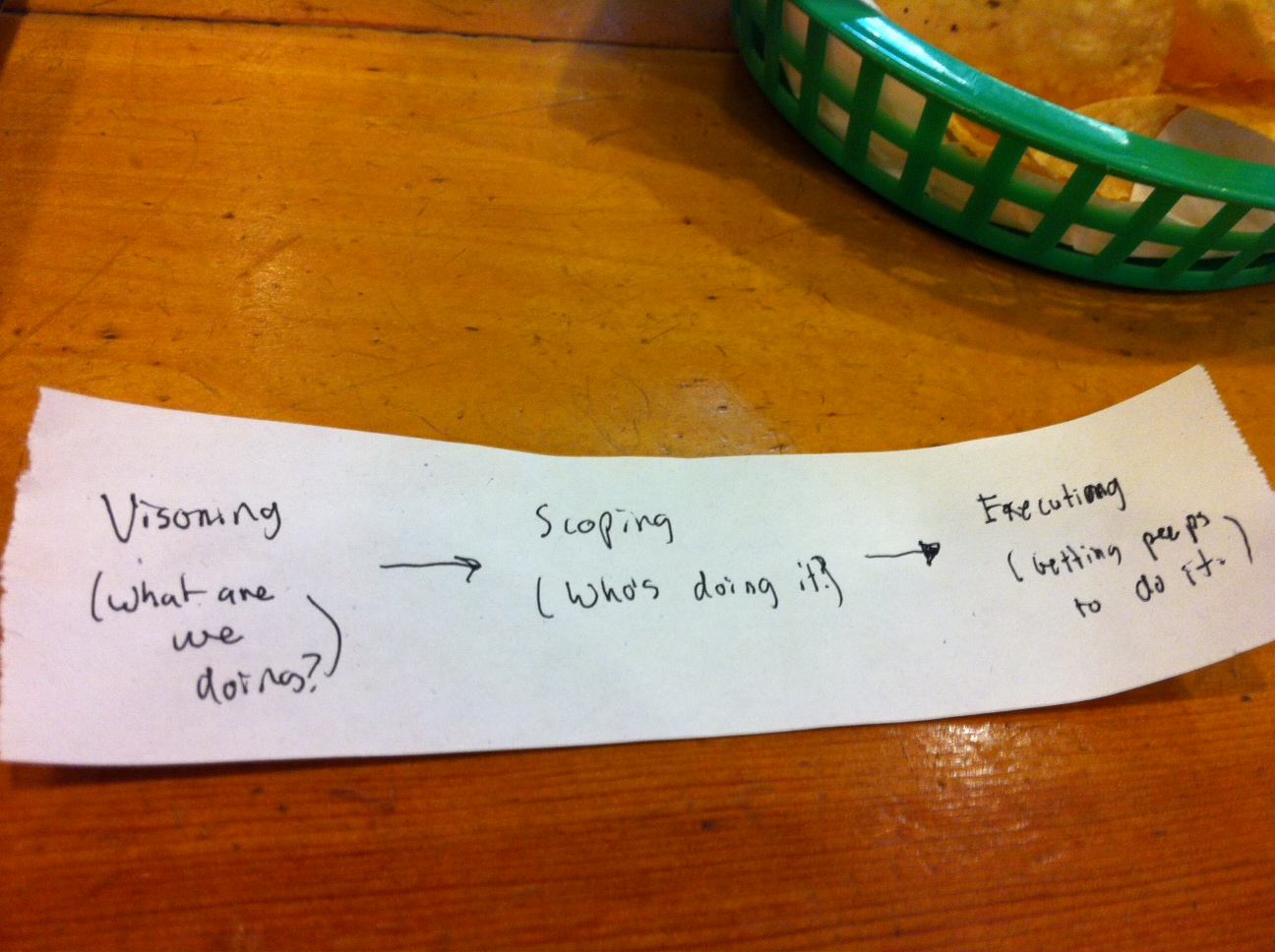
So, I think there are some interesting observations here and implications for business and public/social sector organizations -
Visioning - this is hard no matter what. In the public sector it's especially hard because the vision involves large, large numbers of unique people. In the private sector it's hard because your vision has to turn a profit. These are very different problems, but both are compelling.
Scoping - this becomes easier if you can limit the scope of people that are included in the issue because you can cut people out of the benefits or decision making process. It's kind of "Jobs-ian" view as my friend said...you can say "screw you" to people who just don't get things done and cut those people out of the rewards. Unfortunately, in the public sector/social sector it's hard to do this because the cost of excluding people from the activity / reward has real human costs and moral implications.
Executing - things "get done" voluntarily or involuntarily. In the public sector almost nothing is fully involuntarily. Even taxes are something you can avoid for awhile. In the private sector many organizations have the luxury of getting people to do things involuntarily, in the public sector a lot more inspiration and persuasion is required. The tough part for private sector is, the ability to force people to do things is corroding - eventually (and this is happening already) probably all employees (or at least a whole heap of them) will have leverage over their employers. As a result, "force" won't really work because those employees (e.g., members of the creative class) will just go elsewhere. (Credit where credit is due, John Hagel, John Seeley Brown, Lang Davison and others publish about...the original idea is not mine).
Now, what are the implications?
1. I think this framework helps to understand why leadership in the public/social sector is so hard: each step (visioning, scoping, and executing) involves a lot of people that the leader doesn't really have control over.
2. If it's getting harder and harder to "force" people to do things, the private sector will probably have to learn how to get people to do things without forcing them. That's hard.
3. I sometimes struggle to see the "visioning" of public sector organizations, namely government. It seems like that a lot of the time politicans focus on policy outcomes (a la execution phase) rather than the broader vision of what we're doing and why. Maybe that's why our outcomes often seem to go awry...they're not informed by the dynamics which occur at the system level, which is to say they're not informed by a comprehensive vision.
4. There are three real competencies here that leaders and organizations seem like they need to master, especially in a world where it's hard to force people to do stuff: crafting an insipring vision which people want to buy into, how to really connect with large and diverse groups of people to understand their needs, and figuring out how to get people to do stuff without being able to use force.
5. In addition to number four, you actually have to communicate this stuff, too, so that's a fourth competency.
Anyway, just some musings. Anyone have any thoughts? Am I whack? Is this helpful?
Purpose is permission
There are many reasons to define a purpose, such as:
- It provides focus - by clearly defining purpose organizations can focus their efforts on what really matters to them
- It is empowering - employees feel more engaged when they feel like they are working for a purpose
- It aids recruiting - by championing a specific purpose, employees (and probably customers too) can self-select more easily into your organization's ecosystem. Recruits show up to you and are more likely to stay if they are pre-disposed to support your purpose
- It builds brand - I'll defer to my marketing friends on this one...but if you have a clear purpose it probably helps you be distinctive in the marketplace?
Let me explain.
In organizations, lots of people don't ever bring all their skills and talents to their work...not because they don't want to, because they can't. They're subdued by their organization's culture or by fear of reprimand. Given the choice, people often opt for lesser-risk activities and behaviors. They believe they have to "follow protocol" to get something done. They have to please their bosses and don't want to "step on their colleagues toes". Because they've been taught to value perceptions in the workplace, employees don't give it their all - they can't because they're suppressed by organizational norms.
So, here's the cool thing about aspirational purpose, it gives employees orders from a higher authority, if you will, that supersedes oppressive organizational norms. By conveying a loftier, aspirational purpose, it provides political cover to employees who want to do something different to achieve that purpose (assuming they are sincere in their efforts). If someone questions employees' unorthodox behavior (which bucks the convention of the organization) those employees can point to the purpose of the organization as justification for their behavior. If the organization's leadership truly values the organization's aspirational purpose, achieving that purpose is tremendously important and they are probably more likely to let unorthodox behavior slide. In effect, to employees who are truly motivated by the organization's aspirational purpose that purpose is freeing - the higher purpose gives them implicit permission to break cultural norms to achieve it.
How an organization defines and truly embraces aspirational purpose is the topic of another post, I think. That's a huge question that has intense impacts on life in that organization.
Ambition vs. Actualization in the Social Sector
The post is a good one, you should read it. The takeaway is that there is a difference between ambition and actualization. Here's an excerpt:
Actualization or Ambition?Lianne writes that characteristics of ambition include:
- the need to impress
- status-seeking
- pursuit of acclaim
Ambition is rooted in insecurity. What we do from a place of ambition tends to feel heavy and stressful, and leads to very short-lived satisfaction.
By contrast, characteristics of actualization include:
- authenticity
- vitality
- playfulness
- meaning
I think this is especially important to be self-aware of if doing community work, because the stakes are high and the pain one can cause is real. In the social sector people who are "ambitious" translate into power seekers who seek to influence over serving others, in my opinion. This is problematic when the opportunity to influence or serve becomes a tradeoff. If you are ambitious you might do something that's not in the interests of those you're serving so you can gain influence. This sort of act is hurtful...some might even say it's exploitative.
For that reason, I think that it's our responsibility - if you're looking to influence, serve, or both - to determine whether your goals are ambitious or actualized. If they're solely ambitious, get out of the game. Don't put yourself in a position to be a community steward. It's not fair to be surreptitiously ambitious and pretend to be actualized - it insults people's trust and puts them in a position where they think they are protected from harm when they're really vulnerable to it.
It's hard, I admit, to be self-aware enough to determine if one's motivations are ambitious or actualized. But we have to try to figure it out so that we can minimize the hurt we cause to our neighbors who need the most help.
Service to others is about precisely that: others. I worry that people who have ambitious intentions care more about themselves and their influence than they do about others. That tragically flaws their judgement, regardless how talented they are, because when push comes to shove, they may choose aggrandizement over helping others.
I suppose this may be an impetuous cry, but I really do think it matters. Community stewards need to be able to make sacrifices for others, not the converse. Commitment to helping others must run deep and be able to persist through any circumstance or level of pressure.
So, my community-oriented friends, ask yourself why you do community work. Is it for you (ambitious) or the community (actualization)? Ask yourself this often.