
The Easiest Way to Become Popular
We all try to avoid unpopularity because it’s terrible. And so we have this big, consequential, choice: do we try to become popular by being aggressive or will be choose some other way?
To me, it’s not so much that being popular great, it’s that being unpopular is usually terrible. To articulate why, I look to the greatest explanatory model for social dynamics there is: high school.
I’ve been on both sides of popularity in my school days. When I was unpopular, I was constantly stressing about girls, being harassed, being lonely, or missing out on having fun. When I was popular, I flourished. I had a lot more fun and it was a lot easier to just be myself and have energy when I was liked and not constantly feeling under siege.
I get why people, myself included, will go to great lengths to avoid being unpopular. For me, it wasn’t that being popular was great, it was that being unpopular was much worse.
And the simplest way to avoid being unpopular is to become popular. So how to be popular? Again, it’s informative to think about high school.
One road to popularity is to be the best at something, to have a niche. It’s easy to be at least somewhat popular when you have a lane - whether it’s academics, athletics, arts, or an extra-curricular activity. If you’re the best in the school at something or have a varsity letter on your jacket you earn the respect of your peers.
Another way is to have rich parents. Which I don’t actually mean flippantly; it’s not about being able to buy “friends”. But rather, if you have access to money, you don’t have to say no to fun stuff. You can go to the movies whenever someone’s going. You can take your friends to concerts and sports games, or host fun gatherings at your house with ping pong tables, nice food, and maybe even a pool. Money doesn’t buy friends, but it creates opportunities to have fun and make friends.
In my experience, character and leadership also matter. In high school, if you’re genuinely nice and can transcend the pettiness of the cafeteria or the hallway, people want to be around you. If you can rally people around a shared purpose - whether it’s a charity drive or social change, people want to be around you. If you can stand up for injustices or do something innovative, people want to be around you.
But those three strategies - being a star, being rich, or being a leader - are actually pretty challenging. The easiest way to be popular is to be aggressive.
We have likely all seen this play out, it’s basic in-group out-group stuff. We can be popular by talking crap about people behind their back or bullying other kids. By excluding others, we can build strong cohesion with our peeps (which makes us popular), albeit cheaply and darkly. Also, if the rest of the school knows you roll deep and are willing to be mean, most would prefer to stay out of your way instead of challenge your dominance.
The easiest way to be popular is to be aggressive. Sadly, it works almost every time.
And yes, maybe in high school the stakes aren’t as high because everyone’s awkwardly going through puberty, and everyone leaves in four years anyway. Everything’s made up and most of the time, the points don’t matter.
But these dynamics don’t stop in high school. I’ve seen them play out in every organization and company I’ve ever been a part of. And after high school, it’s not just that people try to become more popular, they try to become more powerful. The stakes and consequences get bigger and realer.
And yes, in the real world - whether it’s in the workplace, at church, or just socially - some people gain power by being a star. Or they gain power by being wealthy. And luckily, in some cases people gain popularity and power by leading people toward an inspiring, noble, shared purpose.
But damn, lots of people take the easy way. Like at work, people get aggressive at the water cooler by demeaning a project team, their boss, their direct reports, their peers, or the customer. Or in social settings, people gossip about the other people in their club, the congregation, the neighborhood, or even their extended family.
A lot of times, I think people intend to lead with integrity and do start with a noble purpose in mind, like: ending the patriarchy, saving the American dream, stopping racial injustice, or preserving freedom. And they inspire people and lead them to achieve something meaningful. And then they get popular, and then they get powerful. And it’s great, because you’re doing what you think is right and you’re popular, too.
But at some point the streak ends. And not everybody is a Dr. King or a Gandhi. Not everyone realizes they have to do the work of self-purification to stay true to their principles and integrity. And then that well-intentioned person devolves into aggression, and brings in all the chest-thumping, and the outrage, and the vitriol to stay popular. And they become a bully in the end, when all they wanted to do at the start was noble and virtuous.
The easiest way to be powerful is to be aggressive and it’s so easy to fall into unintentionally. This stuff starts in high school but for damn sure doesn’t end there.
A through-line of my writing and thinking is the concept of intentional choices. Some choices we make have huge consequences for ourselves, for others, and for the culture itself. These are the choices we should make intentionally, but it’s so easy not to. How to be popular is one of these unassumingly consequential choices.
I think we all want to avoid being unpopular and powerless (because it sucks). The choice we have is how. What path will we take to avoid unpopularity? What strategy will we use to become more popular?
Will we try to be a star and make a huge contribution to earn respect? Will we use our money to create amazing, memorable, experiences that bind us with others? Will we build a deep sense of purpose and fellowship by leading with integrity? Or will we make ourselves part of the in-crowd by making someone else an outcast?
The choice of how to be popular is one we should make intentionally.

What Loneliness Feels Like To Me
We are all on a journey. We are all living out our own memoir, in a way. For our journey to become that of a hero, we must face our fears and conquer them. For me, that means confronting and conquering loneliness.
I fear loneliness. More than anything. I don’t always mind being by myself as I’m happy to be in my own thoughts or take a long run, but I hate being alone. Loneliness is my darkest place. Isolation is my hell. I will do almost anything to avoid loneliness.
I recently finished listening to Will Smith’s memoir, Will, on audiobook. It’s my third venture into listening to memoirs read by their authors, which has become a bit of a hobby as it’s perfect for washing dishes. I’ve completed A Promised Land (Barack Obama), Greenlights (Matthew McConaughey) and I just started Becoming (Michele Obama). All are excellent.
One of the central theme’s in Will is fear. We must face our fears if we want to thrive. If we want to live a meaningful life serving others, we cannot let fear take the wheel. We have to conquer our fears. There is no other way.
Smith has a unique perspective on fear because of his profession. Fear is central to acting. I’m paraphrasing here, but in one of the passages, Smith describes that how fear helps an actor understand a character. Fear shapes our desires, and our desires influence our behaviors. So to play a character well, and represent their story well, you must understand their fears. Fears are central to their story.
Loneliness, therefore, is central to my story. To understand me, you must understand my fear of loneliness.
Honestly, this is something I don’t even understand. I haven’t been able to go there, even though I’ve loosely acknowledged that “I don’t really like being alone” in my own mind. I haven’t even really spoken about the stories I’m about to share, let alone writing them, until literally right now.
—
What does loneliness feel like?
I’m transported back to my childhood. I remember mental images of pay phones. Lots of pay phones. I always had quarters in my bag - whether it was my school backpack or a bag for dance class or swim practice. I always put the quarters in the outside top pocket - the little one, so the quarters would be easy to find when I needed them.
I used so many quarters calling home. It’s me, I’m done with class. Can you come pick me up? Where are you? When will you be here?
In those moments between a phone call and pickup is when the clock was always slowest. Will they make it in time before the building closes? Will I have to wait outside? What will everyone else think as their parents come, of me just standing here? Will I be the last one picked up? Loneliness was the panicking, the waiting. It was the feeling of being stranded, stuck.
What does loneliness feel like?
At our dance studio growing up, we’d have guest teachers come in for workshops. One workshop that I remember vividly was a partners’ workshop. I was probably 12 or 13 at the time. Every male dancer in the company was assigned a female dancer as a partner for the workshop. My assigned partner’s name wasn’t “Michele” but let’s just pretend it was.
One of my buddies, who was a year or two older than me and admittedly a better dancer, was without a partner. His wasn’t there, she was sick or something. Michele knew my buddy better than me, too.
Michele comes up to me, averts her eyes, and tells me she’s leaving to dance with someone my partner-less friend.
“…his partner isn’t here, and he needs one…so I’m going to go dance with him...”
And there I was. Completely dumbfounded. This workshop was about to start, and my partner just left. What is wrong with me? Am I that bad a dancer? Am I disgusting? What is wrong with me? Am I ugly? Does she think I’m weird? Am I a loser? What is wrong with me?
Within seconds, I felt the bottoms of my cheeks starting to quiver, which remains to this day the first physical reaction I get when I’m about to start sobbing. I was humiliated, and it’s still one of the worst memories to relive in my entire childhood.
Loneliness was the feeling of being an outcast, the feeling of being discarded. The feeling of being singled out as garbage. Thank God for Miss Carla, my ballet teacher, who saw this transpire and immediately stepped in to be my partner for the workshop, making it so I could pretend like nothing happened. I wish I had thanked her then.
What does loneliness feel like?
It’s so odd, but in addition to these childhood memories, when I think about what loneliness feels like, I can’t help but think about hotel rooms.
My first job out of college was as a business consultant. I still joke that it was a job I was paid too much for. Starting in November 2009, I traveled every week for almost four years.
The routine was consistent: get up early Monday morning, catch a flight somewhere, drag my briefcase and carry-on to a client site. Then, I would work all day, exhausted from the early morning. When it was finally quitting time, I’d hitch a ride from a colleague in the team’s rental car. Sometimes we’d eat together, sometimes we wouldn’t. I’d usually get a quick run in, and work in the hotel lobby.
And then it would be bedtime. The dreaded bedtime.
I’d walk into the hotel room. It would be dark. It smelled exactly the same as the previous week. Like every hotel room I’d ever been in. The bed would be pristinely made.
But that goddamn bed. Every single week, the bed would remind me that it was just me. I was out here, hundreds of miles from home, with nothing to do but work. It reminded me that I had no partner in life. No girlfriend or wife to call. No children. No kickball game to go to with friends. Nowhere to go. I was just…gone, the only places to belong to were the hotel lobby, and that damn hotel bed. In those days, I worried that I’d always come to an empty home, which wouldn’t be a home at all.
Loneliness feels like the opposite of being home. It feels like being nowhere. Belonging nowhere. Living in nowhere. It feels like what it feels like when I’m in the absence of love. It feels like hopelessness.
—
So many of the choices in my life make sense when applying the lens of loneliness. I have gone to such great lengths to avoid loneliness.
Being a part of every club in school helped me avoid being alone. Trying to be friends with everyone helped me avoid being alone. Joining a fraternity helped me avoid being alone.
Staying in Michigan after college helped me avoid being alone and apart from my family. Living with roommates until I was married helped me avoid being alone. Living in a City helped me avoid being alone. Having a big family helps me avoid being alone. Having music on in this house helps me avoid being alone.
Even my profession is affected by this fear. I work in the niche of business and management that works on organizations, their performance, and their culture. The nature of my works is in teams, so I never have to be alone. The work that I do helps build teams and companies that thrive - and when teams thrive, nobody else ever has to feel alone.
—
I don’t really know how to conclude this essay, because the story isn’t done yet. I am not the hero of this story. I still fear loneliness. Even tiny little things that happen - whether in our marriage, family, or community - trigger this loneliness. It’s paralyzing, still. It’s dark, still. It’s lonely, still.
One of the other recurring theme in Will is that of the “hero’s journey”. It’s something Smith draws on often in his narrative, because the hero’s journey is the most core of human stories. Basically every great book, and every great movie is some form of the hero’s journey. One of the core elements that makes a journey heroic, is that the hero suffers a terrible fate and must overcome adversity, and their fears.
We are all on a journey. We are all living out our own memoir, in a way. For our journey to become that of a hero, we must face our fears and conquer them. For me, that means confronting and conquering loneliness.

Parenting is Truly Bittersweet
It’s bittersweet to realize your kids are growing, but that time is passing.
I rarely take naps on the weekend. But I happened to today because I’ve been getting over a cold, though I somehow managed to avoid catching Covid-19 from my sons.
This is the exact view I woke up to when I opened my eyes from this rare occasion of a nap:

It has four examples of the complex experience of “bittersweet”:
First, the item in the foreground is exactly what it appears to be: a monkey sitting on a Paw Patrol slipper. That’s so hilarious and creative, but it’s so frustrating to be jolted from a nap by a monkey bean bag riding in a slipper. That’s must be the light thud I half-asleep-remember feeling on my stomach.
Second, you an see a facial tissue on the coffee table: It’s disgusting that Bo left a tissue on the table, but it is a relief that he uses tissues instead of his sleeve like I did for most of my life.
Third, next to the facial tissue, is a construction Bo described as, “it’s something you make that has super powers. It’s called a power-punch.” It is kind of cool that he’s making his own sort of art with household objects. Kind of looks like a caterpillar. But damn kid, why you makin’ me do even more dishes?
Finally, you’ll notice a lightsaber all the way to the right. That’s right…Bo brought his lightsaber over and was cuddled up next to me as I fell asleep, which rarely happens anymore. I was so happy to have him right beside me, but now he’s somewhere else in the house. Bittersweet.
I hadn’t thought about how complex the experience of “bittersweet” was until I started reading Atlas of the Heart. In it, Brené Brown describes the science and theory behind several dozen of the most impactful human emotions and experiences.
Her premise for writing the book is that we can’t emote or process our life properly if we don’t have emotional granularity. Not everything is happy, sad, angry, or tired and we need to have a grasp of the right words and concepts to describe what’re we’re feeling.
Apparently “bittersweet” is a cognitively complex phenomenon that develops gradually. Children don’t report simultaneously feeling happiness and sadness until they reach age seven or eight.
And damn, so many moments of parenting are bittersweet. Now that I better understand what bittersweet means, I feel it and see it everywhere. So many things happen where I’m so proud or so in awe of how my sons have grown, acted with courage or shown maturation. But in those moments, I also feel this remorse. Because with every demonstration of growth, they are closer to being grown.
So when I say something like, “wow, they just grow up so fast” I realized that what I’m actually feeling is bittersweet.
As I’ve thought about it more, there’s so much complexity to the statement, “they just grow up so fast” beneath the surface. I want so badly for my kids to be mine and belong to me, but I’ve come to accept that they don’t and they never have.
Yes, on the one hand I can pretend that my kids are mine and they belong to Robyn and me. We love them so dearly. We pour so much time into them. We have sacrificed so much for them. We are their parents. They are our responsibility. They are our children. They have to belong to us.
What makes this so bittersweet is even though we think it so, they do not actually belong to us. These sons of ours are growing and they’re going to keep growing. And as they grow, they’re going to affect the world around them. There are friends they’re going to help out of tough times. There are strangers they might touch the lives of without even knowing it. There are neighborhoods they’ll live in, companies they’ll work for, and causes bigger themselves they will progress forward. There are other children out there, somewhere in this world that they will marry and god-willing start families with someday.
And if I’m being really honest with myself, if all goes to plan, our sons will outlive us and spend a significant amount of time on this earth while we’re not here. They’ll end up belonging to who they chose to spend their lives with and who they choose to devote their lives to. Not us.
So even though we raise our kids and it’s true that we’re their parents, they’re not ours. Our role is to help them grow so they can give themselves to others. Our role is to give them the gift of being good parents, and all the nourishment that good parents bring to a child. We’re merely stewards of this part of their journey on the earth. They don’t belong to us and they never really did.
What I pray for though, is that if we do right by them, and give them the gift of a good, strong, character-based upbringing they’ll want us to stick around. I pray that we do this right so that after they’re grown, they’ll choose to have us be part of their lives, even though don’t have to. They might choose us among the people they belong to. That would be a gift to Robyn and I.
Part of the unresolved grief of losing my father is rooted in this gift. When he died, I was fully grown, but just barely. I was getting to the point in life where I could choose, freely, to spend time with my parents. I realize now, that’s a gift children can give to their parents, not an obligation. I become sad when I realize that it’s a gift I always wanted to give back to my father, but I’ll never get a chance to.
There is, however, a silver lining that I try to remember. As I shared earlier, every moment where I think or say “wow, they just grow up so fast” it’s because there’s an example in front of me that our sons are growing. But even though I feel such joy to see them grow, I feel sadness that because I remember time is passing.
Those moments where they’re “growing up so fast” are also moments that show how much Robyn and I have grown.
Because along the way, our sons are helping us grow. By being parents to them, we are becoming more patient, more caring, and more selfless. By letting us parent them, they are pushing our hearts to open wider and to be more grateful for the lessons that come from suffering. They, too, are strengthening Robyn and I’s marriage by giving us a common purpose to work together on.
I feel an almost divine gratitude for the gifts our sons are giving us and the lessons they are teaching us. Even though every moment I notice their growth I feel a deflating sadness for the fleeting sands of time, I also feel so grateful that they are teaching my soul to be purer and more virtuous. It’s truly bittersweet.
When the pandemic ends, our generation has a choice to make
Every generation has to take it’s turn and lead. For millennials, our time is nearly here. How will our grandchildren remember us?
Our family had a nice run.
We made it through the peak of Omicron before the first member of our household tested positive for Covid-19, this weekend. Thankfully, we’re all fine so far. God willing, our nuclear family’s bout with Covid will pass in a few days and fall into the footnotes of our family’s history.
Ironically, the moment we saw the positive test, it felt like the beginning of the end of Covid-19, for our family at least. Assuming we get through this week without requiring hospitalization (which it seems like we will, fingers crossed), Robyn and I can breathe easier through the next few months as the pandemic hopefully transitions to an endemic. We’ll have gotten it and got through it. Our family is in the endgame. Thank goodness this didn’t all happen the week of Robyn’s due date.
Soon enough, the collective Covid endgame for our country and world will come, too. And when it does, I expect the narratives of what’s next to start forming. It’s what we do in contemporary human society: when crises end, we start to rewrite history.
It’s perhaps unnecessary to say something this obvious, but I don’t think the stories we’ll tell about the end of Covid will be along the lines of, “we just went back to the way things were.”
Our collective minds have changed; something inside us has snapped. We all went just went through an existentially-affective experience. Everyone has lost someone in some way. Some of our communities were ravaged. We all went through waves of lockdowns and uncertainty.
I don’t know about you, dear Reader, but I do not feel like the same person I was two years ago. Like, I feel like a very different person that I was two years ago - with different perspectives on family, work, gender equality, social policy, leadership, health, and public service.
And because we won’t just go back to the way things were, the question becomes - what will the story be? At the end of our collective reflection, what will the call to action be as we emerge from Covid-19? What narrative will be choose to accept and make real?
Speaking as a member of the millennial generation as I write these words in early 2022, the next 20-30 years are ours to lead. We’re at the age where our parents are retiring and we’re stepping in. And if the next 20-30 years are truly our turn to lead, what will our story be?
To contemplate questions with generational implications, I prefer to think in generational terms. The best judges of how we lead as a generation are not us, but our grandchildren and great-grandchildren.
So what I think about is what my children will say to their grandchildren about me. When Bo and Myles tell their grandchildren about how their father and his contemporaries acted between 2020 and 2050, what stories will they tell about us? As the true arbiters of our history, how will our grandchildren and great-grandchildren judge us?
I see two prevailing narratives, starting to form already. The one I think we all expect is the one typified by the big speech.
This is the story that begins with the President and other world leaders making a national address on television, ritualistically performing all the usual elements of pomp and circumstance: claiming victory, honoring the dead with semi-sincere words and and calculated phrases, and celebrating the front-line workers who carried the burden of the pandemic. In the final overtures of the speech that politician - whether Republican or Democrat - will play into our fears and darker memories of the pandemic, and vow: “Follow me, and I’ll make sure something like this never happens again.”
There will be a blue ribbon panel, scapegoats will be shamed and punished. There will be grand, short-sighted gestures implemented to help the nation feel like something will be different, whether or not they actually make things different. And then a few years will pass, the next crisis will emerge, and the same farce - muddle through crisis, posture and stoke fear, gloss over problems, and move on - will repeat.
I do not want that fear-based narrative to be how our grandchildren and great-grandchildren remember us.
The other prevailing narrative I see brewing already is that of enlightened self-awareness. It goes kind of like this.
First, there’s an awakening. Something shaken up in our heads because of the pandemic. We realize life is too short for jobs we hate and keeping up with the Joneses. We lean into our family life or our passions. We, as a generation, pursue our own dreams instead of everyone else’s. We become a generation, not of dreamers, but people who actually chased their dreams and poured everything into the relationships that meant the most to us. We become heroes because we stayed true to ourselves; the generation the finally broke the cycle and began the process of collective healing. The story is so intoxicating, and feels so familiar, doesn‘t it?
Lately though, I’ve worried about the slippery slope of that hero’s journey. If we all pursue our own dreams and build up our own tribes, where does that leave the community? Will we balkanize our culture even further? Will we put ourselves on a path of endless tribialization and greater disparity between those who have the surplus to “do their own thing” and those who don’t? Isn’t it so easy for this narrative to start as as a story of self-actualization but then end as a story of narcissism, self-indulgence, or elitism?
It seems innocuous if we individually pursue our own dreams and invest in relationships with our own loved ones. But what happens if we all narrow our focus to that of our own dreams, our own passions, our own families, and our own tribes? What will happen to the bonds that bind us? Is that a world we actually want to live in?
I sure as hell don’t want to be known as the generation who perpetuated a cycle of fear. But I don’t want to be the generation that turned so far inward that we lost the forest for the trees, either.
What I hope, is that our children and grandchildren remember the next 20-30 years as a time where our generation looked inward, and in addition to advancing own passions, families, and tribes, we also took responsibility for something bigger.
What if in the next three decades we came out of this with an awakening, yes, but an awakening of honestly embracing reality. Where we really understood what happened, all the way down to the roots. Where we asked ourselves tough questions and accepted hard truths about our priorities, our institutions, and our sensibilities about right and wrong.
And what if instead of pursuing quick fixes, we acted with more courage. What if we stopped putting band-aids on one big thing. Just one. Maybe it’s one issue like caregiver support or global access to vaccines. And we drew a line in the sand, and just said - this global vaccines thing is hard, but we’re going to figure this out. We’re not going to kick the can down the road any longer. We’re going to invest, and we’re going to do the right thing and do it in the right way.
And what if that one single act of courage, inspired another. And that inspired another. And another and another. What if instead of a cycle of fear, we ended up with a cycle of responsibility?
I know this is all annoyingly lofty and abstract, and probably a bit premature. But after every crisis comes a VE Day or a VJ Day or something like it. After every crisis comes a writing of history. After every globally significant event comes an inflection point, where the generation taking the handoff has to make a choice about what comes next.
For us as millennials, we’ve drawn the cards on this one. The end of the Covid-19 pandemic is right when it’s our time to take the handoff from our retiring parents, and step into the role of leading this world. It’s our time, our turn, and our burden.
When the Covid-19 endgame finally arrives, and our handoff moment is finally here, I don’t want to be swept up in it so badly that I can’t think clearly. I want to choose the narrative for the next 30 years with intention.
And the only way to do that I can see is to start thinking about the handoff we’re about to take, right now.
And I hope the narrative we choose is not fear, nor narcissism. I hope the story we choose and the story we commit to write, in each of our respective domains, is that of courageous responsibility.

How to take more responsibility
If leadership is essentially an act of taking responsibility, how do we create teams where more people take responsibility?
“I’ll take responsibility for that.”
Hearing this phrase in a team setting is generally a good sign. Choosing to be responsible for something is effectively an act of leadership. And whether it’s in our families, at work, at church, or in community groups, more people choosing to lead is a good thing.
So instead of worrying about abstract concepts like “leadership development”, why not just focus on “taking responsibility”? If more folks - like us and our peers - are taking responsibility for their conduct and the needs of others, isn’t that exactly what we want?
One way to foster responsibility-taking is to make it clearer why taking responsibility is really important. This is fairly intuitive, it’s hard to convince someone to take responsibility for something if they believe it doesn’t matter. In my experience, people on teams don’t take responsibility if the challenge is unimportant, myself included.
Another way to foster more responsibility-taking is to build up competence. This is also intuitive, if someone feels like they’re definitely going to fail or have no idea what they’re doing, they don’t step up to take responsibility. For example, if someone asked me to take responsibility for making sure a car’s design was safe, I would say absolutely not. I do believe having safe automobiles is extremely important, but I am not comfortable taking responsibility for something in which I have no competence.
A third way to foster more responsibility-taking is to make teams non-toxic. I’d put it this way. Let’s say you’re in a meeting about a new problem that’s come up, maybe it’s a product safety recall your company has to do. You’re deciding whether or not to step up and take responsibility for executing the recall effort.
If you believed everyone would dump every last problem on you and vanish, would it make you more or less likely to step up? If you weren’t sure whether your boss would constantly overrule your decisions or if it seemed like your colleagues would scrutinize your work unfairly, would you volunteer? If you questioned whether or not you’d get the money and staff to solve the problem, or felt like you’d get all the blame for a mistake and no gratitude for a success, wouldn’t you think twice about taking responsibility?
I would, regardless of how important it was or how competent I felt. If the culture around us is toxic, we shouldn’t expect to see responsibility-taking.
In the American context, we tend to emphasize competence a lot. We like “all-stars” and “high-potentials” to save the day. There is a danger, however, to overindexing on this when assessing leadership. Competence (and also confidence) is easy to fake. It’s also easy to have hubris and think we have more competence than we really do.
I would also hypothesize there are diminishing marginal returns to competence. After a certain point, adding more competence doesn’t lead to more responsibility taking if importance isn’t clear or if a team has a toxic environment. If we want to increase responsibility-taking, competence matters, but it’s not the only thing that matters.
The big realization from this thought experiment came when I put these ideas into the context of our family.
I, like many others, want my kids to take responsibility for their actions and for helping others as they grow older. In fact, I believe that I owe it to them to help them learn how to do take responsibility. But no extra-curricular activity, or online video is going to do that for me. I cannot expect our kids’ school to teach them to take responsibility.
Rather, the responsibility lies with me. I have to explain to them why taking responsibility for something, like befriending a classmate who is struggling with a bully, is important. I have to create a non-toxic environment at home, and let them make decisions for themselves. I have to give them the time and support, and help them clean up a mess when they screw up - even if I knew beforehand that whatever they were doing was going to fail.
Sure, maybe at the margins, some sort of class, extra-curricular, or book is going to help them build up fundamental competence in some way, like say in how to run a meeting or how to manage the budget of their lemonade stand. But even then, I’ll still have to coach them - they won’t learn everything from a class, video, or book.
In a family setting, it seems to me that learning to take responsibility has much more to do with how we interact with our kids and shape our family’s culture than it does with sending them away to camp for a few weeks and assuming the “training” they receive there will be enough.
So why do we think “leadership training” at work would have different results? It seems to me that if we really want to create teams where more and more people take responsibility, having “leadership development” retreats or “high-potential talent pipelines” are a bit of a sideshow.
What we should be doing is telling stories about why the work we do is important. What we should be doing is finding really specific training courses to build up contextually-specific competence. What we should be doing is treating our colleagues with more compassion so they can count on a reasonable level of support and respect when they step up and take responsibility for a challenge.
I’m skeptical of the concept of “leadership” and have been for a long time. It seems to me that if I want other around me to take on more responsibility - whether it’s my family, my neighbors, or my colleagues - the biggest obstacle to that is not them and their “leadership abilities” or creating more “leadership development” opportunities. The biggest obstacle is probably me, and the way I treat them.

I hope the James Webb Space Telescope changes human history
Exploring space has expanded what we believe about the universe and ourselves. The James Webb Space Telescope could change everything that follows.

Source: NASA - https://www.flickr.com/photos/nasawebbtelescope/33433274343/in/album-72157629134274763/
As I write this in January of 2022, the James Webb Space Telescope (JWST) is hurtling intrepidly to Lagrange Point 2, its home for the duration of its mission, about 1 million miles away from Earth. Launched on Christmas Day in 2021, the construction and launch of the observatory was a massive undertaking - spanning 25 years, at a cost of $10B, involving a team of 1000 people, and the space agencies of 14 countries.
When it arrives at LG2, it will calibrate its instruments, which are protected by a tennis court-sized sun shield that will keep its onboard instruments at a chilly -374 F temperature. Without this protection the warmth of the Earth and the Sun would interfere with the telescope’s ability to detect infrared wavelengths, such as the ones emitted just after the birth of the universe, which the JWST will study during its mission.
The mission’s four science goals, are as simple as they are profound:
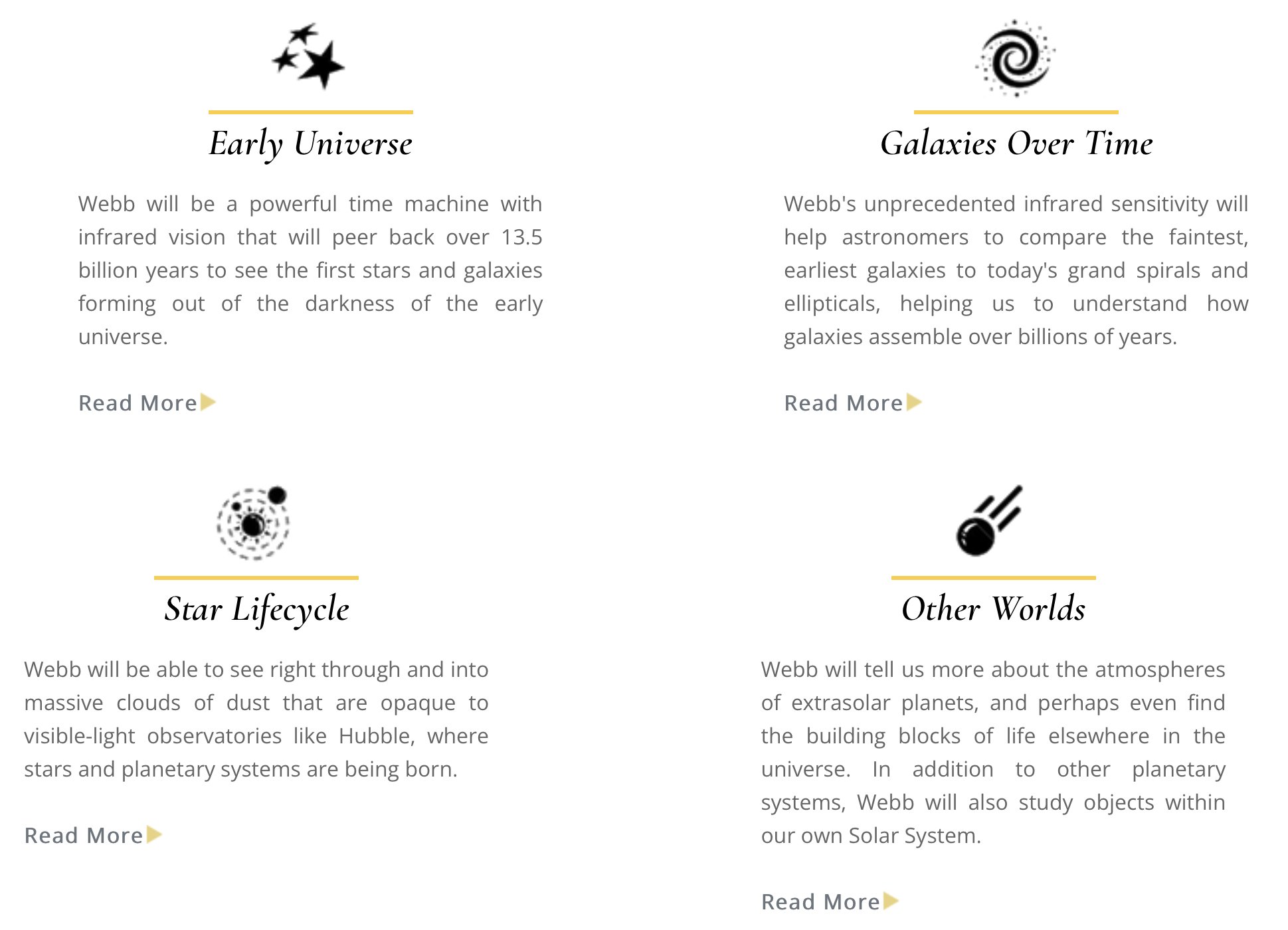
Source: NASA - https://jwst.nasa.gov/content/science/index.html
The observatory’s planned mission is ten years, with its first images expected in June of 2022. Between now and 2032, I think we will learn many very important things about the universe. Perhaps even something that changes the arc of human history.
One of the deepest existential questions we ask as humans is, “are we alone in the universe?” In ten years, I doubt we will have a concrete answer to that question. But even if we had a shred of evidence, that gives us something - some clarity, a more accurate probability, something - wouldn’t that be absolutely incredible?
I am inspired and in awe of the possibility of what we could learn, rather than the reality of what we will learn. What if we learned that the proportion of habitable planets is significantly larger than what we currently estimate? What if we observe that the universe’s early formation makes it possible to predict where habitable planets will cluster? What if we learn that organic life is more possible than we thought?
If we realized that the development of other space-faring species is just a little tiny bit more possible than we currently think, it would open the door to ask dramatically new questions and contemplate exponentially more ambitious possibilities.
If we realized there were many more habitable planets, for example, wouldn’t we imagine if we could explore them? If we realized that space-faring aliens were more likely to exist than we thought, wouldn’t we try to imagine what they may be like, and how their societies may work? Wouldn’t we become more open to thinking about life’s biggest questions with more wonder and possibility?
And yet, despite all of the possibilities of what could be out there in the universe. I think the most profound conclusions we’d have if we look out into the universe will be introspective, helping us to examine life on Earth. By looking out into the expanse of the universe, the most important conclusions we’d draw could be about ourselves and about our own existence. The JWST will help us look outward, but also powerfully inward.
For example, I think often about what I call exomorality, which is trying to philosophize about the moral frameworks space-faring aliens might have. I wonder about how resource constraints on our planet, our physical bodies and lifespans, may affect how we contemplate right and wrong. Would aliens be different? Is it possible to have a society that doesn’t have rigorous ideas of right and wrong? Why? How?
I’ll concede that my forays into exomorality are a bit of a fool’s errand and just a tad premature (but it is fun). But even if I’m 100% wrong about the morality of aliens, it’s a liberating way to reflect on our own, human, morality. Looking outward makes it easier to look inward.
Despite my eagerness to hear about the possibility of habitable worlds and alien species, the JSWT may reveal the opposite. By looking outward, we may instead learn that the universe is an even more barren place than we thought. And learning that may be even more transformative for our species than if we discovered more signs of life.
What if we learn that the likeliest outcome is that we’re mostly alone out here? What if we learned that the conditions for organic life are incredibly and exquisitely rare?
Imagine how quickly how we view ourselves might change if we realized, simultaneously as a species, that maybe we don’t have a safety net. That there is no techno-civilization out there to learn from; no deus ex machina. Maybe there’s really nowhere else for us to go, even if we could get there somehow. Maybe we are alone out here and this one precious Earth really is all we have.
I’m certainly not a NASA scientist, and these hypotheses are all my own. And I doubt we’ll have any absolute “proof” to validate any of the thought experiments I’ve suggested here, especially after just 10 years.
But what if we end up having 1% more clarity on something related to these deepest of the deep questions? What if we have even 0.5% less doubt about some question related to life in the universe?
If we have some evidence, of some thing, that gives us a foothold to think deeper and explore further - I think that could change everything that follows.
I love space. I have followed NASA since I visited the Kennedy Space Center as a kid and somehow got a scholarship to go to space camp. I read interstellar travel blogs, still. I think about aliens, like, 5 times a week at least (just ask my wife, ha!). Perhaps most controversially, I like both Star Wars and Star Trek, (gasp) equally. Especially for a non-scientist, I’m a space nerd of galactic proportions.
Thinking about space is what nurtured my ability to dream and dream big. Like it does for millions across the planet, space exploration gave me something, from an early age, to grab onto, that made it possible to believe in something huge and that anything may really be possible.
Just looking up, on a clear night, is as much a path to a spiritual plane to me as going to church, performing a pooja, or doing transcendental meditation. Seeing a sky full of stars from the trails of our nation’s national parks is still among the most beautiful, humbling moments I’ve ever been part of.
Our efforts to explore our solar system and our universe have already given us, as a species, so many images that have expanded what we, as a species, believe is possible. Exploring space, and going out there, into the final frontier has helped so many people across our entire planet imagine the magical and magnificent possibilities of this universe.
Images like Earthrise from Apollo 8, which some credit as starting the modern environmental movement:

Source: NASA - https://www.hq.nasa.gov/office/pao/History/alsj/a410/AS8-14-2383HR.jpg
Or this “small step” moment from Apollo 11:
Or this image of our “Pale Blue Dot” from Voyager 1 which Carl Sagan famously reflected on:

Source: NASA - https://solarsystem.nasa.gov/resources/536/voyager-1s-pale-blue-dot/
For me and so many others, what we’ve seen and learned about by exploring space has expanded what we believe is possible. And it’s expanded what we believe we can be.
I’m not at NASA scientist, clearly. So do I actually know what we might learn during the JWST’s mission? No, not really. I’ll concede that too.
But let’s remember, we’ve just launched the most powerful telescope with the most ambitious mission in the history of human kind. For goodness sakes, we will be studying the birth of the universe a few hundred million years after the Big Bang, a few blinks of an eye in universal terms. With such bold ambitions, even if what we discover during the JWST’s mission is just 1% of what I hope it is, it could fundamentally transform how we perceive the universe and ourselves.
In 2032, we will probably still have income inequality or political strife. We will probably still have a warming planet. We may still have many of the problems which plague us today (fingers crossed, NOT Covid). But I think it’s possible that in 10 years, when the planned mission of the James Webb Space Telescope comes to a close, we may have learned something that dramatically expands what our species believes is possible. And if we learned something like that, it could change everything that follows.
Other Links:
https://jwst.nasa.gov/content/about/faqs/faq.html
https://jwst.nasa.gov/content/science/index.html
https://jwst.nasa.gov/index.html
https://en.wikipedia.org/wiki/James_Webb_Space_Telescope
The mindset which underlies enduring marriages
For our marriages to survive and thrive - whether to our soulmate or not - we have to believe that life is better done together, not solo. No amount of love, destiny, resources, compatibility, or compromise can make up for not having this pre-requisite shift in mindset.
If our lives can be explained by the treasurers we adventure to find, one of my few holy grails is understanding how to be a soulmate. I search, everywhere I can, for little bits of the wisdom that can help Robyn have a marriage that endures for our whole life and for anything that exists after.
My perspective on marriage and soulmates has evolved, to something like this:
We start our lives with a paintbrush in our hands, and a blank canvas. And we start to wonder - what’s the most beautiful picture I can put on this canvas? What is the life I want to live? As we grow up we experiment a bit as we learn to paint.
Eventually, we get a pretty good idea of the most beautiful life we can paint on the canvas, and we go after it. We start to paint more feverishly as we hit our teens and twenties.
If we’re lucky, along the way we fall in love with someone. If we’re really lucky, we take a leap and marry them. And then the dynamic at the canvas changes.
A wedding, I think, is the moment two people start to paint onto one canvas. But here’s the the trick: the moment we say I do, we suddenly have to figure out how to paint while both holding the same brush.
And suddenly, were not only painting, we’re both trying to prevent the brush we’re both holding - our marriage - from breaking. It seems like there are three ways to survive this.
First, we could strengthen our brush and make it more resilient. In a marriage, there are times when each person is pulling in a different direction, and the brush has to be strong and resilient so it does not break. This strategy represents the body of advice people give about integrity, being faithful, committing to better/worse/richer/poorer/sickness/health, having a thick skin, continuing to date, rekindling love and romance, etc.
Second, we could learn to compromise. Maybe sometimes we paint the way I want to paint. Other times, we paint the way you want to paint. We never pull in different directions at the same time. By compromising, we put less tension on the brush. By putting less tension on the brush, it does not break as readily. This strategy represents the body of advice people give about conflict resolution and compromise.
Third, we could both imagine the painting we want to put on the canvas the same way in our heads. What do we want our lives to be like? What’s the beautiful picture we want to paint together? By having a shared vision for what we want our marriage and life to be, we don’t put stress on the brush because both our hands are moving in the same direction. This strategy represents the body of advice people give about shared values, shared vision, and growing together instead of apart.
Truthfully, every married couple needs to be good at all three of these approaches. Moreover, the first strategy of having a strong and resilient brush seems like a given. I don’t know how any marriage survives without that.
What struck me is that compromising seems to be the least optimal strategy here. Sure, every married couple has to compromise at some point and compromise a lot. Robyn and I compromise, too.
But how terrible would it be to have a lifetime full only of compromise? Either you are settling for the average your whole lives, and the painting you produce is the average, path of least resistance. Or, one person dominates, and one person gets the painting they think is beautiful and the other has lived someone else’s dream.
Compromise is necessary, but it seems best as a last resort. What seems much better is to just be on the same page about life together - and wanting to paint the same painting, constantly evolving with each brushstroke as life unfolds.
This metaphor reminds me of a fundamental tension within management. Teams - whether it’s at work, in sports, in government, or in community - fall apart if people care more about themselves than what the team is trying to accomplish together. So to in marriage.
If I care more about what I want life to look like than I care about painting our shared vision for the canvas, and painting it together our marriage will suffer. This is no different than any team - a team only endures if its members sacrifice to advance the aspirations of the team and evolve as the team evolves.
When I first began to think about soulmates, I thought it was a question of predestination. There was a soul out there, and through God’s will I was linked to that soul. All I had to do was find her. We’d fall in love. We’d work through problems. We’d put in the work for a great marriage, and after we departed this world we’d be committed to anything that came after.
And I did, thank God, find her. But my perspective on soulmates and marriage is different now. I don’t think that it’s only about this compromise, loving each other, keeping on dating, and putting in the work stuff anymore.
To be clear, I do still believe all those things - love, compromise, romance, and commitment - are required to be married and probably to be soulmates.
But because of my own experience being married and learning vicariously from hundreds of other couples, I now believe that there’s a key prerequisite to marriage and even being soulmates. It’s a mindset and orientation toward life that believes together is better.
We can’t just keep painting the canvas we started with prior to being married. We also can’t just find someone compatible, that we love and try to stitch our separate canvases together. We can’t even create a fully detailed blueprint for the canvas of our life and marriage, agree to it prior to a wedding, and never evolve it - life’s unpredictability certainly doesn’t permit that.
Instead, deep down, we have to fundamentally believe that the enterprise of painting a shared canvas, with a shared vision, using the same brush is what a beautiful life is. The critical prerequisite for marriage is that our mindset shifts from believing that the best way to live is being a solo artist, versus being part of a creative team.
No amount of love, destiny, resources, compatibility, or compromise can make up for not having this pre-requisite shift in mindset. For our marriages to survive and thrive - whether to our soulmate or not - we have to believe it’s better together.
Developing courage in the new year
Courage is the king of all virtues. Developing it on purpose can make a huge impact on our own lives and on the people we seek to serve.
As it turns out, developing courage in ourselves is not so easy. We have to learn it by practicing it. There’s no YouTube video (that I’ve found at least) that we just have to watch once and suddenly become courageous. Reflection and introspection is the best method I’ve found so far (and that’s not particularly easy, either).
In lieu of a New Year’s resolution like running a marathon or reading 20 books, I’ve opted to commit to a practice which I hope helps me to cultivate courage.
In hopes that it’s helpful, here It is:
First thing in the morning, answer these two questions in notebook, quickly:
What do I think will be one of the hardest things I have to do today?
How do I intend to act in that situation?
Last thing at night, answer these two questions in notebook:
What was actually the hardest thing I had to do today? Why was it hard?
What should I do differently next time?
I’ve been on the wagon for about 6 days now. Here’s what I’ve learned so far:
Even considering what’s going to be hard, helps me to have a plan. That makes me feel more confident and courageous in the moment
Debriefing and learning from the hard stuff yields benefit quickly, sometimes even the next day
I’m really bad at predicting what the hardest part of my day will be, which is humbling. I’m excited to review the data in my journal after 2-3 months because I suspect it’ll reveal some blind spots I have in my life
Here’s the background on why courage matters so much to me, and why I’m so interested in trying to cultivate it in myself and the organizations I’m part of:
The first obstacle to being better at anything is laziness. If we don’t get off our behind, we can’t figure out the easy stuff. This is the case for being a better spouse, parent, citizen, athlete, accountant, corporate executive, chef, team leader, musician, change agent, or gardener.
Any domain has fundamentals that are easy to learn, but just take work. We’re lucky that in our lifetimes this is true.
Before things like youtube, google, and the internet more generally I suspect it was much harder to learn the basics of anything - whether it was baking bread, grieving the loss of a loved one, personal finance, or designing a nuclear reactor. But the obstacle of laziness remains, if we don’t get out of bed we don’t get better anything.
Eventually, however, the easy-to-learn-if-you-do-the-work fundamentals are already done, because we, correctly, tend to do those first. At that point, all that’s left is hard. So we have a choice: do the hard stuff, or stop growing.
As I’ve gotten to the age where all that’s left is hard or really hard, I’ve become more and more interested in courage. Courage, as I define it, is the ability to attempt and do the hard stuff, even though it’s hard. For this reason courage, to me, is the king of all virtues: it helps us to do everything else hard, including building our virtues and character.
This is a broadly applicable skill because there are all sorts of hard things out there: technical challenges, situations requiring patience or emotional labor, bouncing forward through adversity, product innovation, leading others through solving complex problems, being vulnerable, managing large projects, having a happy marriage, being a parent…the list goes on.
Courage matters, because it is fundamental for us to even attempt the hard stuff once the low-hanging fruit in our lives is gone. Although it is non-trivial, developing courage in ourselves and our organizations matters a lot and can make a huge difference for ourselves and those we seek to serve.

Mentors are momentary fathers
At their best, mentors are not just advisors, they are momentary fathers. I think if we’re honest, those of us who feel like we’ve had some success at living life have been blessed with many momentary mothers and fathers along the way.
I met Phelps Connell in 2005, during my fraternity pledge term in my freshman year at Michigan. Flip, as everyone called him, was an alumnus of my fraternity, Phi Gamma Delta, and moved back to Ann Arbor after retirement. He was always around the house for alumni matters, and our fraternity was one of the organizations he devoted himself to.
He was 80 when I met him, but I would’ve never realized that from his demeanor. He was as vibrant and active as the collegians who lived in the fraternity house he now was overseeing as part of our alumni board. I found this excerpt of his obituary to be a perfect representation of the man he was:
Phelps was first and foremost a gentleman, adored and respected by many for his kindness, loyalty, personal integrity, and concern for others.
I distinctly remember one day I was talking to Flip, in the Fraternity’s kitchen, because I was on dishwashing duty that week. I was a Junior at the time, living in the house, and serving on the Chapter’s executive board. I had gotten to know Flip well during my time as a collegian. He had always taken an interest in me and checked-in on me often.
Flip and I were chatting, but then he asked me - quite directly - if I was going to run in the election for the Interfraternity Council’s executive board, which was the governing body for many of the fraternities at Michigan. In campus life, the IFC as it’s called is one of the more influential extra-curricular organizations for undergrads because it oversees a huge part of the greek system, which at Michigan is a major part of campus life.
I gave him a hemming and hawing answer, and basically shared some lame him excuses for why I didn’t think it was a good idea to run. To be sure, deep down I wanted to run for an office, but didn’t believe in myself enough to try.
Flip was having none of this, of course. He encouraged me to run for a post. He told me that I was a capable leader and that I would represent our chapter well. He saw that I was intimidated at the responsibility and scrutiny that would be part of a campus-wide office and convinced me I could handle it.
He saw something in me and cultivated it. He was probably the first person to do this that wasn’t a teacher or related to me.
And this mentor ship didn’t stop once I graduated college. As a young alumnus I lived in Ann Arbor and served on my fraternity’s alumni board with him for a few years. I got to know his wonderful wife, Jean, over the years I knew home. They invited me and my close friend Jenny - my roommate at the time - over for dinner. It learned the important lesson of what adult friendships are supposed to look like.
I only knew Flip for eight years, from 2005 until he passed in 2013. But in that time he had an outsized influence on my life. He wasn’t just a mentor he was a father to me for a narrowly scoped, temporally limited part of my life.
I realized only recently that the concept of a mentor comes from Homer’s Odyssey (a new translation came out recently, it’s terrific).
In the epic, Mentor is a friend of Odysseus and counsels Odysseus’s son Telemachus to rise up against the suitors wasting his father’s wealth and courting his mother. Mentor, who is inhabited by the goddess Athena during this scene, is a critical figure guiding Telemachus, who has been without a father his entire life, while away at war.
My own father, Girish, was deeply influenced by Hindu philosophy and lived by a code: take care of yourself and then take care of your family. Only then should you help others. He always questioned my community pursuits because in his view, one should get his own house in order first, so that he doesn’t burden others in the community.
As a young man, I thought his view was selfish and narrow minded. But over the years, I’ve come to find great wisdom in my father’s approach. Getting my own house in order does come first, because he was right - we need the community to help with our burdens. But he was also right in that our own stability must quickly be followed by serving others. We cannot enrich our own households indefinitely.
This has become very real to me lately. If I’m being honest, our house is almost in order - at least once we’re out of the newborn phase with all our kids. I am much better off than my parents were at my age, mostly due to their financial sacrifices, their insistence that I get an education, and their upbringing of me.
This is actually a scary, slightly unnerving thought, because the burden of serving others is heavy and consequential.
In our culture today, I think we use the term mentor a bit too lightly. At their best, mentors are not just advisors, they are momentary fathers. Flip was not just a mentor, he was a momentary father to me. Moses and Roger, are not just my neighbors - they have been momentary fathers to me when they taught me how to change my car battery or offer advice on how to go on a camping trip with young kids.
Two Police Commanders were not just my colleagues, they were momentary fathers to me when they reminded me to take a leave of absence when Bo was born or rushed me out of a situation at a community event when a dude who beat double murder was asking me a ton of personal questions.
The father of a friend from business school, who happens to also be a writer, has been a momentary father to me when we have chatted on the telephone about finding purpose in life and work.
I think if we’re honest, those of us who feel like we’ve had some success at living life have been blessed with many momentary mothers and fathers along the way.
There is a time that comes where we must expand our sphere. When that time comes, we cannot walk away from being momentary fathers to others. I - and many of us, I think - am closer to that time than I expected.
To move us forward, faith must come from somewhere
I made a difficult promise to my son, and it turned out to be a lesson on faith.
There’s a old, simple, adage I’ve always liked: Say what you do, do what you say.
It’s essentially my moral upbringing in one sentence. The western version of what my parents instilled in me: Satyam Vada, Dharmam Chara - tell the truth, do your duty. These ideas, whether espoused from an Eastern or Western perspective have been a recurring lesson in my life - truth cannot solely be a theoretical concept, it must have a symbiotic relationship with action.
Which is to say, I really avoid making promises I can’t keep. Even little ones. If my family asks me to get grapes from the grocery store, I don’t simply say “sure”. I always respond to a simple request like this with something like, “Sure, I’ll check if they have any and get them if they’re there.”
Mind you, in the hundreds of times I’ve gone grocery shopping in my life, I cannot think of one time when the store was out of grapes. They’re grapes after all, the store always has grapes. But the thought always remains - don’t make promises you can’t keep.
But this week, I broke my rule. I made a promise, to my son, that I’m not positive I can keep.
Our older son, Bo, has been having a rough week. With Covid exposures in his classroom and the holidays coming, he’s been in and out of school. We’ve been stuck at home. His routine and support network of his friends and teachers is something he just doesn’t have now. We think this has been affecting his anxiety levels at bedtime.
The other night, after probably two hours of shenanigans I tried a different tack. Rather than barking at him to go to sleep - which I’d already tried and failed at, twice - I went up and just gave him a hug. I asked him how he was feeling, and if he was scared.
I never got a clear answer out of him, but he did melt into my arms and lap. Clearly, he felt unsafe and anxious. We don’t know exactly what it was, but presumably his fears came from some combination of “dragons”, the dark, Covid, and “bad guys.”
Then, suddenly, he sat straight up and looked at me intensely. Eyes wide, he said nothing, but I innately understood that he needed comfort, reassurance. He needed to feel like there was nothing to be scared of, that his mommy and papa were there to protect him from whatever monster was lurking.
And so I said it.
“Don’t worry bud, you are safe here. I promise.”
And even as the words came out of my mouth I felt uneasy. Because I cannot, with certainty, 100% guarantee his safety. I can control a lot of the factors affecting his safety, but not everything. There is uncertainty at play here, this is life after all and things happen that we can’t control.
But I had no choice. I had to make that promise. This is what children need their parents for; what sons need their fathers for. And even though there was uncertainty, it’s a promise I could mostly make. I maybe felt 90% confident in that promise, maybe 95%.
But that remainder…it doesn’t sit well, because I know it’s wrong to make promises I can’t keep. And this one was not a small promise, the stakes are about as high as it gets.
—
“Faith” is something I’ve never fully understood. It’s a foreign concept to me, a construct that’s rooted in western ideas and Christianity. There are similar concepts to faith in Hinduism, but it’s much more broadly contemplated, rather than being rooted specifically in something like Jesus Christ or salvation. From my vantage point, In hinduism “faith” is a secondary idea among many others, whereas in Christianity faith seemed more like the whole point.
This promise, made on the floor of our sons’ bedroom, was a real-life lesson in faith for me.
I made a promise I don’t know if I can or can’t keep, but had to make. I took a leap of faith when I made this promise that Bo would be safe here, in this house. And even though I made this promise, upon reflection, I didn’t make this leap of faith blindly. This faith came from somewhere. Faith comes from somewhere.
For me this faith came from the careful decisions Robyn and I made to move into this neighborhood, where neighbors look out for and know each other. It came from the prayers we do nightly, not as a free pass for a divinely intervened halo of safety, but because prayers and the belief that God is listening helps me to reflect on and improve how I think and act.
It came from me knowing Bo is a good kid with a good heart, that will probably make generally good decisions. It came from knowing he has a younger brother who will look out for him and watch his six.
It came from the marriage Robyn and I have, I know together we are more likely to succeed at having our home be a safe place for our kids. It came from all the preparation and practice and debriefing Robyn and I do individually and together to learn from our mistakes. It came from our friends, family, and neighbors who pour love and comfort into our lives. It came from the unconditional love I have for my son and my dogged determination to honor the promise I made.
My faith comes from somewhere.
And yet, days later, I still questioned whether I should’ve made that promise. Because even with faith that comes from somewhere and isn’t blind, I just don’t know. But as I thought about it, what a sad, dull, stale way it would be to live without acts of faith.
A friend of mine said something that was perfectly timed for this week and has been reverberating in my mind for four days straight:
“If I feel ready then it’s a sign I waited too long.”
There are so many “acts of faith” that aren’t remotely religious. Starting a company is an act of faith. Marrying someone is an act of faith. Playing sports is an act of faith. Leading a new project is an act of faith. Standing up to a bully is an act of faith. Planting a garden is an act of faith. Reading a book is an act of faith. Ordering a cheeseburger is an act of faith.
Maybe not in the religious sense, but our lives are an acts of faith, strung together from moment to moment.
And in retrospect, I’m grateful for this. Because even though I don’t understand faith in the Christian sense, I do have a appreciation now that acts of faith are essential for human life to flourish. They help us grow. Acts of faith make us lean on each other and deepen our trust. They alleviate suffering and bond us to others. Acts of faith put us on the hook to figure out difficult but important challenges.
And that’s exactly what I’m feeling. I made a promise I wasn’t sure I could keep, to my son. And now I’ve gotta own it. I’ve got to figure out how to keep the promise that he will always be safe at our home, no matter what. And I’ll be damned if I break that promise to him.
—
I know as I write this that for many, faith is a loaded term. It reeks to them of religious institutions that are untrustworthy, and that have actually inflicted great, irreparable harm to thousands of people.
Because I was raised Hindu, with Eastern philosophy and theology baked into day to day life with my parents, I luckily have some distance from deliberately specific, Western notions of faith.
And it seems to me that, yeah, we shouldn’t make promises we can’t keep. That’s still true. But maybe I shouldn’t be so doctrinally rigid with that belief, either.
Acts of faith move us forward, when they’re not made blindly. And yes, God is one source of faith. But there are many other sources of faith that we all can and do draw from when we leap, with good intent, toward something better. What seems to matter more than where our faith comes from, is that it doesn’t come blindly from nowhere. It matters more that it comes from somewhere.
Faith must come from somewhere.
Conflict resolution can be baked into the design of our teams, families
In hindsight, approaching organizational life - whether it’s in our family, marriage, our work, or our community groups - with the expectation that we’ll have conflict is so obviously a good idea. If we’re intentional, we can design conflict resolution into our routines and make our relationships and teams stronger because of it.
In our family, there are no small lies.
So when our older son (Bo) lied about knowing where our younger son’s (Myles) favorite-toy-of-the-week was, we didn’t take it lightly. He went to “the step” where I directed him to stay for 10 minutes.
“Think about the reason why you lied. I want to know why. We’re going to talk about it over lunch.”
“But papa…”
“You’re a good kid. But lying is unacceptable in this family. We’re going to talk about it over lunch.”
It turns out, Myles did not treat Bo well the previous night. The two of them recently started sharing a room (which they love and they get along great), and Myles was talking loudly and preventing his big brother from sleeping.
Bo, now four, was not happy about this. And even though Bo loves his little brother dearly - they’re best buds, thank goodness - his frustration manifested by taunting Myles about the toy keys, and lying about knowing where they were.
As we talked over lunch, the real problem became clear, lying was merely a symptom. Bo was angry about being mistreated by his little brother. What our lunch became was not an interrogation about why Bo lied, but a expression of feelings and reconciliation between brothers. Our scene was roughly like this:
“Bo, I think I understand why you lied about the toy keys. When someone does something we don’t like, we have to talk to them about it. I know it’s hard. Let me help you work this out with Myles. Could you tell Myles how you felt?”
“Sad.”
“Why?”
“Because you were talking loud and I couldn’t sleep.”
“What would you like him to do to make it right with you?”
“Don’t bother me when I’m trying to sleep, Myles.”
“Can you both live with this and say sorry?”
“Okaaayy…”
Which got me to thinking - this happens in organizational life all the time.
Intentionally or not, we get into conflicts with others. More often than not, the conflict brews until it spills out into an act of aggression. Rarely, in our organizational worlds, is conflict handled openly or proactively.
It’s understandable why it plays out this way Conflict is hard. Admittedly, my default - like that of most humans - is to avoid dealing with all but the most egregious of conflicts and letting things resolve on their own. Stopping everything to say, “hey, I’ve got a problem” is incredibly uncomfortable and difficult. Basically nobody likes being that guy.
It’s MUCH easier to pretend everything is fine, even though it’s usually a bad choice over the long-run. This tendency is unsurprising; it’s well understood that humans prefer to avoid short term pain, even if it means missing out on long-term gain.
But, we can design our organization’s practices to manage this cognitive bias. We can build pressure release valves into our routine, where it’s expected that we talk about conflict because we acknowledge up front that conflict is going to occur.
In our family, we’re experimenting with our dinner routine, for example. We shared with our kids that we’ll take a few minutes at the beginning of our meal to talk about what we appreciated about other members of the family, and share any issues that we’re having.
We had a moment like this with our kids:
“We all make mistakes, boys, because we’re all human. It’s expected. We’re going to talk about what’s bothering us before we get really sad and angry with each other.”
In hindsight, approaching organizational life - whether it’s in our family, marriage, our work, or our community groups - with the expectation that we’ll have conflict is so obviously a good idea. Conflict doesn’t have to be a bug, it can be a feature, so to speak. If we’re intentional, we can design conflict resolution into our routines and make our relationships and teams stronger because of it.
I didn’t realize it, but this design principle has been part of my organizational life already. The temperature check my wife and I do every Sunday is centered around it.
Even my college fraternity’s chapter meetings tapped into this idea of designing for peace. The last agenda item before adjournment was “Remarks and Criticism”, where everyone in the entire room, even if a hundred brother were present, had the chance to air a grievance or was required to verbally confirm they had nothing further to discuss.
The best part is, this “design” is free and really not that complicated. It could easily be applied in many ways to our existing routines:
Might we start every monthly program update by asking everyone, including the executives, to share their shoutouts and their biggest frustration?
Might every 1-1 with our direct reports have a standing item of “time reserved to squash beefs”?
Might part of our mid-year performance review script be a structured conversation using the template, I felt _______, when _________, and I’d like to make it right by _______?
Might the closing item of every congressional session be a open forum to apologize for conduct during the previous period and reconcile?
It might be hard to actually start behaving in this way (again, we’re human), but designing for peace is not complicated.
If you have a team or organizational practice that “designs” for peace and conflict resolution, please do share it in the comments. If you prefer to be anonymous, send me a direct message and I’ll post it on your behalf.
Sharing different practices that have worked will make organizational life better for all of us.

Every person has a remarkable story, and something special to contribute
As it turns out, the antidote to “I can’t” need not be “Of course, I can, I’m the shit.” It can also be, “I have something special to contribute, just as everyone does. So I’m going to figure this out, even if it’s hard.”
One of my most perplexing parenting moments is when something like this happens:
“I can’t do it! I can’t do it!”
Or:
“It’s not working Papa! Can you help me?!”
Or, the most comedic version:
“I can’t do it! Can you carry me? I forgot HOW TO WALK!”
I originally thought, I don’t know where Bo learned this, it must’ve been at school. I don’t remember pouting and screaming “I can’t do it!”, in front of him at least.
Then, I got real with myself. I accepted that I wasn’t so perfect. I have complained, been wounded, or just been flat out pissed about the world around me before:
“I’m sick of people talking over me at work. I don’t see this happening to my white, male colleagues”
“I can’t believe someone put a brick through the window of my Ma’s shop. Why do we have to keep dealing with this?”
“Everyone keeps telling me I’m too verbose during presentations, and then they turn around and tell me to explain my thinking more when I try to be direct. I can’t win with these guys and I don’t see anyone else getting dressed down in front of the whole team”
“I just have to put in my dues. Once I get a bit stronger, confident, and more respected I can really share my opinion with authority.”
”I’m the most inconvenient kind of minority, I get all the prejudice without any of the political clout and social protection that comes from being part of a larger constituency.”
Sadly, I could go on. Upon reflection, these statements - which are selections of my inner monologue, nearly verbatim - are just adult versions of “I can’t do it! I forgot how to walk!”
For much of my teens and twenties, I dealt with this by maintaining an attitude of hidden arrogance which I fooled myself into calling “swag” Even if I wasn’t outwardly a jerk, “Eff these guys”, is more or less what I would think. The cool part was, that attitude actually worked.
Arrogance did serve me well, which I honestly wish wasn’t true. But arrogance comes with a social cost - it requires putting others down, whether it’s directly or indirectly. Actions borne of arrogance make the water we’re swimming in dirtier for everyone else, our culture worsens because of it. In my personal experience, I’ve found, for example, that the more assholes are around, the less a group trusts each other.
There came a point where I couldn’t justify my so-called “swag” anymore. It was wrong, and I didn’t like who I was becoming on the inside. The problem was, when I cut the act of swag, I didn’t feel confidence, or agency, anymore.
The longer I’m alive, the more I believe that humility is a fundamental virtue that keeps our society and culture healthy - it’s an essential nutrient for benevolence, collective action, and ultimately prosperity and peace.
Humility leads to openness and listening. Listening leads to love and understanding. Understanding and love leads to commitment for a shared vision toward a better future between people. Commitment leads to shared sacrifice. And shared sacrifice leads to a better world.
So how do we be humble and confident at the same time? How do we believe we have worth without veering darkly into arrogance? How do have inner strength without having to exert outward dominance?
This is where I’ve been wandering for my late twenties and early thirties. It’s become a bit of an obsession to figure this out since I became a father. Humility is so important, and I know it in my heart, but I want to be able to explain how to my sons, beyond saying “just be humble.”
Humans of New York is one of my favorite communities. I’ve followed their instagram page and have read it regularly for many years. Humans is one of our coffee table books and is excellent.
Basically, HONY is a photo-journalism project, where the founder, Brandon Stanton, tells the stories of everyday people, with photos, one New Yorker at a time.
Every single story is a powerful example of the human condition’s beauty and strength. No joke, every single story of every single person, is extraordinary. I’ve read hundreds of these stories on HONY. And I began to realize, every single person in the world has incredible capabilities, has unique gifts, and has endured significant personal struggle. It’s there, in everyone. If we don’t see them or can’t find them, that’s on us - because they’re there.
As I’ve moved through life as an adult, I’ve somehow figured out how to connect with people about their core stories, sometimes within minutes - even waiting in line at a store’s checkout counter. Or maybe it’s my neighbors or colleagues. Or the person waiting our table at a restaurant. Everyone has these capabilities, gifts, and triumphs over struggle.
I’ve got glimpses of people’s love for their parents and children. Or, their dedication to their work, their church. Some have overcome addiction, or grief, or the grueling journey of finding their voice. It doesn’t matter their station - it could clearly be a wealthy professional, or a house cleaner. I’ve found that every single person has something special to contribute. Every single person has gifts and a compelling story.
To me, that’s a strong reason to be humble. Every single person has gifts. Every single person has something to contribute. Every single person has something special to contribute that I don’t.
That merits my respect to every person on this earth. It doesn’t have to be earned, nobody has to earn my respect. If I haven’t figured out what that special gift or unique capability is, it’s on me. If some arrogance creeps into my heart, I’d best remember that and humble my ass down.
The real eureka moment in this idea came some years later.
Yup - everyone else clearly has gifts. That’s why I should be humble. It’s to respect the unique light in everyone and the special contribution that’s within them to make.
But, if I see this light, this special atman and soul in everyone - literally everyone else - it also means a version of that light lives in me too. It would be audacious to think otherwise; I have no good reason to think that I don’t have something special to contribute, or some unique capability to share. If everyone else does, I must too.
That’s the secret. The elusive third-option truth I’ve struggled to find for the better part of three decades. It does not have to be a choice between arrogance and humility. I can be humble and confident if I recognize that the light in everyone else lives in me too.
I Believe in Christmas Magic
Our Christmas Tree is our life story, our histories intertwined with the branches and lights. It is the only time machine I know of that actually works - drawing me into memories and stories of a different time and place. This to me, is magic.
There is magic in Christmas, and I believe in it.
The root of where my belief comes from is our family’s lore, originating from a time just preceding my birth. As the story goes, my parents were having a hard time conceiving. At the time they were new immigrants to this country, living in Chicago, I think.
They didn’t have much support or know many people. I can only assume they had little money. As I recall, my father insisted upon my mother learning English. And so she went, taking the bus in the dead of winter, to a Catholic Church that offered English classes to new Americans.
And if you know Chicago, it’s damn cold in the winter. And yet, despite my mother’s protest, my father sent her off trudging through the frigid city to learn to speak the language of this country.
At some time during that season of their life, my mother prayed. Prayed in the broadest sense, I suppose, but really she was making a deal. She promised, to whom I don’t know, that if she was blessed with a child she would put up a Christmas tree, every year.
I am obviously here now, and sure enough, every year a Christmas tree goes up in our Hindu household, for reasons bigger than the commercial and assimilating to avoid conflict. On the contrary, we have not assimilated into Christmas, we have assimilated Christmas into us.
Christmas trees are a durable tradition for Robyn and her immediate family, too. Every year on Thanksgiving she trims the family tree while her mother cooks dinner and the rest of the crew heads to the stadium to watch the Detroit Lions football team, almost invariably, lose the Thanksgiving Day game.
In our own home, we have created our traditions with each other and our children. We trim the tree right around Thanksgiving and start a solid month of listening to Christmas music and watching Christmas movies, always starting first with White Christmas. We eagerly await the first weekend snow, and like clockwork we watch The Polar Express and drink hot cocoa. We unpack and read classic books out of the seasonal box, like How the Grinch Stole Christmas, or ‘Twas the Night Before Christmas which Robyn’s father reads to the family on Christmas Eve, after we all go to church, eat a family dinner, and do a secret sibling gift exchange.
But of all these traditions, and others I haven’t described in detail, the Christmas tree is still the most mystic and alluring. It’s where the magic of Christmas has always resided, at least for me.
After we put up all our ornaments and trimmings and lights, I find myself, every year, sitting on the wooden floor of our family room, carefully studying the tree. This year, I had our sons beside me, for a fleeting moment at least, looking up. It is our family yearbook up there.
Every ornament has a story, a purpose. There are ornaments from Robyn and my’s childhood, representing our experiences and interests growing up. Then there are the ones that represent significant moments in our life together - like our first Christmas together, our first home, or the metallic gold guitar ornament we bought in Nashville which commemorates our honeymoon.
There are ornaments demarcating when our family has grown, dated with the births of each of our children. There are the ornaments we have from our family trips, most recently a wooden one we luckily found in the gift shop on our way out of North Cascades National Park.
Our Christmas Tree is our life story, our histories intertwined with the branches and lights. It is the only time machine I know of that actually works - drawing me into memories and stories of a different time and place. More than that, it’s a window to the future, leaving me feeling wonder and hope for the possibilities of the coming year. When I am there, at the foot of the tree, sitting at the edge of the red tree skirt, I am all across the universe.
This to me, is magic.
As I am sitting here writing this, it is the Sunday after Thanksgiving in 2021. The first weekend snow fell last night. We are in our family room, watching The Polar Express. Robyn and the kids brewed some hot chocolate, right on cue with the appropriate scene in the film. I see them all on the couch, snuggling a few feet over from me. Our family Christmas tree is immediately behind me, the reflection of it’s lights glowing softly on my iPad screen.
I see the snow covered branches, wet and heavy, out our study room window. The neighborhood is quiet and our radiators are toasty warm, as if we were able to set them at “cozy” instead of a specific temperature.
As I sit here, trying my hardest to soak up this moment, I know that much of the stories we share at Christmas, like Santa Clause’s sleigh and reindeer, Frosty the Snowman, and any assortment of Christmas “miracles” reported on the local news probably are not true, strictly speaking. I cannot verify them or explain them enough with empirical facts to know they are true. And I will never be able to.
But I still believe in the magic. Because of the tree, and what happens nearby.
Our tree, and what it represents, is a special relic in our family. As we put it up, year after year, it reminds me that our history is worth remembering and that our future is something to be hopeful about. Our tree, and what it represents, renews my belief that there is magic in Christmas.

Khan Academy, but for learning leadership
We need to be developing leaders by the millions. Yet, leadership development feels like this exclusive club that you have to be anointed into.
Leadership is hard, but not complicated. Why not demystify it?
Leading teams is hard, but it’s not complicated.
Leadership has all this mystique around it, and it drives me crazy. It’s like you have to be one of the chosen ones, have some purported “natural” aptitude, or go to a fancy graduate school to be a veritable leader.
I think all these stories we tell ourselves about leadership are dogma. And hogwash.
The way I see it, leadership is a choice. If you choose to lead, take the responsibilities that come with leading, and work hard to get better at it, you’re a “leader”. Full stop.
The way I see it, the demand for people who choose to lead outstrips supply. For a peaceful, prosperous, vibrant, sustainable world we need SO many capable leaders.
We need leaders on every block in every neighborhood. We need leaders on every team in every company, large or small. We need leaders for every book club, sewing group, community service organization, and every non-profit organization. We need leaders in every family and circle of friends, probably more than one each. We need leaders in every civic group, every bible study in every church, and every youth sports team, every library, and school classroom.
I don’t have empirical data to back this up, but here are some illustrative numbers, to size up the prize here.
Let’s say…9 out of every 10 people above the age of 14 are capable enough leaders. That may be generous, but roll with me on this.
Let’s also say that after you count every neighborhood block and every church, every team and company, and every group - large or small - that needs capable leadership, the numbers say that requires 93% of people above the age of 14 to be capable enough leaders.
Let’s say that 93% figure assumes people who are capable of leading will lead in more than one area of their life.
If the demand for leaders is 93% of people over age 14 and the supply is 90% of people over age 14 - that means we’re 7.9 million leaders short. And that was (hopefully) being generous that 90% of people are capable leaders. (Here’s the link to population estimates used).
Even if those numbers are not precise, and are merely direction, the conclusion stings. Unless we’re incredibly close to the pin, we could have a leader deficit in the millions.
In my experience, being trained or designated as leader is some ridiculous, exclusive club you have to be anointed into, which is the exact opposite of what we need. We don’t need to be thinking about developing capable leaders by the dozens, thousands, or even the hundred thousands. We need to be developing leaders by the millions.
Leadership is hard, but it’s not complicated.
It can be explained. I personally feel like it’s made to feel like a secret club, because it benefits the people who are in on the joke, so to speak. If there’s a shortage in the supply of leaders, those who figured it out can raise their prices - whether that’s charged in money or status.
I’ve started an experiment to try chipping away at this problem.
Why not try to explain some of the basics of management and leadership that apply to every team in any domain, just like Khan Academdy does for so many other subjects? Why not try to make leadership simple enough for anyone who wants to learn?
You can check the first video I’ve posted on a new YouTube channel called “Leadership in 10 minutes”. It takes a simple, universal, concept of leadership and explains it in 10 minutes or less.
The first video is on “strategic planning”, which is a super complicated way of saying, “figure out what to do.”
Good, bad, or ugly, I’d love your feedback on how to make it better or your guidance to abandon the experiment if what I’ve tried to do is just not helpful at all.

Trading emotional labor for freedom is well worth it
“This is why, boys, if you are reading this I tell you that I love you, and some version of ‘be honest and kind’ at school drop off. It’s because it’s sacred duty we all must fulfill to live in a free and peaceful society.“
Something I think about a lot is what I want to say to my sons when I drop them off for school. According to Robyn, my father-in-law always used to say, “learn something new, do something special.” Even today, it’s clear that phrase left an enduring impression upon how Robyn interacts with the world.
Our words, especially the ones we repeat to our closest, matter.
I’m still refining my own watchwords for the boys. As it stands today, it’s something like “Be honest and kind.” To me, being a good person has two basic components: acting with integrity and character (be honest) and treating others with respect and openness (be kind).
One day, I expect Bo and Myles (and our third, still in the womb) to ask me why. Why does being a good person matter? Why should I be honest? Why should I be kind?
There are two obvious answers to this question: faith and family.
Every spiritual tradition I’ve come across has some invocation of character and kindness. As a theist myself, this is justification enough. And, on both sides of our family character and kindness matter. It is how Robyn and I were both raised; integrity and respect are a family tradition. It’s just what we do because it’s the right thing to do and it’s what we’ve always done. Again, as a family-oriented person, this guidance is self-justifying.
The problem is, that’s not good enough. My sons aren’t compelled to be men of God, nor are they compelled to honor the norms of our family. Faith and family may not be good enough reasons for them to be honest and kind. They deserve a better argument.
Here’s my best shot so far:
When humans live in society, there is conflict. This is because we have diversity and we are not perfect - we act in ways which hurt others, intentionally and unintentionally.
We aspire to resolve this conflict peacefully, without violence. To this end, we have chosen to live in a democratic society. In democratic societies, we make rules (laws) and seat a government to administer and enforce those rules (institutions). Institutions are our solution to mediate conflict and violence.
Institutions, by necessity, are a concentration of power, which creates a power asymmetry between citizens and the institutions that govern the society. To prevent abuse of power by the institution we create even more laws about how the government should act and what it can and cannot do (oversight, institutional design).
Our choice to moderate conflict through institutions creates a trade off: we must give up money and freedom.
Institutions aren’t cheap, it costs money to run an institution, so we trade some of our money (taxes) for the benefits institutions provide (welfare). Institutions also wield power and the rules they enforce circumscribe what we can and cannot do, we also trade some of our self-determination (freedom) for the welfare the institutions provide.
So we really have 3 options if we live in a democratic society and conflict increases (which is likely to occur as diversity increases): we can move elsewhere, increase the scope of our institutions by sacrificing money and freedom, or live with increased conflict and violence.
I pass HARD on each of these options.
First, I prefer democracy to any other alternatives available. Second, I don’t want to live in a society with more conflict or violence. And finally, given the choice, I’d want to keep more of my money and increase my freedoms, not reduce either.
Which brings me to the crux. There is a fourth option: reduce the need for institutions at all.
If we have less conflict to begin with, the demand for institutions lessens rather than increases. To have less conflict, we have to treat each other better and more fairly. Put another way, we have to increase our character and our kindness and be better people. If we are better people, we have less conflict and violence. If we have less conflict and violence, we might even be able to decrease the scope of our institutions, or at least keep their scope constant.
To be sure this is a also trade-off, because character and kindness costs emotional labor. It’s not free, people don’t just snap their fingers and become better toward each other. Each of us has to do the work.
But I’m very willing to trade emotional labor for freedom. To me, it’s a much better deal than trading away our money and freedom because we need to increase the scope of institutions to moderate conflict and violence.
This is why, boys, if you are reading this I tell you that I love you, and some version of “be honest and kind” at school drop off. It’s because it’s sacred duty we all must fulfill to live in a free and peaceful society.
This is why honesty and kindness matters.
The fear of wasting our talent; living a happy but unremarkable life
The funny thing is, I still feel this dread, even though every day I have bubbles, and even overflows, with joy.
This, decidedly, the life I chose and I wanted. “Family first” is our mantra and “It’s a good life, babe” is our refrain. We have a fairly simple life that’s fun, and fulfilling. And joyous. And meaningful. Our days, admittedly, are remarkable mostly because of their consistency.
Our kids waddle into our room, wearing their pajamas of course, at about 6 AM on most days. Robyn and I work our jobs. If it’s a school day, we go through our morning routine with the kids and “do drop off” as a family. If it’s a “home day” we all move a little slower as I prep for the work day and Robyn prepares herself for a day with the kids - mixing in walks with Riley, swim lessons, doctors appointments, snacks, and other modest mischief and adventure throughout the day.
What anchors our day, on most days, is a free-flowing sequence of cooking dinner while the kids play, followed by a family dinner, dessert, tooth-brushing, potty, pajamas, two stories, and a lullaby before tucking them in.
Our nights and weekends waltz and sashay with different versions of roughly the same activities. We do whatever remainder of work we haven’t crunched through during the day, which luckily isn’t as pervasive, urgent, or stinging as when we both worked in public service. We have chores that never seem quite finished - dishes for me, laundry for Robyn. In the rare instance we watch television, it’s either a British detective drama like Endeavour, or a music competition like The Voice or The Masked Singer.
If it’s a weekend, our chores remain but are different (groceries don’t buy themselves, yet, at least). Our excursions outside are a little longer and a little more like a sauntering ramble than the focused, brisk walk Robyn and I take with Riley at lunchtime when we’re both working from home.
And then there are the weekend’s mix-ins. We take Bo to soccer practice and try to go to church and participate in civic and cultural life as best we can. We do our best to see our family once a weekend and nurture friendships with our small group of close ties, our neighbors, or extended family. We both steal away an hour of exercise, as many times we can.
I try to write and chip in to the efforts of the neighborhood association and Robyn tries to explore her budding interest in photography, plans trips, and tries to support the other young moms she knows through small but deliberate acts of kindness.
The moment of the week I relish most, probably, is a short window between 8 and 10pm Friday nights. That’s the one part of the week where Robyn and I are most likely to be able to spend together, doing nothing but enjoy each other’s company. This, again, is remarkable only because of the consistency of our activity - we watch a show perhaps, open up a bottle of wine, fire up the power recline feature of our La-Z-Boy love seat, and or listen to some light music while absorbing and reflecting on the last week of our life. It is the time of week, I feel most comfortable.
This is our life. And as I said, it would otherwise be unremarkable if not for its consistency. Because it truly is unglamous, and seriously is not for everyone. Plenty of people would probably go bonkers under our roof, as we would under theirs.
But for us it works. Because as consistently unremarkable our daily grind is, the moments of laughter, joy, love, and gleefully, willing suffering & sacrifice - the moments we live for - are consistent and remarkable.
It’s hard to explain, but there’s an inexplicable ease and warmth I feel when our sons cast spells of “giant golf ball powers!” completely unannounced. Or when we have 60 minutes of struggle and yelling and tears to get out the door, only to spend an hour and a half with someone at their birthday party. Or when we get to walk outside and see the majestic 100-year old trees triumphantly changing color down our block. And there are dozens more small moments like this, which are unremarkable in isolation, but their consistency feels remarkable.
This is the life dreamed of when I was wandering through the badlands as a younger man. It’s the life Robyn and I wanted together and that we both still want, even though we have to hustle for it damn near every day. It is a happy life, made more exquisite by how challenging and sacrificing it is.
This is the life we chose, intended with each other. It is a life on purpose. Every day is a good day, truly. Our life is admittedly quite opposite of a novel, flashy life - much closer to boring than glamorous, more like monochrome than technicolor. But it’s still a thrilling adventure - healthy, prosperous, joyful, and meaningful,
And yet, I hear the echoes of my father’s stubbornly accented voice and the dream-like memory of him talking to me in the kitchen of my family home - “you are a very capable person,” he said, in a way that was straining, almost exasperated even, to make me understand how serious he was.
And then, on top of my serene and happy state of mind, the existential dread sets in.
I have been brainwashing myself to stop comparing myself to others for the better part of a decade. And I’m mostly there, I don’t feel jealously of my peers like I used to. I don’t have the addiction to keep up with the Joneses or stack up my professional resume like I used to. Instead of being acute, my inclination to social comparison and seeking the approval of others is now more of a chronic condition - something I can manage and live with, rather than having to treat intensely after a bad episode. I am more comfortable doing my own thing than I ever have, and I have a better grasp of what “doing my own thing” or “being myself” actually means, than I ever have in my whole life.
This relatively nascent state of contentment has come from looking inward. It has come from consistent, intense, reflection trying to understand my inner world and how that inner-self can integrate with the broader world. I suppose you could say, I’ve tried to put into practice an “examined life” as Socrates put it in Plato’s Apology.
But in that act of examination, I haven’t been able to help but contemplate whether I’ve lived up to my Father’s assessment of my talent, or even my own assessment of my own capabilities.
Because it’s true, I am a capable person, even if I was afraid to accept the responsibility that came with acknowledging those capabilities for most of my life. And so I wonder, have I lived up to what I’m capable of? How much of my talent and time have I squandered?
To be clear, I’m under no delusion (anymore) that given different choices, I’d be more wealthy of famous than I am now. The way I operate and think, I’ve accepted, it not attractive of fat profits or paparazzi. And, I know for sure that I’m not a once in a generation genius whose wasted talent has become a missed opportunity to bend the trajectory of humanity.
What I long for and am haunted by, however, is contribution. Meaning, lower-case “c” contribution. Like how many more people’s days could I have made by now, had I made different or better choices? And by different choices, I don’t even mean sacrificing family or my own sanity to work harder or longer hours. But maybe if I had focused differently, or made different choices on the margins, or gotten drunk on fewer weekends in my twenties, or just tapped into my talents more intentionally or earlier..
How much higher would the literacy rate be if I applied myself to it? How many fewer people in Detroit would have been shot or killed had I stayed in public service for longer or been better at my job? How many companies could I have started by now if I acted on one of the dozens of businesses that I’d thought of with my buddies that ended up becoming profitable enterprises? How many people could I have brought out of a dark place had I lived up to how capable I actually am and been more generous? What might’ve happened if I buckled down and finished this book two years ago? How might the world be a little different, and hopefully better, if I were better and contributing my gifts?
Perhaps the dread I feel is better described as remorse. I have everything I dreamed of, and it truly is enough - I feel fully happy, complete and satisfied. And yet, I feel this guilt and a lingering malaise because I know I had more in the tank to give. I know that in a different version of my life, somewhere else in the multiverse, I would’ve been able to create a cherished and charmed home life while making a greater contribution to the world outside our backyard.
And I suppose it’s true that life is long, and many people don’t hit their stride until well past middle age, some even not until their sixties or seventies. It’s just this bizarre reality where I feel confident in the choices that I made, feel blessed and complete in the life I have, but still feel the heaviness of imagining counter-factual life.
I wonder often if this must be a new phenomenon for people coming of age. Because now, for people coming of age right now, we have a much broader understanding of the world and our role in it. The amount of information we have or travel we can do or people we can interact with, gives us a difficult awareness both of who we are and how we influence others. This heaviness of imagining a counter-factual life probably wasn’t possible for nearly as many people even 30 years ago.
What I’ve tried to take relief is is that despite how informed or worldly we can be in today’s time, we still know very little of how far our actions actually travel. We don’t know the extent of the wake we’ve created for others to be cared for, to grow, to live more freely, or to thrive. Because now, the contribution and goodwill of our actions can travel much farther than they could 30 years ago. This is true because of how globalized our world is, even if most of us aren’t destined to have a litany of press clips to our name because of what we do on this earth.
What I hope for now is that even though most of the contributions that most of us are able to make are unremarkable, we just keep doing them. Over and over. If we consistently put good things out into the world, maybe just maybe it will turn to be remarkable and make an extraordinary contribution. With any luck, if we’re at least consistent in being unremarkable we’ll be towards the end of our lives and we’ll see that our talents weren’t squandered and we’d been making a remarkable contribution all along.
The bar is too low for men as parents. Enough is enough.
I want to get out of this self-perpetuating cycle of men being held to a low standard of parenting.
After four years of being a father, I’ve noticed several ways that other people treat me differently as a parent than Robyn. Here are some examples:
In the past three months, Robyn and I each took 2-3 day trips away from home. When I left Robyn alone with the kids, it wasn’t much more than a blip on the radar. Nobody we knew stressed too much about it or honestly thought much of it.
When Robyn left me alone to solo parent for a few days, so many people offered to help in one way or another. It was a topic of some note, rather than just a passing mention. People, kindly, asked if I was scared to be home with the kids “all by myself. That was all very generous, but noticeably different than how Robyn was treated.
Robyn and I are also complimented differently as parents. Which is to say I actually receive compliments and Robyn, again, doesn’t get more than a passing mention. Robyn is an outstanding parent to our sons. I’m no slouch either, and we both love being parents so we share the load. Somehow, that leads me to get noted as an “involved dad” or “doing a great job” and Robyn gets that sort of affirmation much less, if at all.
Which, is all very kind. But it makes me feel like the often discussed example of a person of color being complimented as “articulate.” I usually feel like our culture must expect me to be some degree of uninvolved and incompetent to pay me a compliment just for being a father who isn’t a total moron.
At the same time, whether it’s school, the doctor, or even waiters at restaurants - if any person engaging in an arms length transaction needs any information about the kids’ wants and needs they almost invariably ask Robyn. Like, almost literally never am I asked about them, sometimes even by close friends and family.
It’s like the same dynamic of waiters automatically giving the man at the table the check at the end of the meal. I often feel like people assume that I’m off the hook for having any information or an opinion about our childrens’ affairs.
Finally, when in establishments that aren’t run by large corporates (like Disney World or McDonalds), it always seem like that the women’s bathroom is more likely to have a changing table than the men’s. To be sure, I don’t have hard data to back up this perception. But it’s happened enough times where the women’s restroom has a table and the men’s doesn’t that we believe it.
Net-net, in four years as a father, my experience strongly suggests that Robyn and I have different expectations as parents and are held to different standards.
To be real blunt: as a father, I have a chip on my shoulder.
Because from my vantage point, our culture is sending signals, 24/7, implying that men are beer-drinking, butt-scratching, sports-watching oafs that don’t have a clue on how to be caregivers to their own children. I feel like I’m constantly having to prove that I can be held to a higher standard than the abysmally low bar our culture sets for men as parents.
This is definitely a hyperbolic, stereotype-rooted, perhaps even ridiculous claim to make. But I feel it. Like all the damn time. It makes me bonkers that the bar is set so low.
I am not trying to get a pat on the back, or suggest that I’m some all-star father. Because honestly, I don’t deserve one. I decidedly am not.
I screw up with my kids and/or need Robyn to help me clean up a mistake I’ve made, literally daily. By all accounts, I’m a solid (but average) father, at best, with a solid performance thrown in about once every ten days.
What I am trying to do is bring light to the fact that our culture has self-perpetuating, low expectations around men as fathers. We treat men as if they’re incompetent fathers, make fun of them when they screw up, and then lower the expectations we have. And then, we give them less responsibility, which all but assures that those men will become even less competent and confident than they already are.
This cycle is infuriating to me because a lot of men I know (myself and many friends from all parts of my life) are trying really hard to be present, competent parents. I hope that by bringing light to this cultural phenomenon it will cause at least a few people to act differently. Because I don’t think most people mean to belittle men or imply low expectations for them - it just happens because it’s the culture.
That said, I get that there’s probably an equal number of men who aren’t trying to be competent parents. But conservatively, even if only 20% of men are actually trying, we shouldn’t be setting the standard based on the 80% who aren’t. No more low expectations. The bar is too low.
And for all you fellas out there, who know exactly what I’m talking about because you’re frustrated by the same pressures I am, let’s keep on plugging away.
Maybe you disagree, but I don’t think we want or need to be celebrated as “super dads” by our friends or family, just for being a competent parent. I don’t think we need to start a social movement or get matching t-shirts with some sarcastic tag line about how we’ve been stereotyped. I don’t think we need institutional relief or recognition. I’m probably being petty even just ranting about this.
Let’s just keep doing what we’re doing, until the bar of expectations rises and this beer-drinking, butt-scratching, sports-watching oaf that’s clueless persona is a thing of the past.
Test Track
For me, memories are elusive. I feel like most people I know remember much more of their childhood than I do.
I’ve been exploring some nuance of memories this week. There’s me wanting to remember more, say of time with my sons. But there’s also me hoping my sons want to remember time they spend with me.
I don’t know quite what to do with this thought yet.
My childhood memories are sparse.
I have childhood memories, strictly speaking, but they feel so feathery and breezy, light and passing rather than vivid and concrete. I remember my childhood the same way I remember dreams, in vignettes rather than as a movie. I don’t know why that is.
One of the few vivid memories I have is when my father took me to the Test Track ride at Disney’s EPCOT Center. Because he worked for GM at the time, we got to go “backstage” into the employee lounge overlooking the ride, and had an express pass to the front of the line.
I still remember how we were escorted to a secret side door, the view of the tall-windowed overlook, and the trappings of the ride itself. I remember, too, that I had a Cherry Coke in a red paper cup. I remember my father taking out his employee badge, out of his massive leather wallet. For me, fleshy memories like these are mythical creatures, rare and special.
I remember feeling so intrigued by the whole affair, it was a glimpse into my father’s life outside our family. And I remember the rare occurrence of my father at play, relishing the speed of the ride and the freeness of the wind around us, perhaps even glowing in the humble pride that comes from getting your family a VIP treatment.
And I remember too, how the ride was a bit fast and jerky for me at that age, and that I was comforted just by my father being in the vehicle next to me, his laughter and enjoyment signaling that there was nothing to be scared of.
I wish so badly I had more memories like this - visceral and detailed - of my childhood generally, but especially with my father. I want to remember more, and more of him. I can’t understand why I don’t.
With my own sons, I want to remember so many things of our time together, too. The big stuff, yes, but also the mundane.
Like afternoons in the garden, or cleaning our house, or just having an ice cream cone on Friday nights. And I think I will. Thanks to Robyn, we are blessed to have lots of photos and lots of moments where we tell old stories - it’s like she innately knows how to preserve memories, and she does it lovingly and skillfully.
I want to remember every moment of time I can with my sons and my wife. But I too hope that our relationship is loving, strong, and cherished enough for them to want to remember time with me.
The Power of Thinking in Flywheels
Feedback loops are what underpin huge changes in our world. Understanding what Jim Collins dubbed “the flywheel effect” is essential learning for anyone trying to lead or change culture.
These are learnings I’ve had trying to apply flywheel thinking in my world, over the past 2-3 years. Flywheels have helped me to understand everything from business strategy, to management, to gun violence prevention, and even my own marriage.
There are two types of growth, generally speaking - linear growth and exponential growth. And I’m not just talking about for a corporation, but for teams, culture, families, and ourselves as individuals.
The problem with linear growth is diminishing marginal returns - once your market is saturated you have to spend more and more to get less and less. The problem with exponential growth is that it’s hard and also doesn’t last indefinitely. (Sustaining exponential growth is a topic for a different day.)
Jim Collins developed an interesting concept to make exponential growth less hard, which I find brilliant - the flywheel effect. Flywheels are basically a way of thinking about a feedback loop, deliberately. He explains it well in this podcast interview with Shane Parrish on the Knowledge Project. Some of the key takeaways for me were:
The goal of a leader is to remove friction from the flywheel, because once you get it turning, it builds momentum and starts moving faster and faster.
Each step of the flywheel has to be inevitable outcome of the previous step. Think: “If Step 1 happens, then Step 2 will naturally occur”
The key to harnessing flywheels aren’t a silver bullet or Big Bang initiative, it’s a deliberate process of understanding what creates value and building momentum - slowly at first, but then accelerating. To the outside it’s an overnight breakthrough, but to the inside it was a disciplined, iterative process to understand the flywheel, and reducing friction to get it cranking
I was introduced to this concept when I read Good to Great years ago, and was reintroduced to it before the Covid pandemic. Only recently has it started to click.
I’ve found flywheels to be a transformative way of thinking, both at work and in my real life. Here are a few examples of flywheels I’ve experienced and experimented with.
Most business types will be familiar with strategies of differentiation or cost leadership. Both are powerful, value-creating flywheels:

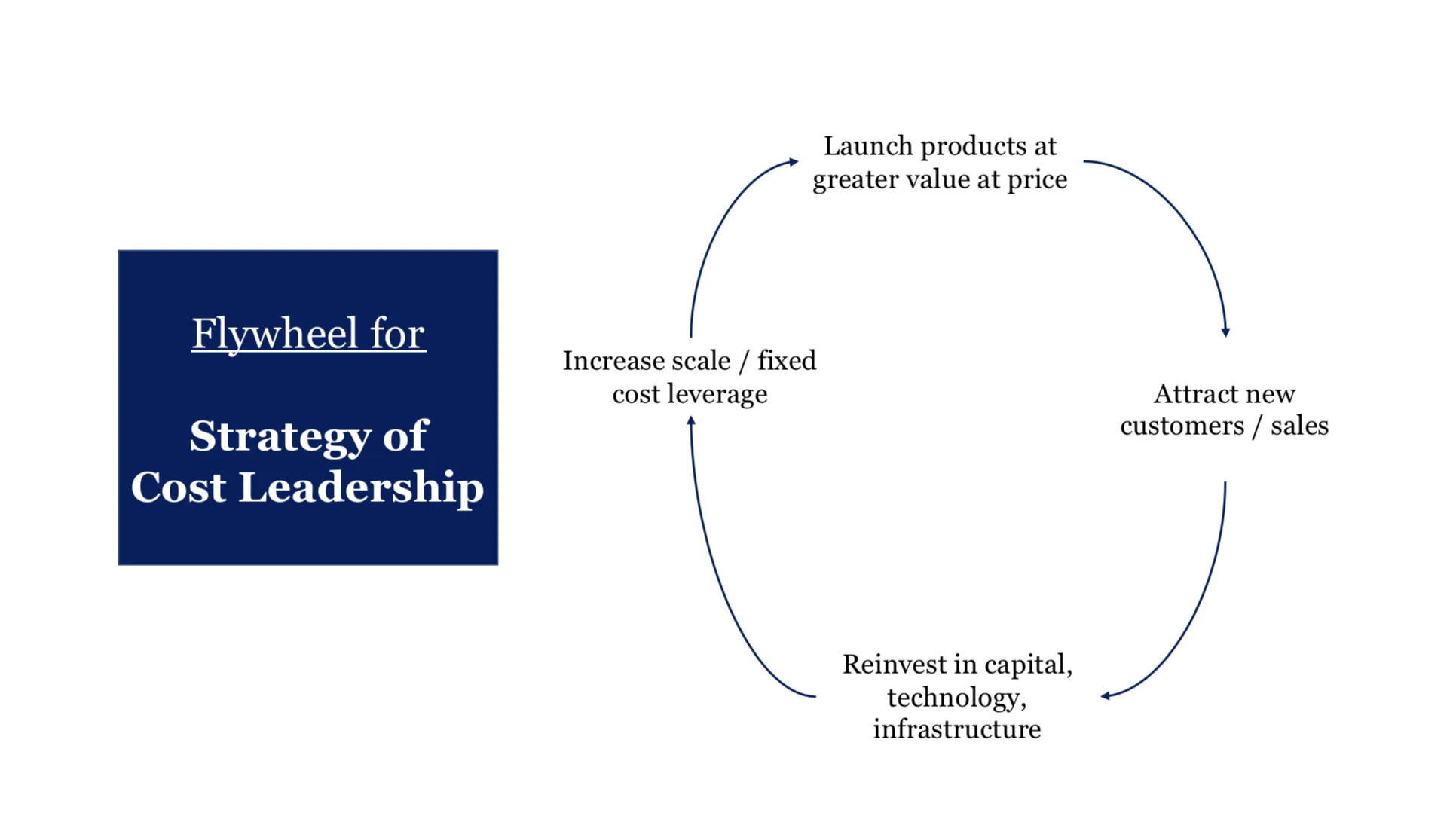
Flywheels are even helpful at the business-unit level. This is an example of how a Chief Data Officer might think about how to create a data-centric culture within their organization.
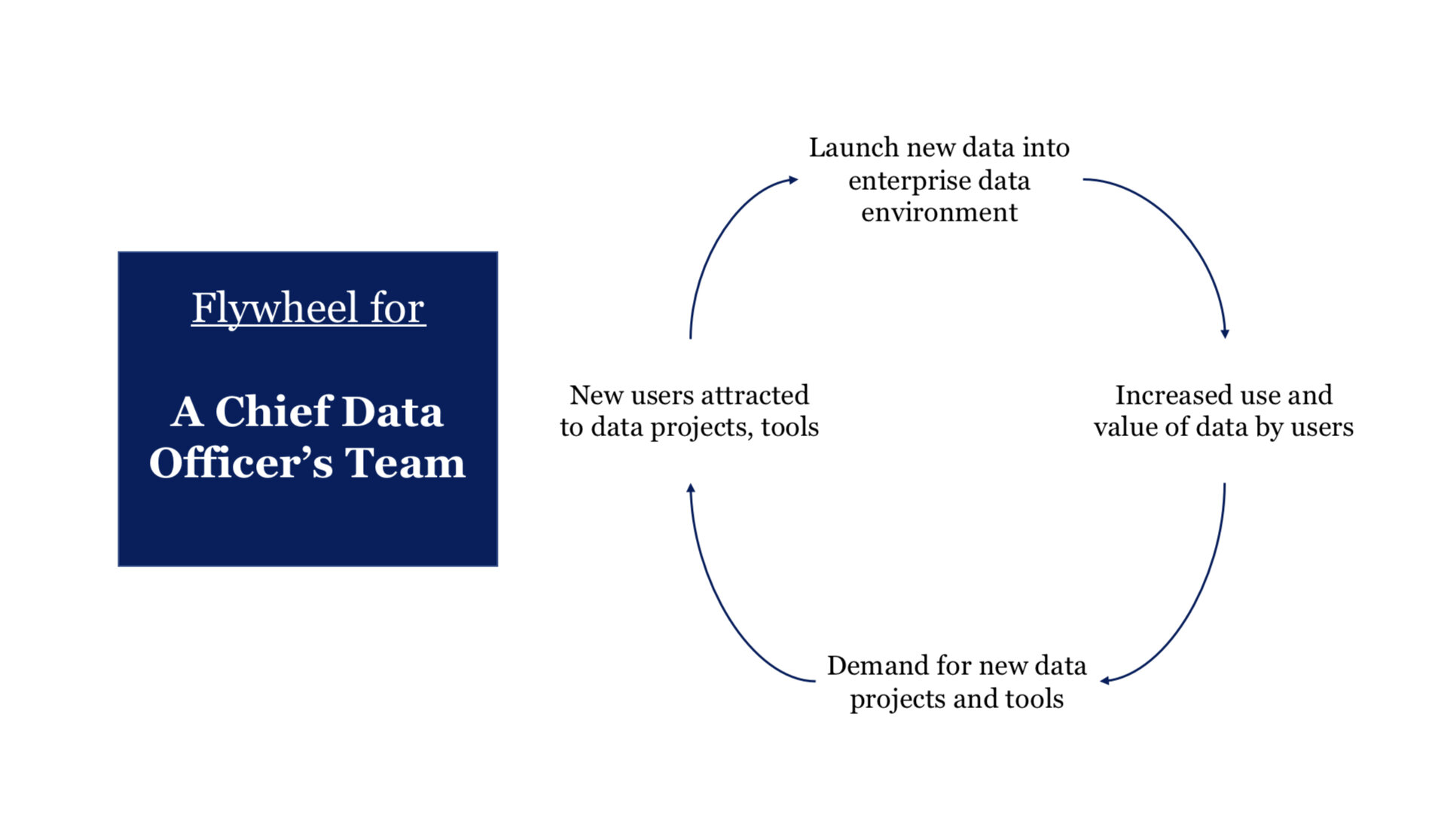
When experimenting with flywheel thinking, it turns out Robyn and I have been operating a flywheel of sorts within our marriage, and temperature check has been a big part of that.
This is also a good example of how flywheels need to be specific to the stakeholders involved in them. This flywheel doesn’t work for every marriage. Among just our friends, I’ve seen flywheels that are organized around faith or civic engagement.

Gun violence is an interesting example of flywheel thinking because it helps illustrate how particularly complex domains can have multiple flywheels intertwined within them. These are just two dynamics I observed when working on violence prevention initiatives.
Each flywheel has different stakeholders and explain different categories of violence: at the left it’s more about influencing perpetrators making a “business decision” to shoot, at right it’s more about influencing members of trauma-afflicted communities that tend to have simple arguments end with gunfire, usually unintentionally and without pretense.

How we manage and coach is also a classic example of a feedback loop that operates like a flywheel. It’s simplicity doesn’t make it any less powerful, or easy to do in practice.
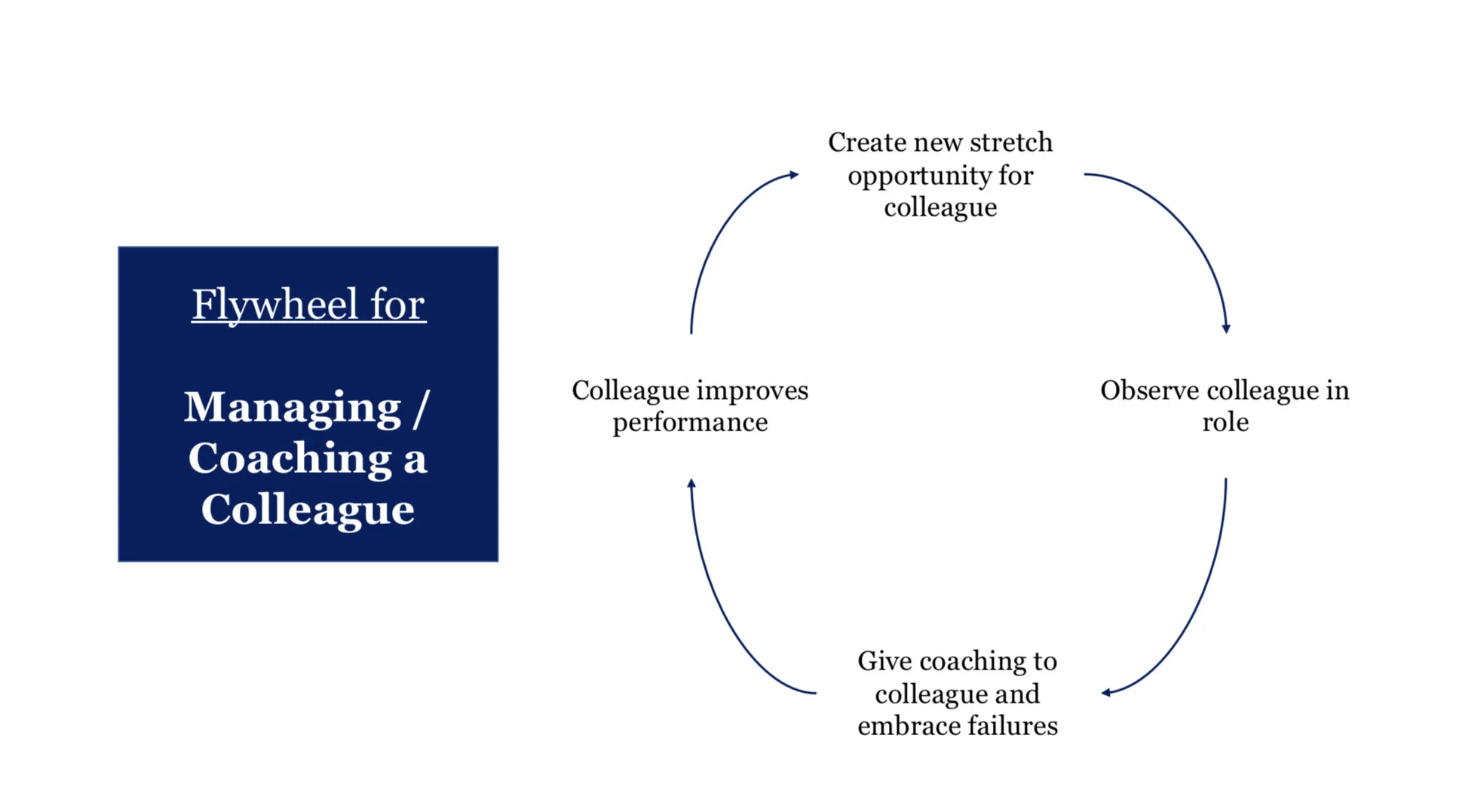
We also have flywheels that explain our behavior as individuals. For me, this is how I specifically respond well to improve my physical fitness.
My flywheel really took off when I understood and started measuring my BMI, Body Fat%, Sleep, Blood Pressure etc. I happen to love the products from Withings because they made the flywheel much more transparent to me as it was occurring, which led to rapid and permanent changes in my behavior.
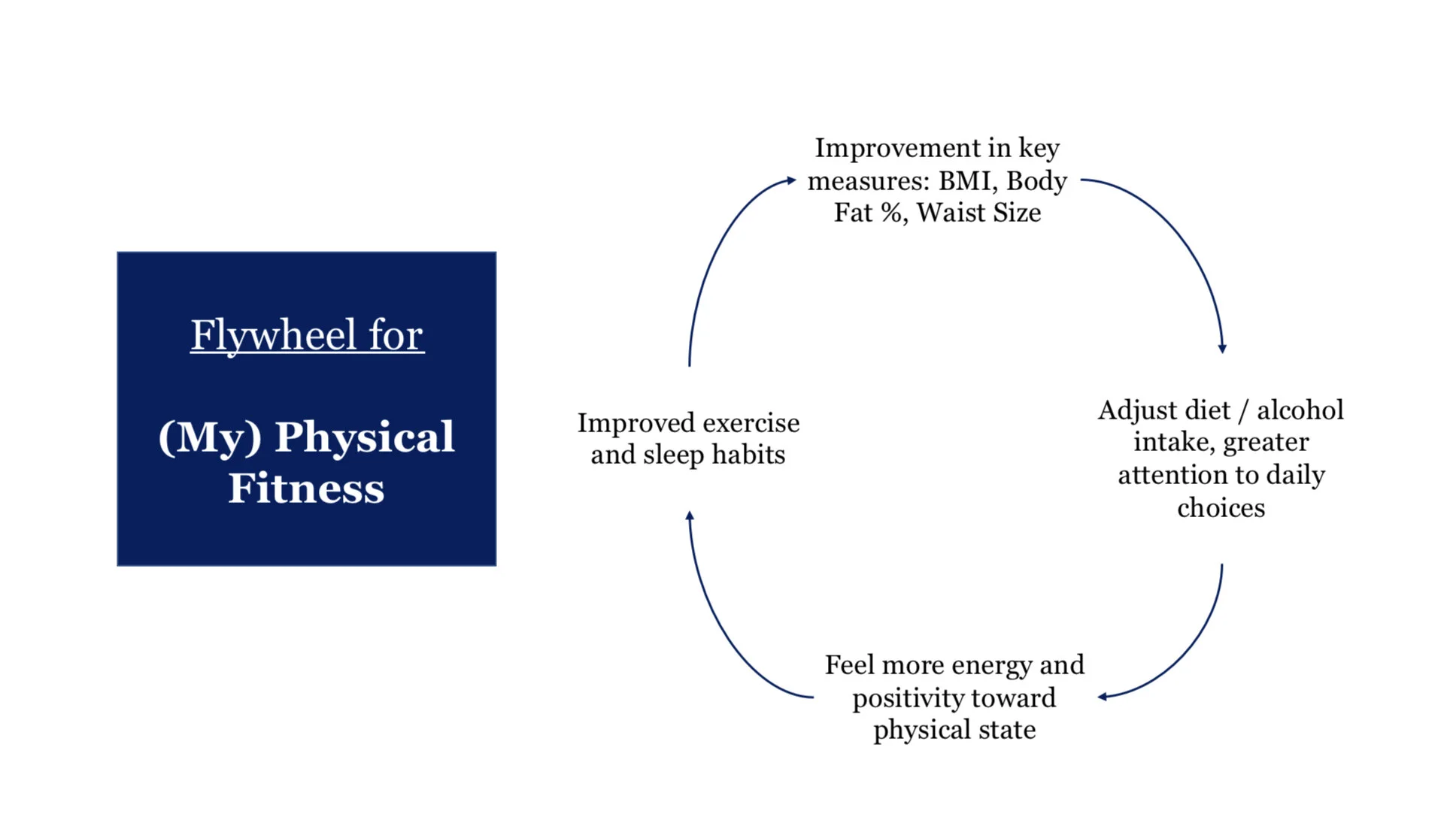
Social movements utilizing nonviolence techniques (i.e., think US Civil Rights Movement, India Independence) also seem to fit the concept, showing the breadth of flywheel thinking’s explanatory power.

Going through this exercise of identifying flywheels in a number of domains I’m familiar with, I’d offer this practical advice for articulating flywheels in your world:
Think about what is valuable to each involved party. At its core, flywheel thinking is rooted in an understanding of what drives value for everyone. What are the things that if increased or decreased would create win-wins for everyone involved? If the flywheel doesn’t encompass value creation for everyone involved, it’s probably not quite right. Zero-sum flywheels, which create winners and losers between the flywheel’s stakeholders aren’t sustainable because someone will end up trying to sabotage it.
Mind magical thinking. The beauty of the flywheel is that each step in the process is a naturally occurring inevitability of the previous step. Which means as a flywheel detectives we have to be honest about how the world really works; the flywheel has to reflect what the parties involved will actually do in real life and what they’re actually motivated by.
Identify agglomeration. In every flywheel there’s a step where some sort of resource accumulates, and that resource is one where it’s value and impact increases exponentially the more you have of it. That resource could even be things that aren’t technologies or infrastructure (cost leadership example), like data (chief data officer example), knowledge (managing / coaching example), or moral standing (social movement example).
I didn’t use an example with a network effect, but the same idea applies. These agglomerations are all critical resources to the exponential growth unlocked by the flywheel, so if you’re not seeing evidence of that sort of resource agglomeration, the flywheel is probably not quite right.
Identify interactive feedback points. Additionally, there seems to be a step in each flywheel where there is feedback or a learning interaction between the stakeholders participating in the flywheel. Maybe it’s learning about the customer (differentiation strategy example), or maybe it’s response to a measurement (physical fitness example). If there’s not interactive feedback happening, the flywheel is probably not quite right.
I wanted to share this post because applying flywheel thinking is a huge unlock for value creation. It helps, me at least, to get beyond linear thinking and operate at a higher level of effectiveness and purpose.
I get especially excited by how this thinking can apply across disciplines. Jim Collins, who pioneered the concept, is a business guru. But the concept applies broadly, and far beyond what I even suggested - I can imagine it being used to inform feedback loops influencing decarbonization, community development, or regional talent clustering and entrepreneurship.
But flywheel thinking can also be used for nefarious purposes. Rent-seeking and political corruption feedback loops are good examples of this. Specifically, a flywheel like this quickly comes to mind:

My bet is that the sort of people who know me and read my writing are disproportionally good people. By sharing this learning I’ve had, I suppose it’s me trying to do my part create a feedback loop for a community of practice that uses flywheel thinking to make the world a better place.
Life without her
I don’t know if anyone else thinks about what life would be like without their partner. It’s like the worst thing. Which is probably why it’s a thought experiment that’s private, saved for dark corners and late nights, never to be acknowledged.
At the same time, perhaps it’s a pain that, when confronted, helps us to truly live. I don’t know. It’s a complicated feeling and idea. I don’t know for sure, but it’s something I think my father understood.
This is the sort of thing I only think about when I’m Robyn isn’t around. I’m not capable of it at any other time.
It’s when she and the kids are already in bed, and I’ve returned to the night-owlish tendencies of my younger days, drawn to the silence of the night. Or I’m driving home from work in the winter time when dusk hits early and I can’t get comfortable with music or nobody’s around to talk on the phone.
I’m protected from all this when I’m with her, because the thought of having to live without her seems implausible, because she’s right there. I can hold her hand, or laugh with her, or give her a peck on the cheek just because. I never end up thinking about this when I’m with her because she’s right.
Even before my father went ahead, I would think about this sometimes. But his passing made it more frequent and sharper, because now I can’t pretend like Robyn going ahead to the next world before me is an impossibility. It’s what my mom and a few of my aunts and uncles are living through now - life without their partners. It’s more likely that I’ll pass before Robyn; the numbers say average life expectancy for someone like me is shorter than for someone like her. But we can’t know either way.
I’ve wondered, often, two things: why do I even let myself think about this, and, does anyone else let themself think about this?
Life without your partner is among the 3-5 most painful things one can think about. It’s up there with burying a child, global nuclear war, or some damning ecological catastrophe - like what plays out in the movie Interstellar. It would be more comfortable to distract myself until the thought passed, or hid behind not-actually-validated probabilities and feed myself a line like, “odds are I won’t have to worry about this for a long time.”
And yet, I still think about this. I let the thought and the pain it brings wash through me like a flu-season’s fever. I let the thoughts run their course. I let myself think about the worst case scenario - life without Robyn - because I tell myself it’s “preparation” in case it actually happens. As if thinking about it in advance and living through it in my head will actually prepare me for what would likely be the worst days of my life. I let the thought cut deep enough into my core, so that I can feel it enough and then I cry. Then I let the fever break, and my mind comes home.
Contemplating this type of “what if…” is not polite conversation. It’s not something that “comes up.”
It’s a topic that’s weirdly a cultural anathema, the most unnatural of conversations, yet perhaps one of the most “natural” of topics because death is a natural certainty. Even now, I’m squeamish, and trying to avoid actually naming “the topic” - how to deal with your spouse dying, there I said it - as if it was the dark wizard in Harry Potter’s world, not to be named.
I can’t be the only one that thinks about this. I can’t be the only one thrashed by the question that any of us living in a union face: which of us is going to go ahead first?
I wonder about this so often. Am I the only one haunted by this? How does everyone else deal with it? Do you let the fever wash through you, too? Do you talk about it with your wife? Do you write about it in a journal that’s hidden away as if it didn’t exist? Do you try to dilute and delude yourself of the thought by hiding behind shadowy probabilities as I do? Is there some other way to prepare for the pain? Is there some other way?
Late in life, my father had to move to Seattle to find engineering work. He loved it there. I always think about how he described the place. “It is cloudy or rains six days of the week, and the seventh day makes the others worth it.” My father had a great appreciation for the extremities of life - suffering and joy, peace and chaos, love and loneliness. He understood that we must confront difficult truths to truly live.
Pain reminds us to laugh, to love, to appreciate time and not waste it, to be kind and humble, to focus our time on what matters. My father understood this and subtly reminded me throughout my life that a man who doesn’t know clouds and rain and snow, cannot possibly value the full splendor of the sun.
This to me is the silver lining of this unhealthy tendency I have to think about the painful notion of life without Robyn. She is my wife, my love, my soul’s counterpoint in the universe. When we’re apart, like we were this weekend, I really feel the gut wrenching pain of it.
And because of that pain, I am grounded enough to value the everyday, miraculous beauty of what it will be for her to walk through that door and be back in our arms again.