
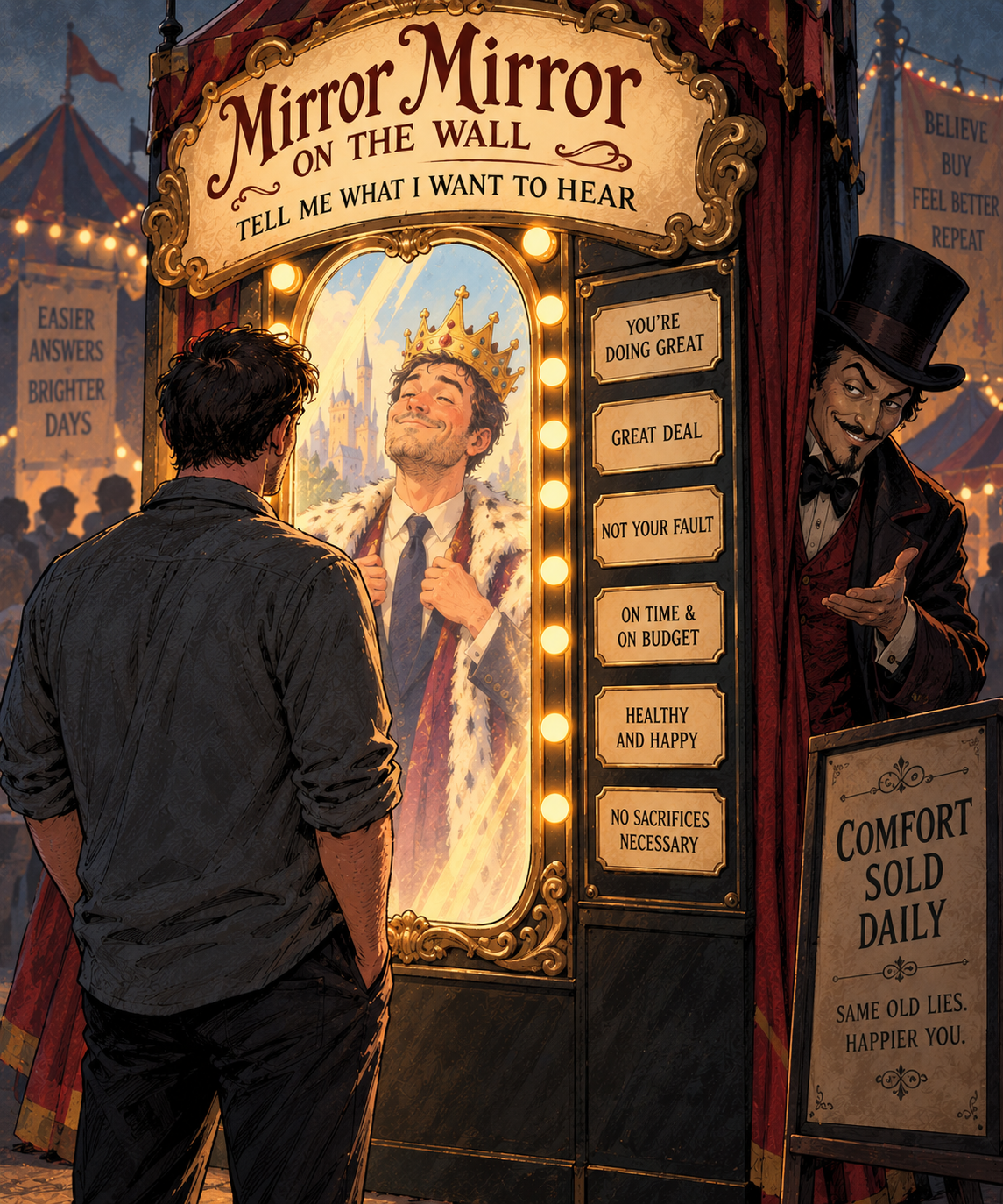
I’ll Pay You to Lie to Me
We blame the snake oil salesmen. But we're the ones signing the checks.
When the used car salesman says "you're getting a great deal on a great car."
When the politician gives the rousing speech at a rally saying "the problem isn't you, it's them, you don't have to make sacrifices."
When the project manager tells the executive "the project is on time and in budget - nothing to worry about."
When the marketer tells the parent, "buy this and your kids will be healthy and happy."
All these times are when we - the customer, the client, the citizen - want to be lied to. So they lie to us, because that's what we want from them.
We pay them for it. Hell, sometimes we're desperate for it. We demand that they let the ruse continue, because it's more comfortable that way. And it gives us someone to yell at and "hold accountable" as we hide from responsibility.
Budgeting makes this real. When I budgeted loosely as a twenty-year-old, I drained my money at the bar. When I got YNAB, a great budgeting tool, it became a lot harder to lie about money to myself. When my budget was honest, it was very uncomfortable but it changed my behavior.
When I really saw how expensive childcare, food, gas, and home renovations were, I became my dad real quick. I didn't buy new clothes until they had holes. We ate out much less. My subscription of cool, guy stuff? Canceled.
Or there was the time I hired a contractor who repaved our driveway. He gave me a great price and promised timely service, with high-end steel rebar to stabilize the concrete. Exactly what I wanted to hear - and I didn't even research whether what he proposed even made sense.
But then, he used the same lower grade wire mesh as the other quotes I got, did sloppy work, and took an extra three days to complete the job. I paid him to lie to me, and he happily obliged by taking my money and doing less than he promised.
I often blame those lying salesmen or those corrupt people, or the incompetent professional, or the greedy marketer for my problems and the world's problems alike. But if my behavior insists upon, rewards, or even begs people to lie to me, the real problem is me.
We should not expect change, if we pay people to lie to us and then blame them for our problems.

What if death wasn’t certain?
The heaviest truth of human life is that death is certain. But the alternative, if death were uncertain, might be even heavier.
Friends,
I was driving the other day when a thought hit me.
Death feels unpredictable, doesn’t it? We have no idea when it’ll come.
But it’s also the most predictable thing there is—it’s the only thing we know for sure is coming.
But here’s the thing—it’s not just certain that we’ll die. We even have a rough window for it, right? Most of us can expect to go somewhere between 70 and 100 years old, and almost no one makes it past 110.
But what if that wasn’t the rule anymore?
Imagine this: a new treatment for longevity. You’d have to take it by 25, but here’s the kicker—it only works for half of us, and we can’t even tell who it’s working for.
This kind of life? It would be tough—devastating, even.
I can’t imagine not knowing whether I’d have to live without Robyn for 100 years. Just thinking about it—it’d tear me apart.
And what about my kids? Their kids? Would I end up burying generations of my own family because I lived to 500?
Then there’s friendships. Would they cross generations too? Or would we all start isolating, afraid to get close to people when we had no idea how long they’d be around?
Money—would we work forever? Could we even retire?
And politics? Would having immortals who cared about the extreme long-term make things better? Or would culture fall apart because the thread of shared experience stretched too thin?
I don’t have the answers. This idea—this uncertainty about how long we might live—it’s unsettling in ways I didn’t expect.
But what about you? How does this land for you? What would it mean to live in a world where death was no longer the one certainty we had?
With love from Detroit,
Neil